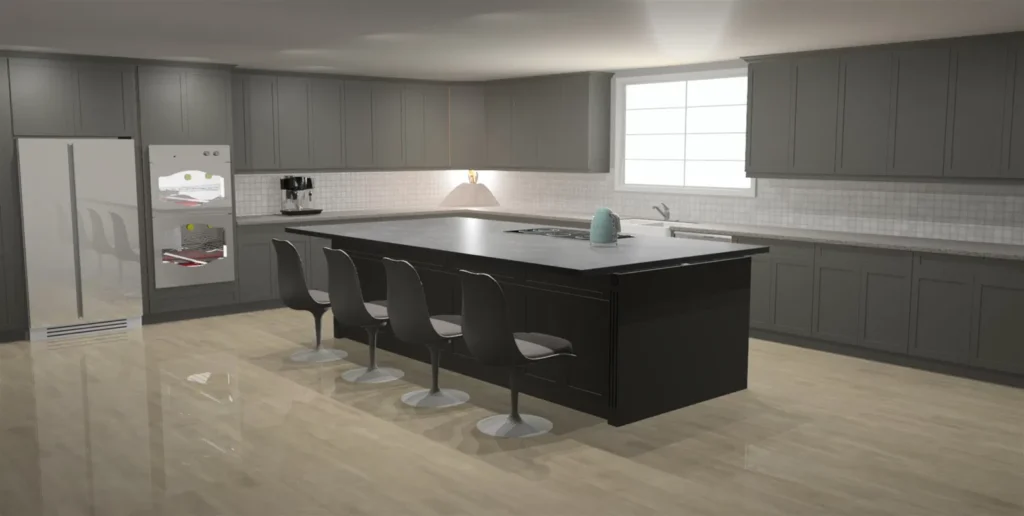
Your cabinet quote is probably complete.
That’s not the reassurance it sounds like.
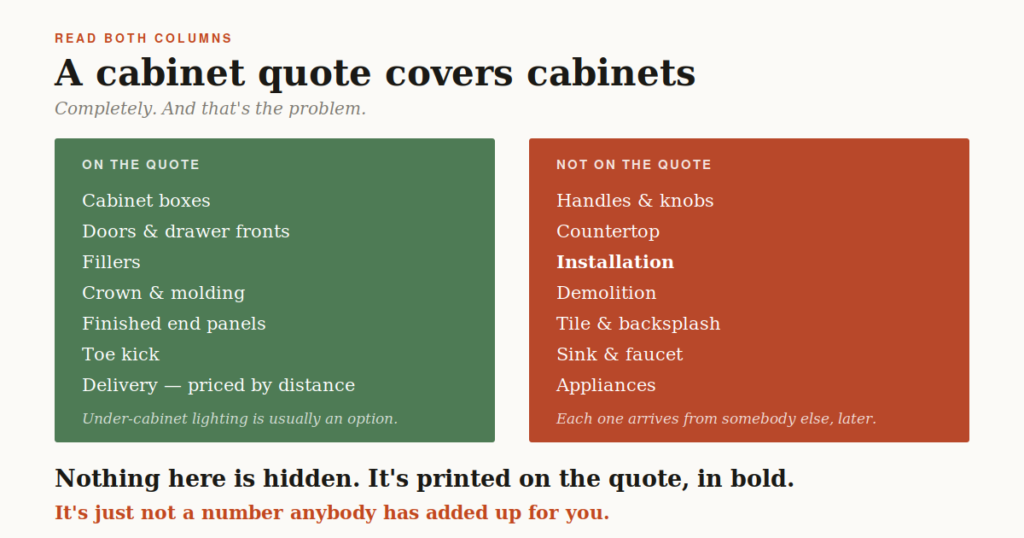
A good cabinet quote covers cabinets thoroughly — boxes, doors, drawer fronts, fillers, crown molding, finished end panels, toe kick, delivery. All of it, itemized, nothing quietly left out. Mine did. Most decent ones do.
And you can still walk out of that showroom with no idea what your kitchen costs.
The line most people’s eyes skip
Look at the bottom of the cabinet section on your quote. There’s usually a line in bold that reads something like:
Handle, Countertop, and Installation Not Included
That’s on my quotes. I put it there. It’s not fine print, it’s not hidden, it’s in bold on the front page.
And people miss it constantly.
Not because it’s sneaky — because it’s a negative. You read a quote hunting for what you’re getting. Your eye is pulling numbers and cabinet names. A sentence about what isn’t there doesn’t register as information; it registers as boilerplate.
So here’s what that one line actually means for your project:
Handles. Every knob and pull in your kitchen. Thirty of them, sometimes fifty. Separate purchase.
Countertop. Different company, different quote, different lead time, its own measurement appointment.
Installation. The big one. We’ll come back to it.
And a few things that aren’t even on that line, because they were never in this conversation:
Demolition. Whoever installs decides how your old kitchen comes out and what that costs. It’s not a cabinet question at all.
Tile and backsplash. Another trade, another quote.
The sink and the faucet. You buy those.
The appliances. Those too.
You buy it. Somebody else installs it.
This is the part that catches people, and I’ve never seen anyone explain it up front.
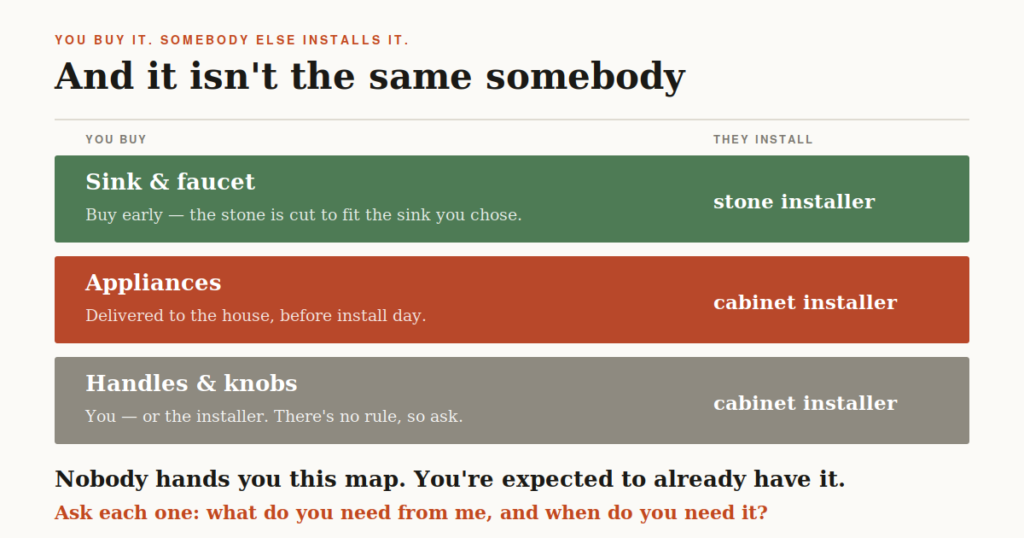
You buy the sink and the faucet. The countertop company installs them — because the sink gets cut into the stone, so it’s their job, not the cabinet installer’s.
You buy the appliances and have them delivered to the house. The cabinet installer fits them — the oven into its opening, the dishwasher into its slot.
So you’re purchasing things, and other people are installing them, and it’s a different person each time.
Nobody hands you this map. It’s assumed knowledge — obvious to everyone who does this for a living, invisible to everyone doing it once.
Handles are the odd one. The cabinet installer always fits them — that part’s never in question. But who buys them isn’t fixed. Sometimes the installer picks them up and bills you. Sometimes you’re expected to choose them yourself, because they’re jewellery and people have opinions.
There’s no rule, which makes this the item most likely to fall in the gap — both sides can reasonably assume the other one has it handled.
Ask out loud, early: “Am I buying the handles, or are you?” Ten seconds. Occasionally saves a whole install day.
The sink has a deadline you don’t know about
This one is worth the whole article.
Your countertop is cut to fit your specific sink. The fabricator templates your kitchen, then cuts the stone with your sink’s exact opening in it.
Which means the sink has to physically exist, in your possession, before the countertop is fabricated. Not before installation day. Before the stone gets cut.
So if you’re leisurely browsing sinks in week nine because you figure it’s a small decision you can make later — you’re not delaying the sink. You’re delaying the countertop. And everything that sits on, under, or waits for the countertop moves with it.
Same logic on appliances: they need to be at the house before the cabinet installer needs them, not the week after.
Ask each company two things: what do you need from me, and when do you need it by? Write the answers down. That’s your real schedule — and nobody is going to build it for you.
Nobody owns the total
Here’s the structural thing nobody explains.
Your cabinet designer quotes cabinets. Your installer quotes labor. Your counter fabricator quotes counters. The tile guy quotes tile.
Every one of those numbers is accurate. Every one of those people is doing their job honestly.
And not one of them is quoting your kitchen.
There is no document, anywhere in this process, with the real number on it. You are the only person who can add it up, and you’re the one person who’s never done this before.
The number I didn’t have either
I want to be honest about the limits of what I knew.
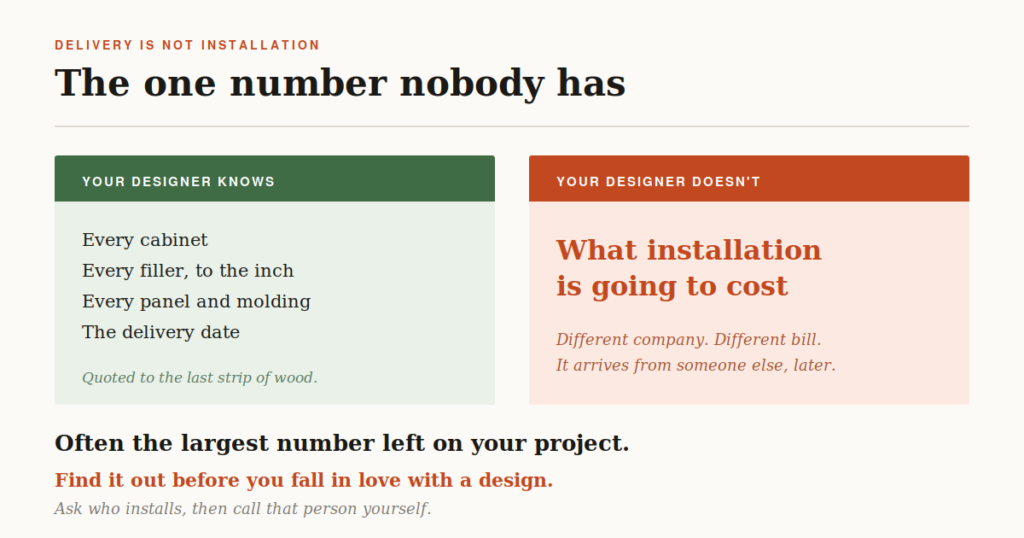
I could quote you every cabinet. Every filler, to the inch. Every panel, every molding, every strip of wood in your kitchen. I knew the delivery cost, which changes with distance. I knew the lead time.
I did not know what installation would cost.
I didn’t set it. I didn’t see it. It came from a different company, and it arrived in your life later, from someone else.
So if you asked me “what’s this whole kitchen going to run?” — I couldn’t tell you. Not because I was hiding it. Because I genuinely didn’t know, and neither did anyone else you’d talked to yet.
What that costs people
I had a client I worked with for weeks. Eight revisions to the design. Eight. We moved things, we tried things, we got it exactly right — and she loved it.
Then she got the installation quote.
She cancelled the whole project.
Not because the cabinets were too expensive. She’d been fine with the cabinets. Because the number she hadn’t seen yet turned out to be bigger than she’d assumed, and by the time it arrived she’d already spent weeks falling in love with a kitchen she couldn’t afford to actually install.
That’s the part that still gets me. Nobody did anything wrong. The cabinet quote was honest. The installation quote was honest. She just never had both at the same time until it was too late for either of them to matter.
Find out what installation costs before you fall in love with a design. Ask who installs, then call that person yourself. Do it in week one, not week eight.
The other thing that moves: quantities
There’s a second surprise, and it’s different from the first. It’s not about what’s missing. It’s about what changes.
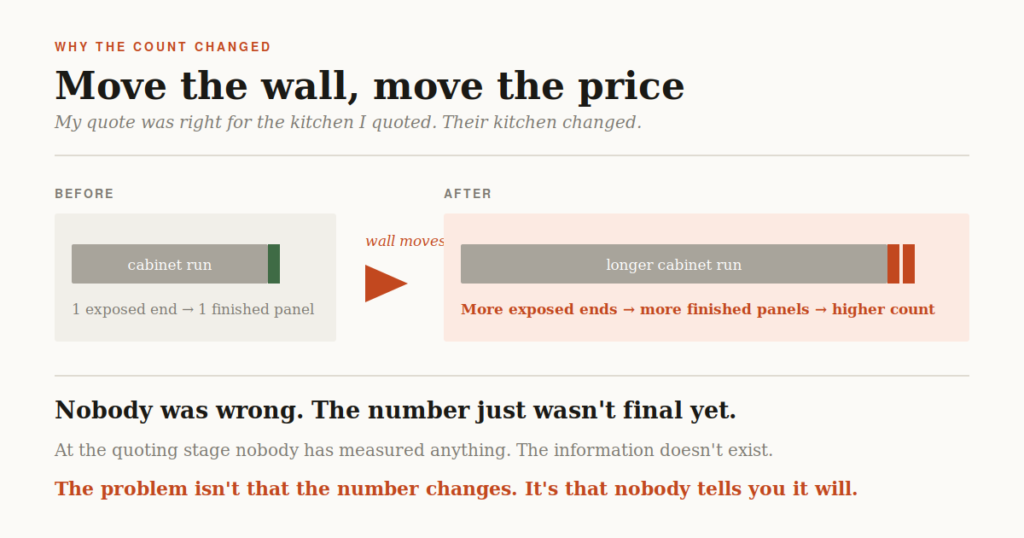
I quoted a kitchen once, and the client loved it. Then they expanded the room — the wall moved back, the run got longer.
More run means more exposed cabinet ends. More exposed ends means more finished panels. The count went up. So did the price.
My quote had been right for the kitchen I quoted. Their kitchen changed.
Nobody was wrong. But it feels wrong when you’re the one getting the new number, because the first number had already become “the price” in your head.
Ask at the start: which parts of this count can still change, and what would change them? A quote is a snapshot of the kitchen as it exists on paper today. Move a wall and the snapshot expires.
Four questions
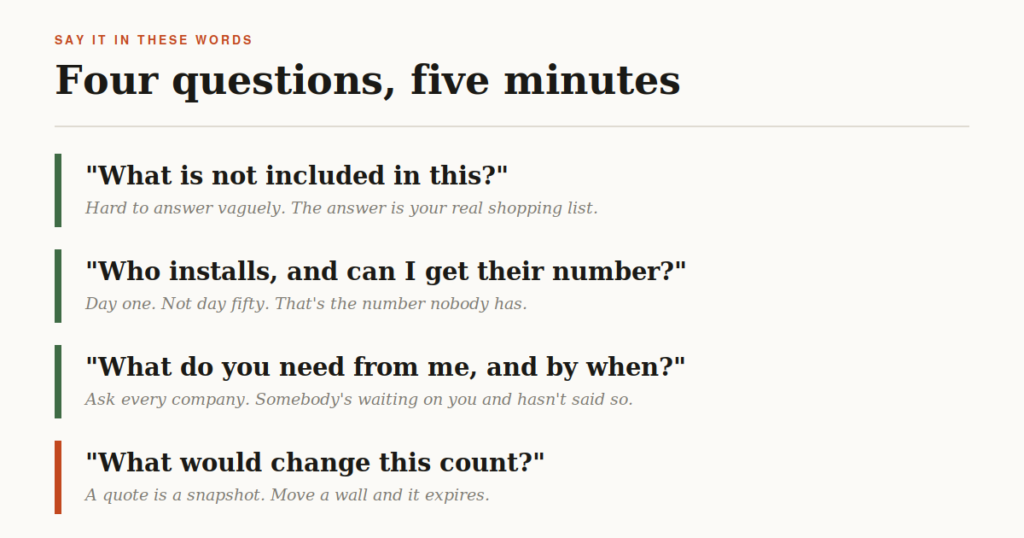
“What is not included in this?” Exactly those words. It’s a hard question to answer vaguely, and the answer is your real shopping list.
“Who does the installation, and can I get their number?” Ask on day one. Not day fifty. That number is the one you don’t have.
“What do you need from me, and by when?” Ask every single company. The sink, the appliances, the handles — somebody is waiting on you and hasn’t mentioned it.
“What would change this count?” A quote is a snapshot of the kitchen as it exists on paper today. Find out what’s still moveable before you assume it isn’t.
The thing to remember
A cabinet quote isn’t the price of your kitchen. It’s the price of the cabinets, and it’s usually a very good, very honest, very complete document about exactly that.
The gap isn’t between the quote and the truth.
The gap is between the quote and everything else that has to happen in that room — and the only person standing in that gap is you.