Three years of writing kitchen quotes. Nobody ever asked me about thermofoil vs painted cabinets — not once.
And I sold plenty of thermofoil.
I don’t blame anyone for that. You’re standing in a showroom, you like the white door, you want to know what it costs. “Is that a vinyl film or is that paint” is not a normal thing to wonder about.
But it decides a few things later. So let’s start there.
Think of a car
You know how some cars are wrapped and some are painted?
A wrap is a big vinyl film laid over the panels. It looks fantastic, it’s seamless, it costs less than a real respray. A painted car is just painted. Both can look great in the driveway. They fail differently, and you fix them differently.
Thermofoil is the wrap. A vinyl film gets heated until it’s soft, then vacuum-pressed down over an MDF door so it hugs every curve and folds around the edges in one piece. That’s why thermofoil doors look so impossibly smooth. No seams. No brush marks. No joints anywhere.
Painted is paint. Sprayed onto MDF, or hardwood, or the usual combination — a hardwood frame around an MDF center panel.
Hold onto the car thing. It’s going to do most of the work here.
First though — which one is in your quote?
Here’s the part I can tell you from the inside, because I’m the one who typed these.
Your quote probably doesn’t say.
It lists door codes. Something like SW-3050-WHT. That code carries the style, the color, and the construction — but the construction part is written in the factory’s language, not yours. A thermofoil door and a painted door can sit two lines apart in the same catalog, in the same white, under codes that look like cousins.
Nobody was hiding anything. I typed the code, the code was correct. I just also knew what it meant, and the person sitting across the desk didn’t.
So the first move isn’t choosing. It’s asking.
“Is this door thermofoil or painted?”
Six words. Ask it before you read the rest of this, because the answer might already be sitting on your kitchen table.
Back to the car
Wraps hate heat. So does thermofoil.
The film is held down by adhesive, and heat is exactly what makes adhesive let go. The number that gets quoted most is sustained heat somewhere around 150°F. The failure looks like a corner lifting, or a small bubble, or an edge slowly curling away from the door.
And it shows up right where you’d guess. Beside a wall oven. Next to a range. By the dishwasher, which fires a cloud of steam out the top at the end of every cycle. Sometimes on a run that catches hard afternoon sun every single day for ten years.
And you don’t buff out a wrap. You can’t sand thermofoil. You can’t repaint it. You can’t really glue it back down — people try, and it holds for a while, but it’s a patch, not a repair. The actual fix is a new door.
Paint is the opposite kind of problem. Painted doors go slowly. They chip. They scratch. On a frame-and-panel door you can get hairline lines where the pieces meet, because wood moves with the seasons and the paint on top of it doesn’t. White paint can warm up a shade over the years from sunlight and cooking.
None of that is fun. But almost all of it is fixable. A chip gets touched up. A tired door gets refinished. You’re not immediately shopping for a replacement.
There’s one round thermofoil wins clean, though: water. The film is one continuous non-porous surface, so steam and splashes don’t soak into anything. If we’re talking about a laundry room or a powder room vanity instead of a range wall, the whole comparison flips.
What I honestly don’t know
I did this for three years. In three years I never saw a thermofoil door fail.
I want to be careful here, because that sentence could read like good news, and I don’t think it is.
Thermofoil problems are usually described as a years-later thing. Ten years comes up a lot. Three years in the business isn’t long enough to watch that window open. The kitchens I drew were still shiny when I left them. Nothing landed on my desk, but nothing had had time to.
I’d rather tell you that than pretend. And if someone tells you flatly that thermofoil lasts fifteen years, or that it’s junk in five, it’s fair to ask them how they know.
The question is smaller than it looks
“Which one lasts longer” sounds like a question about materials. It’s mostly a question about where you’re standing in the room.
Thermofoil doesn’t have a lifespan. It has a lifespan per door.
The thermofoil drawer stack on the far wall, nowhere near anything hot, is living a completely different life from the thermofoil panel wedged in beside a wall oven. Same kitchen. Same product. Installed the same afternoon. One of them is fine. One of them is on a clock.
So don’t read product pages. Pull out your drawing and find the heat.
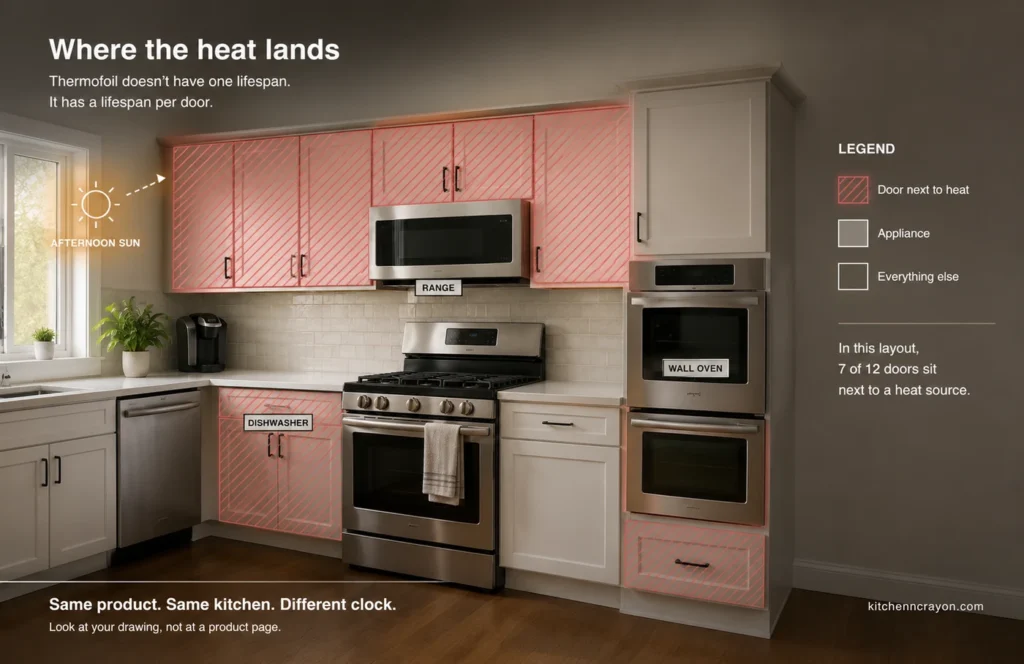
- Where’s the range, and what’s immediately beside it?
- Is there a wall oven, and what sits above and below it?
- Which door is next to the dishwasher?
- Does one run take direct sun every afternoon?
Those spots are what decide this. If your quote is thermofoil and those spots are exposed, that’s a conversation worth having with your dealer. Sometimes you can change the finish in just a few positions. Sometimes a panel can move. Sometimes there’s a heat shield.
And if your kitchen doesn’t have much heat landing on cabinet faces at all, a lot of the case against thermofoil quietly stops being about you.
About the money
Thermofoil usually comes in under a good painted finish. The figures I’ve seen put it somewhere around 20 to 30 percent less on comparable doors.
On a whole kitchen that is not a small number. It’s a real reason to choose it, and choosing it is not a mistake. I’ve written separately about what actually moves the price on a cabinet quote — the door line is one of the biggest levers on the page, and finish is part of it.
Read the warranty part. Actually read it.
I’m not going to tell you what your warranty covers, because they’re all different and I’d be guessing.
But finish tends to be one of the thinnest sections in the whole document. Joint line separation, cracking, discoloration — those turn up as exclusions or short-term coverage fairly often. And heat is frequently listed on its own as something that voids coverage.
Sit with that for a second. The thing most likely to take out a thermofoil door is heat. Heat is often the exact thing the warranty won’t cover.
Ask for the warranty document itself, not a summary of it. Then find the finish section and read the exclusions before you read anything else. I got into that more in what a lifetime warranty actually means
The short version
You don’t need to learn anything about vinyl adhesives. You need four things.
Ask which one you have. It’s probably not spelled out on your quote.
Find the heat on your drawing. That’s the thing that actually decides this.
Read the finish exclusions in the warranty. Not the summary. The exclusions.
Then choose. Thermofoil is a real product at a real discount and it’s perfectly fine in a lot of kitchens. It just has one specific weak spot, and you should know where that weak spot lands in your room.
The people I’d worry about aren’t the ones who picked thermofoil. They’re the ones who never knew they did.