Nothing in your kitchen is priced by the square foot.
Keep the same layout, the same cabinet count, the same dealer — and your number can still move by thousands. Because most of what determines a kitchen cabinet price isn’t a cabinet. It’s a decision you haven’t made yet.
I’ve already written about why two dealers quote the same kitchen differently. That’s about the invoice they got from the factory. This is about your side of it — the choices inside your own project that move the number, no matter who you buy from.
Here’s the short version. Then I’ll show you where it happens.
The number of cabinets barely moves your price. Two things do. The door — its style, and the wood species that style comes in. And how many of those boxes open as drawers instead of doors. Everything else is smaller than you’d think.
I spent years drawing these kitchens and working with the companies that built them. I don’t sell cabinets anymore. That’s exactly why I can put this in writing.
| What buyers think sets the price | What actually sets it |
|---|---|
| How many cabinets | Which door style, and its species |
| The brand name | How many boxes are drawers |
| Cabinet size | The parts that aren’t cabinets |
| The showroom | Where it’s made, and when you order |
If you’ve read why I couldn’t just give you a number, this is the follow-up. That post explained why a price can’t be quoted from a photo. This one explains what the price is made of.
Size isn’t the price. The door is.
A cabinet box is a box. Flat panels, cut and assembled, and the price climbs with width the way you’d expect. A 36″ wall cabinet costs more than a 30″ one. That part is boring, and it behaves.
The door is where the money is.
The door is the one part of your kitchen that gets machined, sanded, assembled, and finished as something you look at. A slab door is one piece. A shaker door is five. A raised panel is more than that, and every joint is a place labor goes in. Then it gets finished, and the finish is its own line of cost — every joint filled, every surface brought up to something you’d run your hand across. The more the finish has to hide, the more it costs.
Here’s the part most people miss. On a lot of lines, the door style decides the species. You don’t pick “shaker” and then pick “maple.” You pick a style name, and that name already comes in maple, or oak, or cherry. And the species is a big share of what you’re paying.
So when your quote says Door Style: Fair Haven / Color: Summer Sand, that isn’t decoration. It’s the most expensive decision in the document, written to look like a color swatch. I broke down what each spec line means in how to read a cabinet quote, line by line.
So the door isn’t an item that adds cost to your kitchen. It’s the thing that decides which price range your kitchen gets built inside of — before anything else is counted.
Change nothing else — same layout, same count, same manufacturer — move from a base door to a premium one, and the whole quote moves with it. Every door and drawer front in the kitchen just changed price at once.
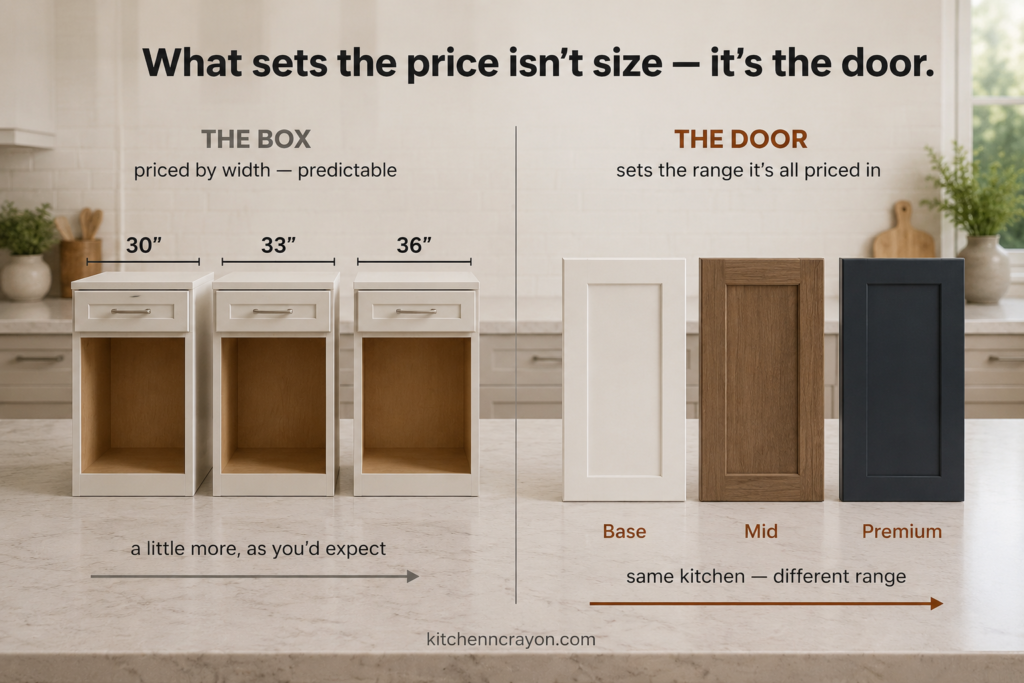
I’ve re-quoted the same kitchen across door lines more times than I can count. The totals moved by thousands of dollars — nothing on the plan touched, just the door. And here’s what stuck with me: people would see both numbers, side by side, and choose the more expensive door anyway. Then ask if I could come down a little on it.
They weren’t being reckless. The door is the face of the kitchen. Once you’ve seen the one you want, the cheaper line stops looking like the same kitchen for less. It starts looking like a different, lesser kitchen. That’s a real feeling, and I won’t talk anyone out of it. I just want you looking at that number knowing the door is the reason it’s where it is.
A drawer costs more than a door
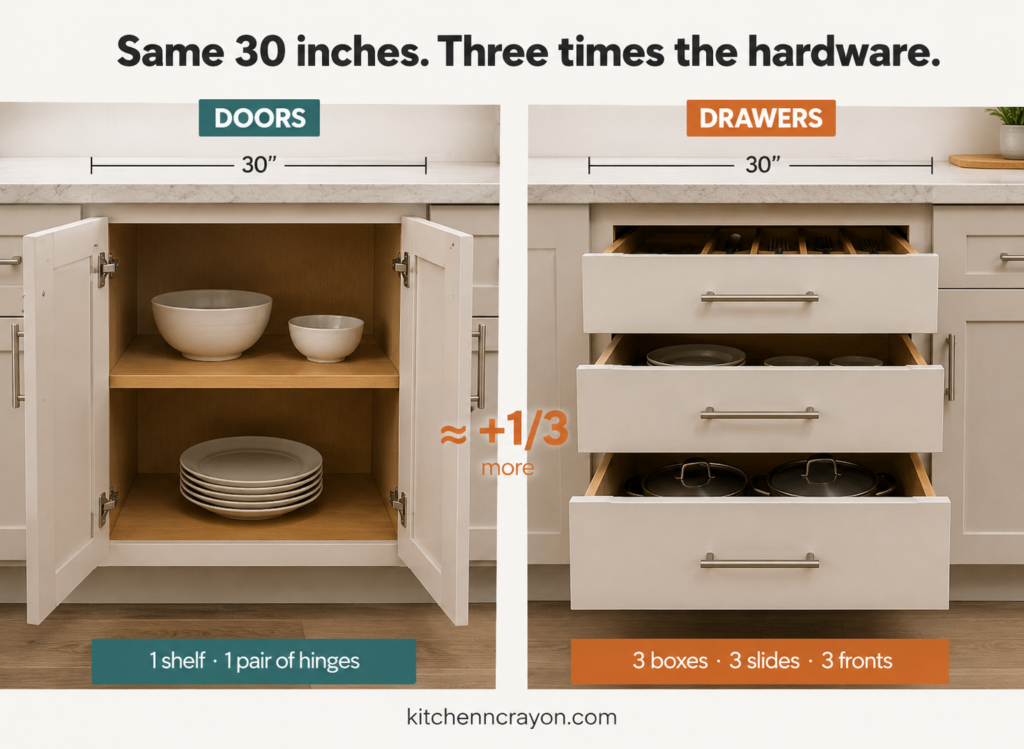
Take one base cabinet. 30 inches wide. Two ways to build it.
Doors: two doors, one shelf, one pair of hinges. Done.
Drawers: three drawer boxes, three sets of slides, three drawer fronts, three times the hardware — in the exact same 30 inches of floor.
Same width. Same spot on the wall. To put a rough shape on it: building a base cabinet as drawers instead of a door runs about a third more. That’s before you touch the slides or the drawer box — just door versus drawers, same size. And it repeats at every base you convert.
Then there’s what the drawers are made of, which nobody asks about until it’s too late:
| Costs less | Costs more | |
|---|---|---|
| Drawer box | Stapled, engineered material | Solid wood, dovetailed |
| Slides | Epoxy side-mount, partial extension | Undermount, full extension, soft-close |
| Front | Slab attached to the box | Matching front, same style as the doors |
Somewhere in the last several years, drawers stopped feeling like an upgrade.
Younger buyers especially walk in already assuming the base cabinets open as drawers. It reads as modern, and it’s more practical — a drawer brings the back of the cabinet to you, and a door makes you crawl in after it. I won’t argue any of that. I’ve argued for it, at length, in the upgrades worth paying for.
But the price sheet never got the memo. What people now think of as the normal way to build a kitchen is still priced as an option — line by line, cabinet by cabinet. That gap, between what feels standard and what’s billed as extra, is where more budgets break than anywhere else on a quote.
So if your number came in higher than you expected, count your drawer bases before you blame anything else. That’s usually the answer. And it’s the one lever you can move without changing a single dimension on the plan.
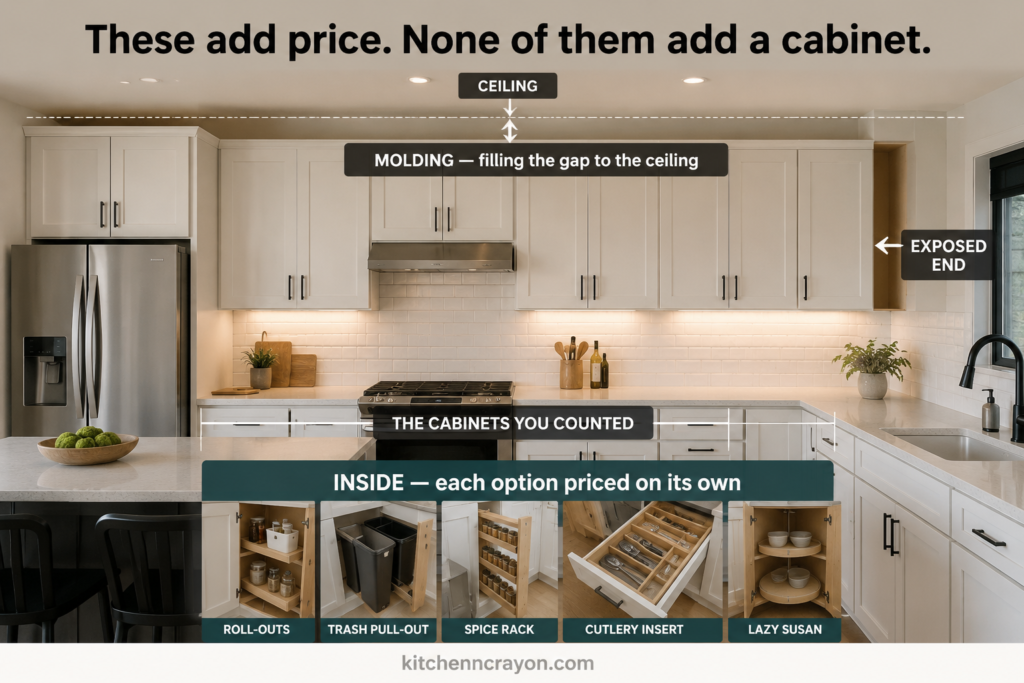
What gets added without adding cabinets
This is the part that surprises people. And it’s why two quotes for the same kitchen can be pages apart.
A lot of a cabinet quote isn’t cabinets.
- Molding, and what happens above the cabinets — the type of molding matters, and so does whether you carry it to the ceiling. When there’s a big gap between the wall cabinets and the ceiling, that space gets closed with stacked molding, or with a filler panel used like molding. Either way it’s more material and more labor
- Finishing an exposed side — where a run of cabinets ends out in the open, that side has to be finished. Some lines panel it, some just paint it — either way it’s an option, and either way the price goes up
- Fillers and scribe molding — the pieces that make cabinets meet a wall that isn’t straight
- Toe kick — a finished strip along the whole base run
- Appliance panels — dishwasher fronts, refrigerator panels, tall-run ends. Priced like doors, sometimes more, because they’re large and they have to match perfectly
- Interior options — roll-out trays, trash pull-outs, spice racks, cutlery inserts, lazy Susans. Each one is priced on its own, and they add up fast
- Hardware and hinges — soft-close is standard on some lines and an upcharge on others
- Glass doors and mullion frames — a door with glass costs more than the same door without it
None of these adds a cabinet. All of them add price. And many of them never show up under their own name — which is why you can read a quote twice and still not find where the money went.
| Adds a cabinet | Adds only price |
|---|---|
| Another base or wall unit | Molding, ceiling panels, toe kick |
| A pantry or tall unit | Fillers and scribe molding |
| An island box | Appliance and refrigerator panels |
| Interior organizers and inserts |
Two designers can plan the identical kitchen. One specifies matching appliance panels, crown, and roll-outs. The other doesn’t. Both quotes are honest. Only one is complete. That’s the whole subject of what your cabinet quote doesn’t cover.
People ask me which line on the quote surprised buyers the most. It was never a line. It was the total.
They’d look at the number on the bottom, then climb back up the page hunting for the one item that explained it. They rarely found it. Partly because there usually isn’t one item. And partly because a lot of what I just listed doesn’t get printed as its own line — an appliance panel or a run of molding doesn’t announce itself the way a cabinet does. The total was high because every decision above it landed a little above the version they’d been carrying in their head. And not one of those lines looked wrong enough to argue with on its own.
So take this from the section. If the total is bigger than you expected, don’t go hunting for the mistake. Go looking for the pattern.
The three things you don’t control
Everything above is a choice you make. These three aren’t.
Where it’s made. As of July 2026, imported cabinets and vanities carry a 25% Section 232 tariff. The jump to 50% got pushed to January 1, 2027. If your quote is dated now and delivery lands next year, that gap is worth a question — specifically, whether your price locks at order or at shipment.
Freight. Cabinets are big, heavy, and easy to damage. Delivery is a real line, it moves with fuel, and for a full kitchen it’s larger than most people expect.
When you order. Quotes expire because manufacturer prices move — so a project that drifts a few months can land on a different number than the one you were shown. I went through that line, and the rest of the fine print, in the fine print I put in my own quotes.
What to do with the quote in front of you
Four questions. Any dealer who works this way answers all four without flinching.
- “Can you re-quote this exact kitchen in a lower door style, same line?” The cheapest test you can run. Nothing else changes. You see the door’s real cost, on its own.
- “Which of these bases are drawer bases?” Then decide, cabinet by cabinet, where a drawer actually earns its money.
- “Which interior options are in here — and which aren’t?” Roll-out trays, trash pull-outs, spice racks, cutlery inserts, lazy Susans. Not to strip them out. Just so the pull-outs you’re picturing are actually on the quote, and the ones you’re not paying attention to aren’t quietly padding it.
- “What species is this door style?” If the answer is the style name repeated back at you, keep asking.
Comparing three quotes by their totals tells you almost nothing. Comparing them by those four answers tells you everything. And the cheapest total is very often the one that answered the fewest of them.
I used to hand people two or three versions of the same kitchen — a good, a better, a best. Almost every time, they’d point at the most expensive one and ask if I could take a little off. I usually could, a little.
But it always told me the same thing. They were negotiating the total without knowing what was inside it. They wanted the best version cheaper, when the honest move was usually to keep the version they liked and change what was in it — a lower door line, drawers only where they’d use them.
That’s why I wrote this. Not so you can find the cheapest kitchen. So that when someone hands you two or three numbers, you’re choosing between kitchens — not just between prices.