You get three quotes for your kitchen cabinets. Same manufacturer. Same door style. Same color. Same box construction.
The prices are thousands of dollars apart. I’ll explain why cabinet prices vary that much. It isn’t what most people assume.
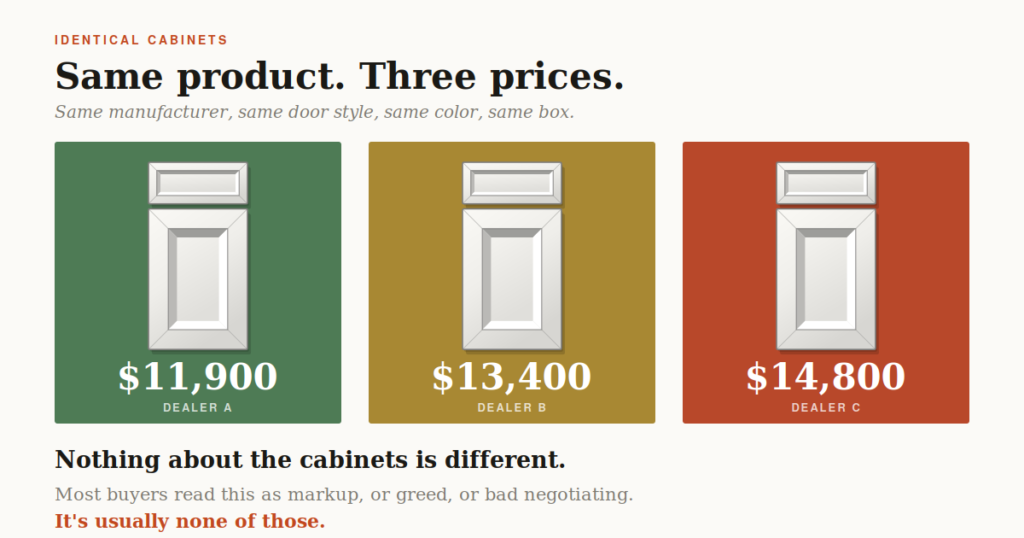
Almost everyone reads that gap the same way. Somebody’s marking it up. Somebody’s greedy. Somebody thinks I don’t know any better. And so people go into the cheapest showroom feeling clever, or into the most expensive one feeling suspicious.
Both feelings are usually wrong, and the reason is something almost no buyer knows.
The dealers didn’t pay the same price either
Here’s the part that never comes up in the showroom.
When a dealer orders cabinets from a manufacturer, the price they pay isn’t fixed. It depends on how much they buy.
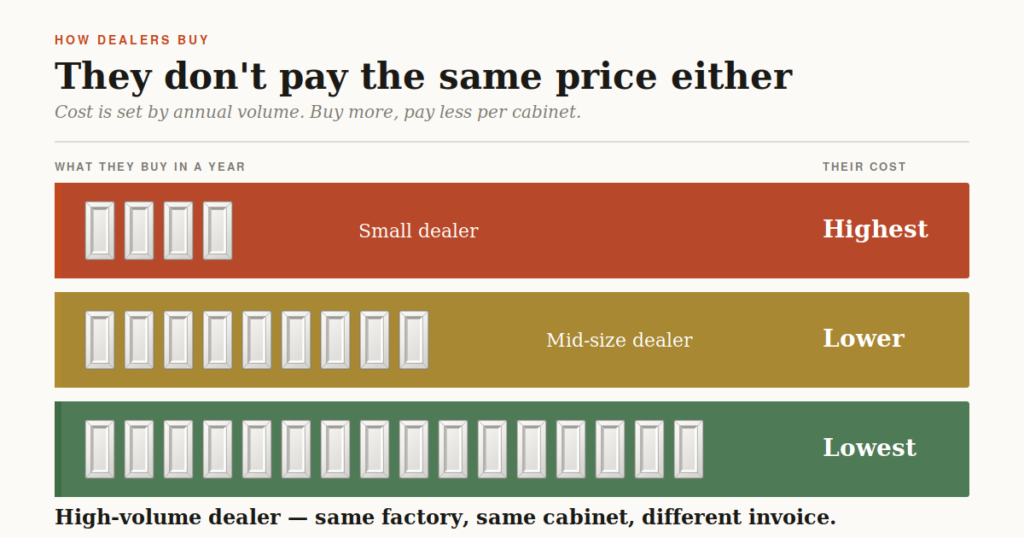
It’s based on annual volume. Buy a little over the year and your cost per cabinet sits high. Buy more and you move into a better tier. There are several tiers, and the dealer moving serious volume sits at the bottom of the ladder paying the least.
This isn’t a secret and it isn’t a scandal. It’s how almost every distribution business on earth works — cars, appliances, flooring, lumber. Volume buys leverage. Nobody in the industry thinks twice about it.
But nobody mentions it to you either. And that silence is what makes the price gap so confusing from the outside.
Same margin. Different price.
So look again at those three quotes.
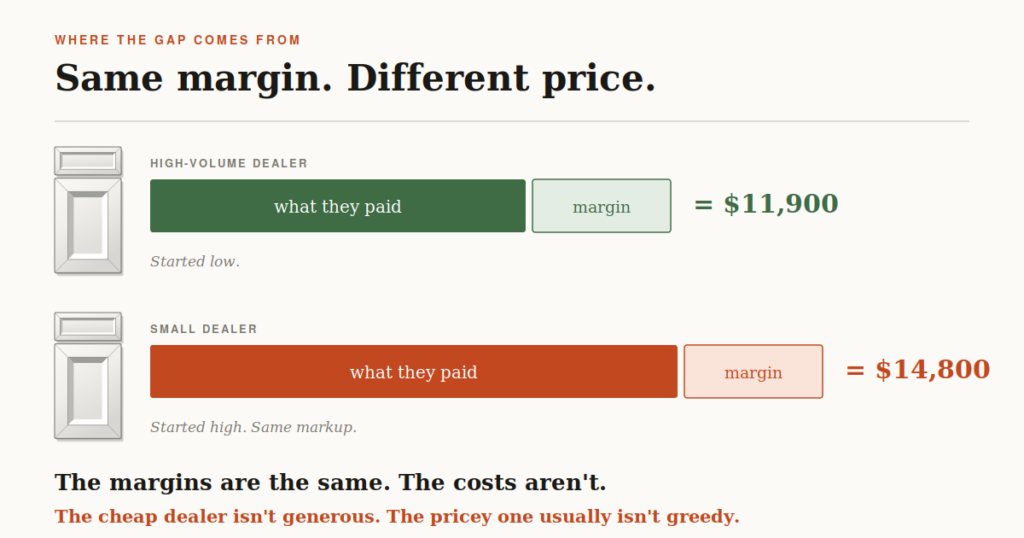
The dealer quoting $11,900 might be adding exactly the same margin as the dealer quoting $14,800. They’re both taking a normal, ordinary markup on what they paid. The gap between them isn’t greed — it’s the invoice they got from the factory. That invoice depends on what’s actually in the box — the structure, the plywood grade, the drawer construction.
Which means two things that most buyers get backwards:
The cheapest dealer isn’t being generous to you. They’re not taking less. They just started from a lower number. They’d make the same money either way.
The most expensive dealer usually isn’t ripping you off. They may be running an honest business with a small volume and very little room to move. If you push them hard on price, you might not be uncovering hidden profit — you might just be asking them to work for nothing.
I say that as someone who has been on both ends of that conversation.
The uncomfortable version
I’ll be straight about the part that sounds bad.
A dealer who sells a lot of cabinets can beat a dealer who sells a few, on identical product, all day long. Not by being better at their job. Not by caring more about your kitchen. By being bigger.
And a smaller dealer might be the better designer. Might catch the mistake in your layout that the big one misses. Might answer the phone in week seven when something goes wrong.
Price and value are genuinely not the same thing here, and I’m not going to pretend the market sorts that out fairly. It doesn’t.
But you should at least know which one you’re paying for.
What this changes about how you shop
Most people get three quotes from three showrooms and end up with three different manufacturers, three different door styles, and three different specs.
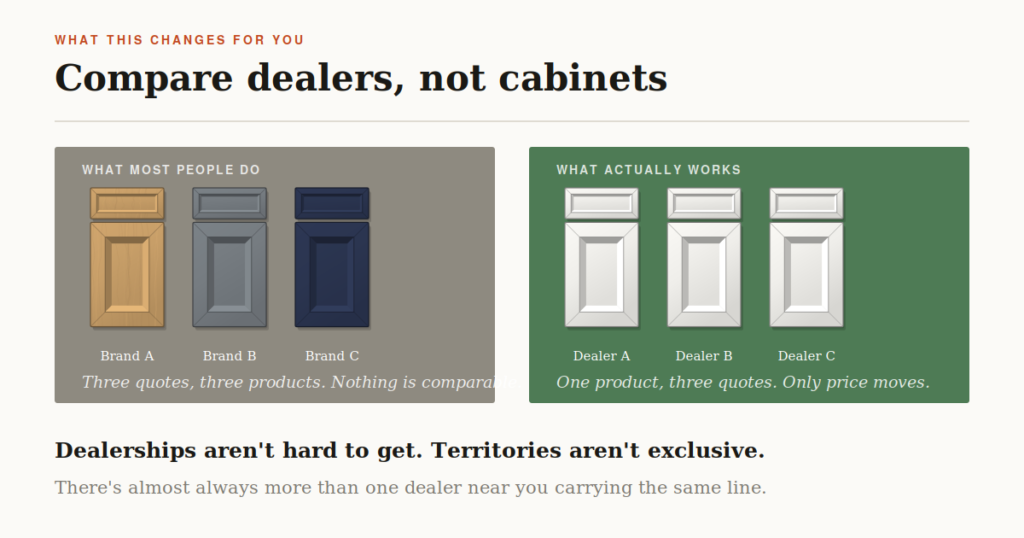
Nothing in that stack is comparable. You’re not comparing prices — you’re comparing three unrelated products that happen to be kitchens. So people end up choosing on the showroom, or the salesperson, or the picture.
Do it the other way around.
Pick the cabinet first. Manufacturer, door style, color, box construction. Get specific — the exact spec, written down.
Then take that spec to more than one dealer. Most manufacturers sell through many dealers, and they’re usually not exclusive by neighborhood.
Now the product is a constant and the only variable is the price. That’s a comparison. The other thing wasn’t.
Finding the other dealers is easier than you’d think. Most manufacturers have a dealer locator on their website — search their name and your area and they’ll come up. You don’t need anyone’s permission to do this, and you don’t need to tell the first dealer you’re doing it.
Here’s why that works: dealerships aren’t hard to get. There’s no exclusive territory. Any showroom that meets the manufacturer’s basic requirements can carry the line, which is exactly why several of them near you probably do.
One dealer, several brands
Here’s a wrinkle that runs the other direction.
Most showrooms carry more than one manufacturer. Dealerships aren’t hard to get and nothing stops a dealer from holding several at once.
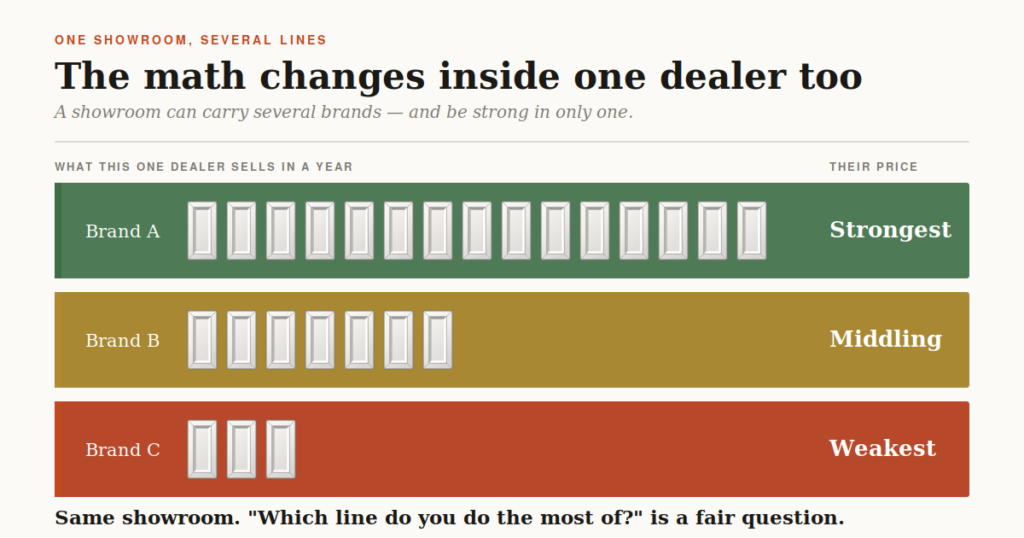
Which means the volume math doesn’t only vary between dealers. It varies inside one dealer. The same showroom might move a lot of one line and very little of another — and their cost, and therefore your price, follows.
I want to be careful about what I am and am not saying here, because there’s a cynical version of this that isn’t true.
I’m not saying your designer steers you toward whatever they’re strongest in. In my experience that isn’t how it works — and not because anyone’s a saint. Because it doesn’t work. A kitchen you don’t love isn’t an order. You match the customer’s budget and their taste or you don’t get the sale at all. That’s the entire job. Pushing someone toward a line they don’t want is a good way to sell nothing.
But if you’re genuinely open on brand — and plenty of people are, once they’ve looked at four door styles that all seem fine — there’s a question worth asking:
“Which line do you do the most of?”
It isn’t a trick question and nobody will be offended by it. The answer tells you where that showroom’s pricing is strongest, and it costs you nothing to find out.
And the reverse holds too. If you’ve fallen for a specific brand, that brand might be somebody else’s strongest line — which is the same advice as before, pointed at a different door.
One warning about “cheaper”
Everything above assumes the two quotes actually contain the same things. Often they don’t.
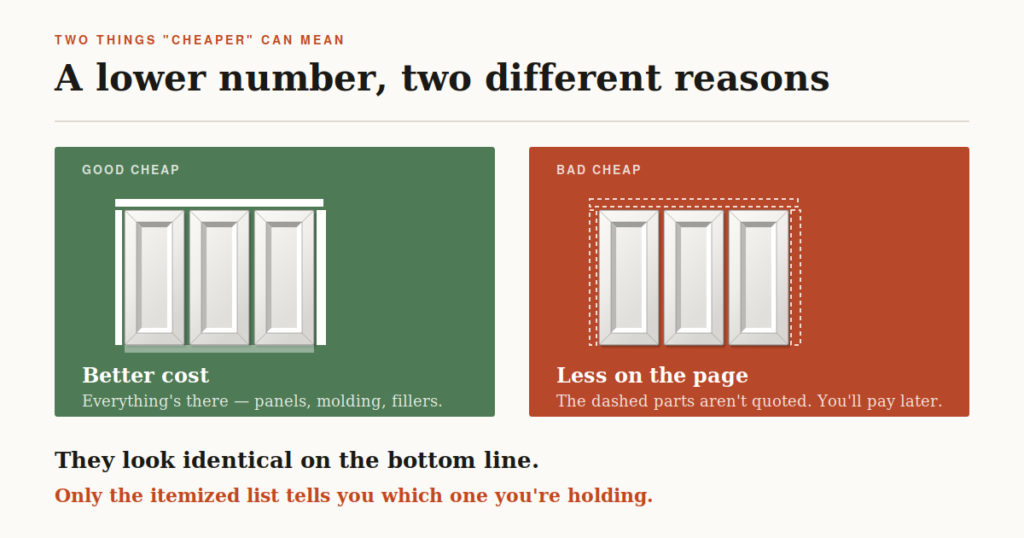
A lower number can mean the dealer has a better cost. It can also mean the quote is simply shorter — no fillers, no finished end panels, no molding, no installation. Those quotes look like discounts and aren’t.
You can’t tell the difference from the total. You can only tell from the itemized list.
So before you decide a dealer is cheaper, check that they quoted the same kitchen. Same panels. Same molding. Same everything. If one list is shorter, that’s not a better price — that’s a different order.
What to actually do
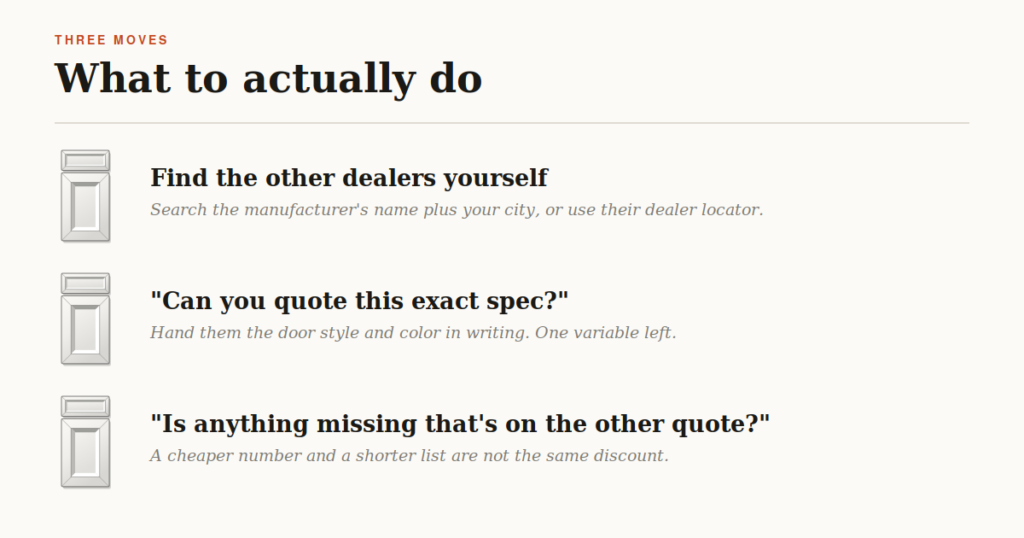
Find the other dealers yourself. Search the manufacturer’s name plus your city, or use the dealer locator on their site. Nobody has to help you with this step.
“Can you quote this exact spec?” Hand them the door style and color in writing. Now you’re comparing one variable instead of five.
“Is anything missing from this that’s on the other quote?” Say it plainly. A cheaper number and a shorter list are not the same discount.
The part worth remembering
The gap between those three quotes was never really about you.
It was decided long before you walked in, in an annual volume agreement between a dealer and a factory that nobody was ever going to explain to you. You can’t negotiate your way around it. You can’t argue with it.
But you can find out who’s on the good side of it. All it takes is one written spec and the willingness to walk into a second showroom. And knowing how to read the quote they hand you when you get there.