There are four or five lines on a cabinet quote that describe what you’re actually buying, and almost nobody reads them properly.
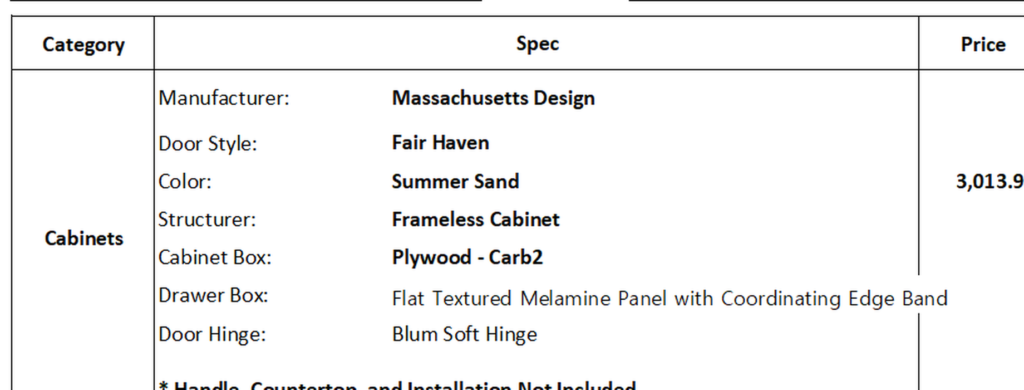
Structure. Cabinet box. Drawer box. Hinges. A code like CARB2 sitting there without explanation.
They look like specifications, which is a polite way of saying they look like somebody else’s business. But this is the section that decides what’s in your kitchen for the next twenty years, and there’s one thing in here that almost everyone gets backwards.
Let’s go through it.
Framed or frameless: the argument is mostly over
Your quote should say one or the other. If it doesn’t, that’s the first question to ask, because it’s a real difference in the product and not a finish preference.
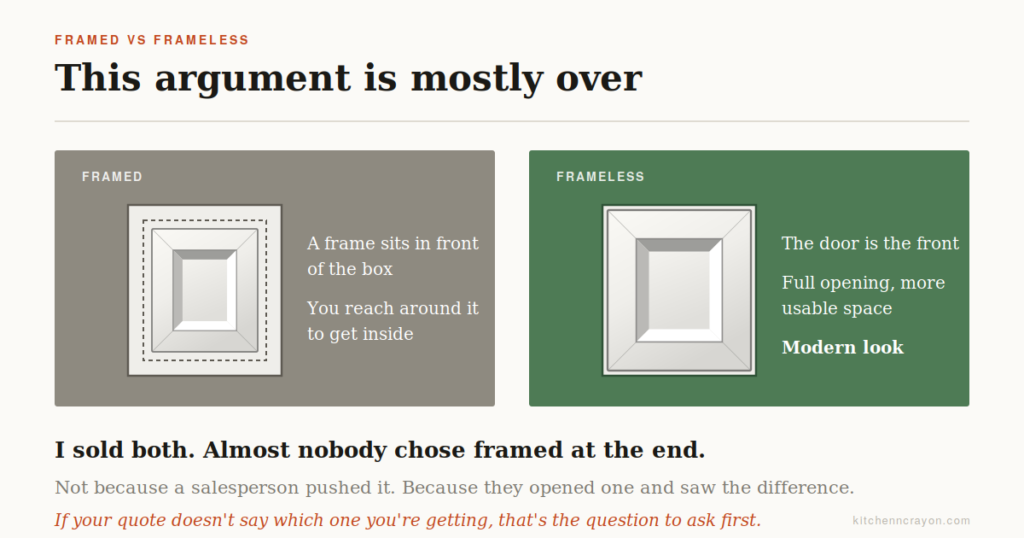
Framed cabinets have a face frame across the front of the box. The door mounts to the frame. You reach around the frame to get inside.
Frameless has no frame. The door is the front. You get the full width of the box as opening.
I’ve sold both. And here’s the part that tells you something:
Framed was slightly cheaper. People bought frameless anyway.
I recommended it, and I’ll own that. But it wasn’t only me. Because frameless gives you more usable space out of the same footprint, because it reads as modern, and because when you open one and then open the other in a showroom the difference is not subtle.
They paid more for it, on purpose, over and over, until I stopped being surprised.
That’s not me arguing for frameless. That’s just what happened — though I’ve since thought harder about what “more usable space” actually means, and about my own part in it.
The box is not one material
Your quote says “Cabinet Box: Plywood” and you read that as: the box is plywood. Done.
Now open the doors.
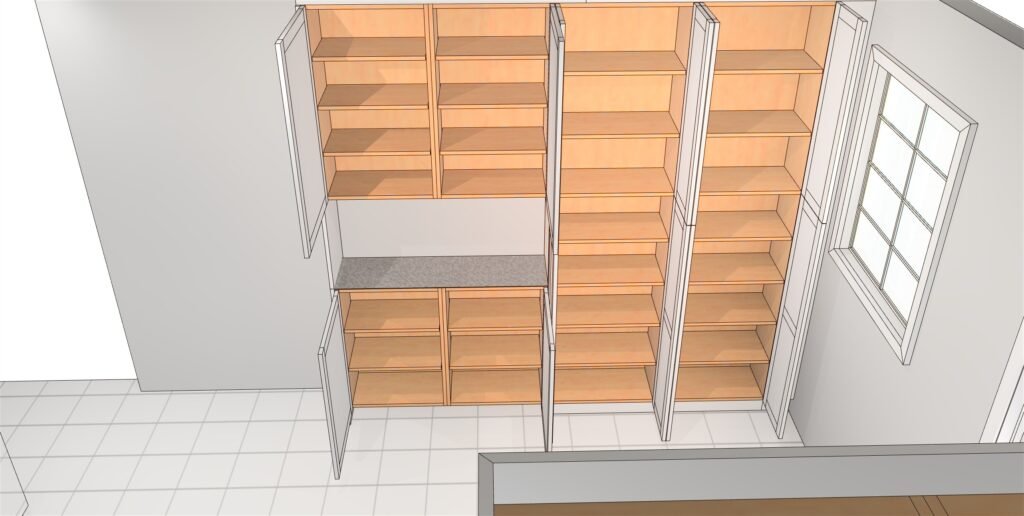
A real spec sheet doesn’t say “plywood.” It lists the parts, one at a time:
- Sides, top and bottom — ¾”
- Shelves — ¾”
- Back panel — ¼”
- Front edge band
- Toe kick
Five things, separately specified, because they’re not the same thing and they don’t do the same job.
Notice the back panel. A quarter inch, when everything else is three quarters.
That’s not a corner being cut. It’s the industry standard, and it’s standard because the back isn’t what holds the cabinet up.
A wall cabinet full of plates is hanging on your wall, and the thing carrying that load is a pair of thick reinforcing strips — hanging strips, or nailers — built into the box at the top and the bottom. Those are what the screws go through. That’s what’s actually attached to your studs.
The back panel just closes the box.
So a quarter-inch back is not a weakness. But it does mean the nailers have to be there and have to be properly built in — and that’s a real question with a real answer:
“Does the box have hanging strips top and bottom?”
Ask it, get a yes, and you can stop thinking about whether your cabinets are going to stay on the wall. It’s the same move as asking which hinge brand: a specific part, a specific answer, something you can actually check.
None of this is on your quote. Your quote compresses five parts into one word.
So: ask for the construction spec sheet. It exists. Every manufacturer has one, and it lists every part of the box with a thickness next to it.
Now the big one
Here’s the most repeated claim in American kitchen remodeling. It’s on every blog, in every forum, in every showroom:
Plywood good. Particleboard bad.
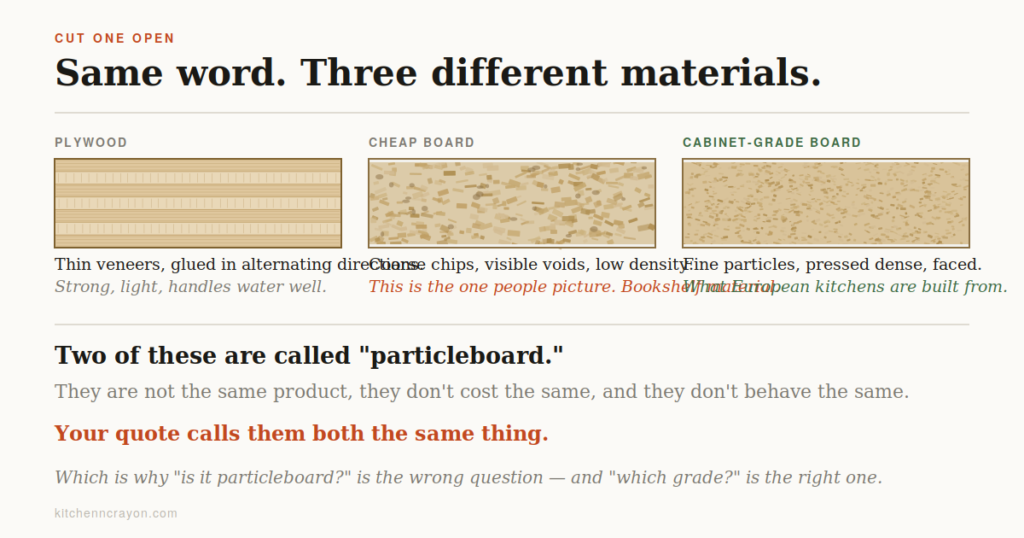
I want to complicate that, because I sold these for a living and it isn’t what I saw.
Cut three panels open and look at them. The plywood is thin veneers glued in alternating directions — strong, light, good with water. The cheap board is coarse chips with visible voids, and that’s the one everybody pictures: the bookshelf that sagged, the desk that swelled.
And then there’s the third one. Fine particles, pressed to high density, faced. That’s what a European kitchen is built from. It’s the base material in high-end modern frameless cabinetry — the kitchens people put on mood boards and call “architectural.” Kitchens that cost more than yours.
Two of those three panels are called “particleboard.”
They’re not the same product. They don’t cost the same, they don’t perform the same, and one of them is in an eight-thousand-euro German kitchen while the other one is holding up a printer in somebody’s spare room.
So “is it particleboard?” is the wrong question.
The right question has no answer
Because there are grades. There have always been grades.
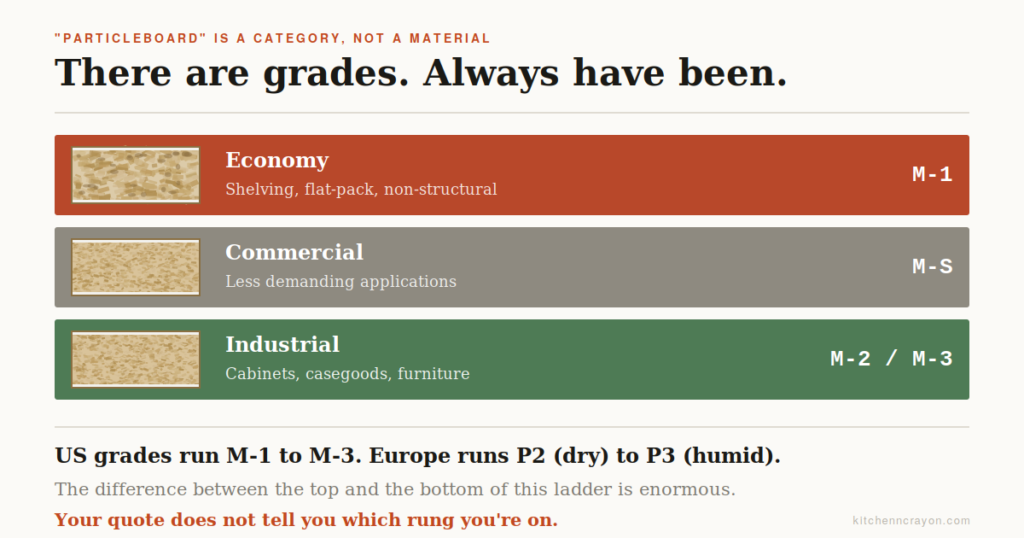
In the US, particleboard is graded under ANSI A208.1. M-1 is the economy panel — shelving, non-structural work. M-2 and M-3 are the industrial grades, the ones made for cabinets, casegoods and furniture, and they’re the most commonly produced.
In Europe it’s EN 312, and the split that matters is P2 versus P3. P2 is interior furniture in dry conditions. P3 is rated for humid conditions — kitchens, bathrooms, laundry. Budget kitchens get built from P2. Good ones get P3.
Same word. Different rung. The distance between the top and bottom of that ladder is enormous.
So the right question is: which grade?
The grade exists.
The grade exists. It just isn’t sent to you.
I went looking for what manufacturers actually publish. Here’s the pattern.
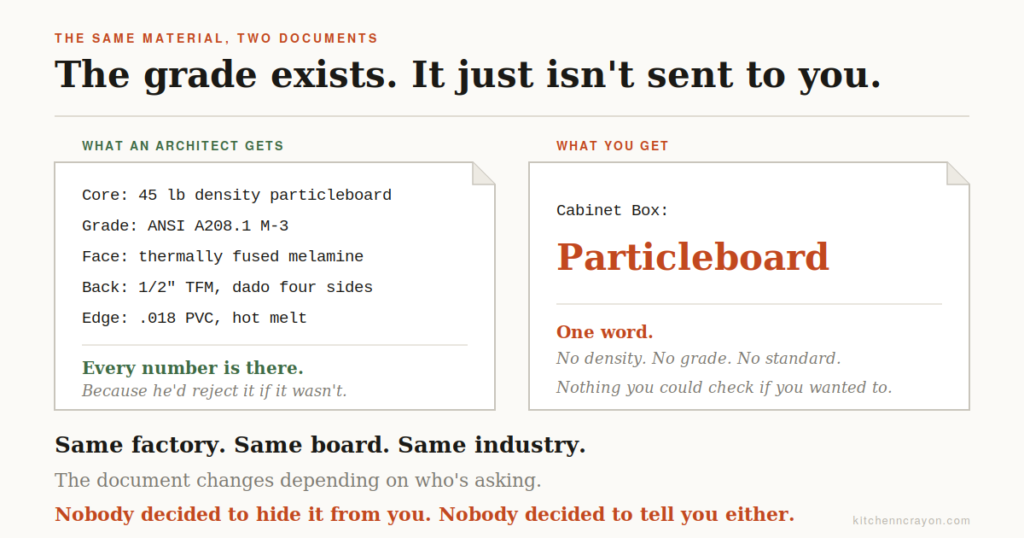
Commercial casework — the cabinets that go into offices and schools, specified by architects — comes with real numbers. I found spec sheets listing things like “thermally fused melamine on 45 lb. density particleboard core”, with the grade, the backs, the edge treatment, all of it. Because an architect would reject the submittal if it didn’t.
Residential cabinet brands don’t do that. One of the largest cabinet makers in America publishes a whole “construction details” page — soft-close guides rated to 75 lbs, dovetail drawers, warranty terms, an upgrade to furniture grade plywood end panels. Real detail, proudly listed.
The particleboard grade isn’t on it.
Not hidden. Just not there. Same for the manufacturer I sold, and I couldn’t find it published anywhere for them either.
So the grade is a real number, in a real standard, that real professionals demand in writing — and the homeowner gets one word.
That’s not a conspiracy. Nobody sat down and decided to keep it from you. It’s just that the document changes depending on who’s asking, and nobody ever expected you to ask.
Where plywood genuinely wins
There’s also a real physical argument, and I’m not going to skip it.
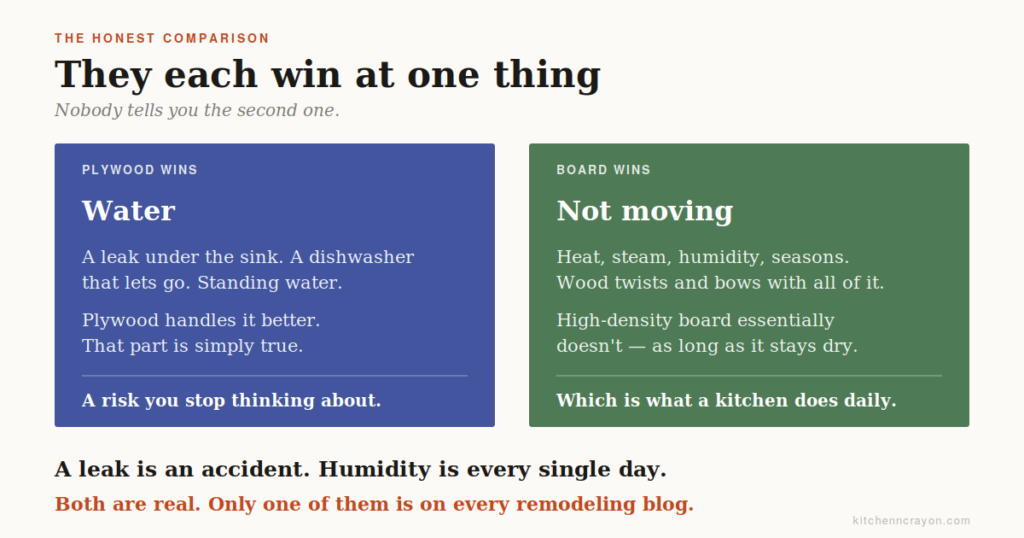
Plywood handles water better. That’s true. Not marketing — true.
A leak under the sink, a dishwasher that lets go overnight, a supply line that fails while you’re away. Standing water against a cabinet bottom is where plywood earns its reputation, and board does not enjoy it.
If your whole kitchen is plywood, that risk is handled and you never think about it again. That’s worth something.
And here’s what nobody puts on the other side of the scale.
High-density board barely moves. Heat, steam, humidity, the swing from a dry January to a humid August — wood responds to all of it. It twists, it bows, it comes back a little different. Board essentially doesn’t, as long as water isn’t directly penetrating it.
Which is worth sitting with, because a leak is an accident and humidity is every single day.
So what do you actually do
Here’s where I land, and it’s not where I expected to land when I started writing this.
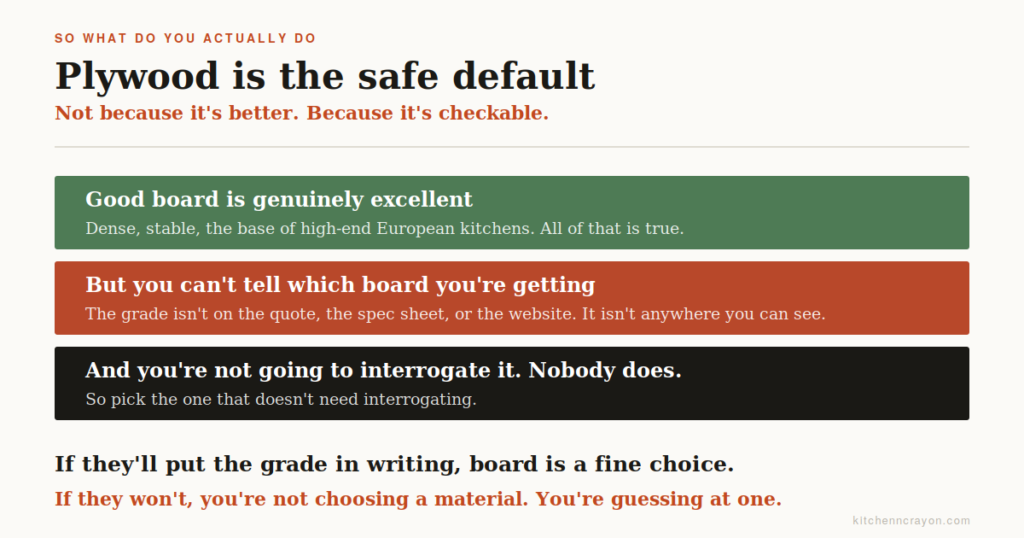
Good board is genuinely excellent. Everything above is true. If someone offers you a high-density, properly graded, melamine-faced carcass, you are not being downgraded. You’re being offered the thing Europe builds its best kitchens from.
But you cannot tell which board you’re getting. The grade isn’t on the quote. It isn’t on the spec sheet. It isn’t on the website. It’s a number that exists, that the factory knows, that an architect would be handed on request — and it is not in any document you will be given.
So plywood is the safe default. Not because it’s the better material. Because it’s the one you can verify by looking at it.
That’s a different reason than the one you’ll hear in the showroom. The showroom will tell you plywood is stronger. I’m telling you plywood is knowable, and in a purchase this size, knowable is worth paying for.
And if a vendor will put the grade in writing — an ANSI grade, a density, an EN class, any of it — then board is a completely reasonable choice and you can stop thinking about it.
If they won’t, you’re not choosing a material. You’re guessing at one.
Why a brand name is on the quote
Door Hinge: Blum.
A brand name, printed on a quote. Most quotes don’t do this — they say “soft close hinge” and move on.
Notice what naming it does. It’s the vendor saying: this exact thing, from this exact company, and you can go look them up.
That’s the same test as the grade question, pointed at a different part of the cabinet.
I could give you the sales pitch here — the cycle testing, the Austrian engineering, the numbers on the brochure. I’m not going to, because I can’t verify any of it and neither can you, and that would make me exactly the thing this article is complaining about.
Here’s what I can tell you: in three years, I never had a single hinge claim. Not one. Nobody called me because a door stopped closing right.
That’s a small piece of evidence. It’s three years, not thirty. But it’s mine, and it’s more than a brochure gives you.
The useful bit isn’t the brand anyway — it’s that a brand was named at all. A named component is a checkable one. Hinges are one of the places where cheap cabinets hide: the box looks the same, the door looks the same, and two years later one of them doesn’t close the way it used to.
If your quote says “soft close hinge” with no brand, ask which brand. There’s an answer. Someone knows it. The fact that it’s not written down is the information.
The line nobody ever asked me about
CARB2.
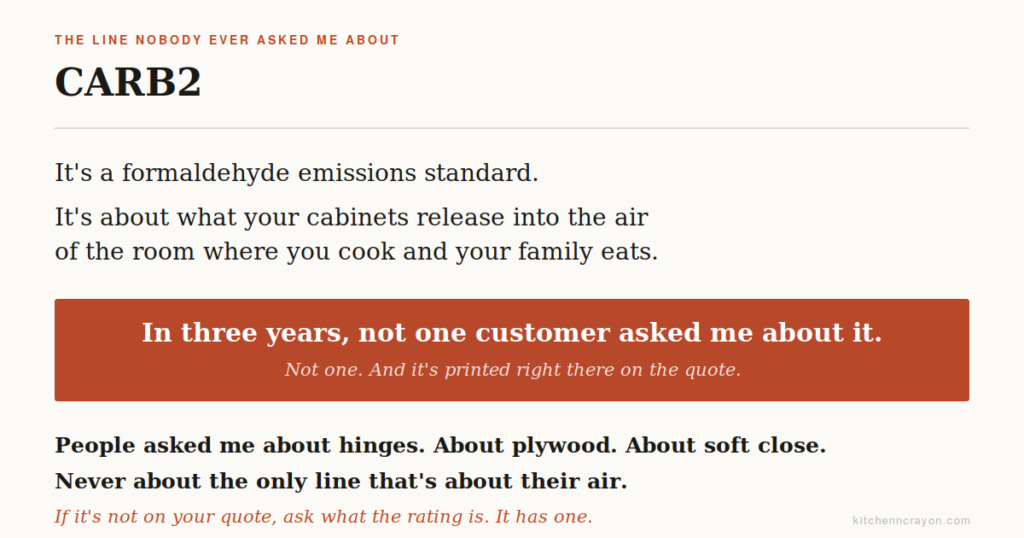
It’s a formaldehyde emissions standard. It’s about what your cabinets release into the air of the room where you cook, where you eat, where your kids do homework.
In three years, not one customer ever asked me about it.
Not one. And it was printed right there, on the quote, in the same block as the door style they’d spent four weeks agonising over.
People asked me about hinges. About plywood. About soft close and dovetails and whether the drawer would hold a stack of plates. Never about the only line on the page that’s about their air.
I’m not going to pretend that’s a scandal — the standard exists precisely so that you don’t have to think about it, and that’s the system working. But if it’s not on your quote, it’s worth asking what the rating is.
Every cabinet has one. Yours does. You just have to ask.
If you ask one thing
I know you’re not going to ask all of these. Ask the first one.
“What grade is the board?” An ANSI grade, a density, an EN class — any of it, in writing. If the answer is “it’s high quality,” that’s not an answer, and now you know something.
“Is this framed or frameless?” If the quote doesn’t say, the quote is incomplete.
“Which hinge brand?” Not “soft close.” Which brand.
“Does the box have hanging strips top and bottom?” That’s what holds it on your wall — not the back panel.
“What’s the emissions rating?” There is one. Somebody knows it.
Nobody asks any of this
I should tell you how this actually goes, because I watched it happen for three years.
People choose their kitchen from three things: the door style, the rendering, and the total on the quote. That’s it. That’s the decision.
They agonise over the door — for weeks, sometimes. They fall in love with the render. They compare the totals. And then they sign, and the spec block goes by in about four seconds, and nobody has ever once asked me what grade the board was or what CARB2 meant.
I’m not being superior about that. It’s completely reasonable. The door is the thing you’ll look at every day. The render is the thing you’re buying. The total is the thing you can actually act on. The spec block is written in factory language about parts you will never see.
But that’s exactly why I’d point you at plywood.
Not because you should become an expert in board density. You’re not going to. Neither did any of my customers, and they were spending five figures.
Because when you’re not going to interrogate the spec — and you’re not, and that’s fine — the right move is to pick the one that doesn’t need interrogating.
The thing to remember
The spec block is the only part of your quote that describes the actual product. Everything else is price, timing and terms.
And the thing I’d want you to take from it isn’t “buy plywood.” It’s this: a specification you can’t verify isn’t a specification. It’s a word.
Blum is a spec. “Soft close hinge” is a word. M-3 is a spec. “Particleboard” is a word.
Learning to tell those apart takes about a minute, and it’s the only minute of this whole process where nobody is trying to sell you anything.