I sold both for years, and by the end almost nobody walked out with framed.
That wasn’t an accident. I recommended frameless, and I recommended it for a reason I still believe: you get more usable space inside. Customers cared about that. Storage was near the top of the list for most people, and when I explained that frameless gives you more of it, the conversation usually ended right there. Good reason, easy yes.
What I didn’t do — what I don’t think anyone does on a showroom floor — is explain what “more space” actually cashes out to. People heard bigger. They pictured shelves. Nobody pictured the specific morning two years later when a half-sheet pan doesn’t clear the opening.
So this is the part of the conversation I never got to finish.
The difference is one piece of wood
A framed cabinet has a flat wood frame across the front of the box. The doors hang off that frame. It’s the traditional American build, and it’s what most people picture when they picture a kitchen cabinet.
A frameless cabinet doesn’t have that. The doors mount straight onto the box. You’ll hear it called European, or full-access.
That’s the whole thing. One piece of wood, present or absent. Everything downstream — storage, hinges, price, how it ages — follows from that.
“More storage” is not about shelves
When people hear a cabinet holds more, they think vertically. More shelf, more stacking room.
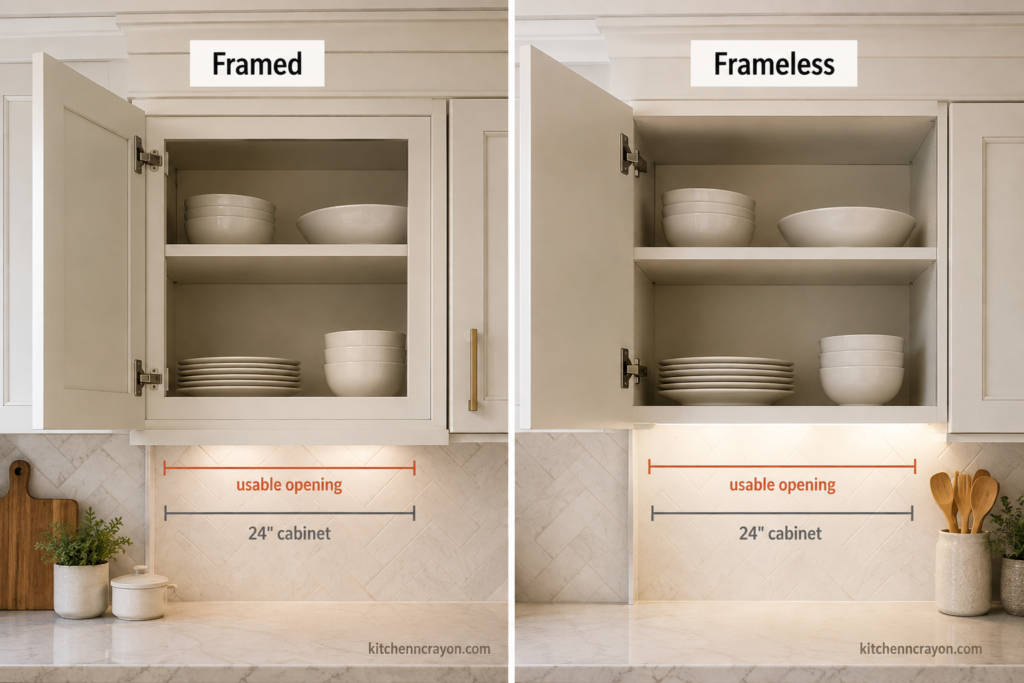
That’s not where the difference lives. The difference is the width of the hole you reach through.
The frame is usually an inch and a half to two inches wide on each side, and it sits between you and the inside of the box. So the opening is always narrower than the cabinet. Buy a 24-inch base and you don’t get a 24-inch opening — you get the box minus the frame on both sides. With frameless, the opening is the box.
The usual estimate is around 10 to 15 percent more usable interior with frameless. That number moves depending on who’s counting what, but the direction never changes.
The reason this matters more than it sounds: a cabinet is only as useful as the widest thing that fits through its opening. Shelf space you can’t reach is not storage. It’s just volume.
Where you actually feel it
Three places, in the order people notice them.
Drawers. The drawer box has to pass through the opening. Narrower opening, narrower drawer — and that’s the cabinet you open twenty times a day. It shows up in small, daily ways: a utensil tray that sits crosswise in a frameless drawer has to turn lengthwise in a framed one, or doesn’t fit at all. Same drawer organizer, same kitchen, different answer.
Wide flat things. Baking sheets, platters, the big cutting board, the roasting pan you use twice a year and resent storing. These are the items that either go in flat or go somewhere else, and there’s no middle ground.
Corners. This is the one people notice most, and it’s part of why the pole in an old lazy susan causes so much trouble. A tight corner opening turns a large cabinet into a place things disappear.
The one nobody warns you about
There’s a version of this that catches people even when they knew about the frame.
Some framed cabinets have a center stile — a vertical strip of wood running down the middle of a two-door cabinet. Open both doors and it’s still there.
That cabinet isn’t one wide cabinet with two doors. It’s two narrow cabinets that happen to share a shelf. Whatever you were planning to slide in there has to fit through one side or the other.
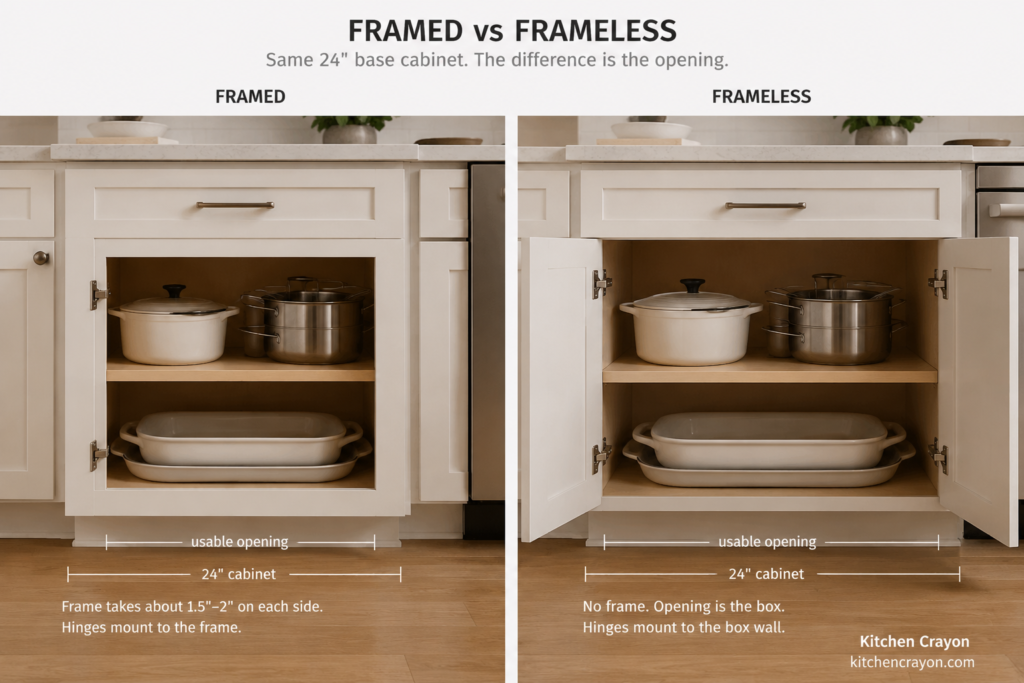
Not every framed cabinet has one. Some lines have removed them from their wider boxes. But it’s worth knowing which of yours do, and it’s a lot easier to find out now than the day you try.
What about price?
I went looking for a clean number here, because I couldn’t remember one myself and I figured the industry would have settled it by now.
It hasn’t. Search it and you get contradictions.
One source says framed runs 10 to 20 percent higher, because the frame is more work to build. Another says frameless runs 15 to 20 percent higher, because of thicker box panels and European hinges. A third says frameless is generally cheaper, since there’s less material in it.
Those aren’t obscure sites. They’re the top results, and they flatly disagree.
Here’s why the question doesn’t hold together: construction style isn’t what sets your price. The product line is.
A manufacturer’s entry-level frameless line and their upper-tier framed line aren’t competing on frames. They’re competing on box material, door material, drawer glides, hinge brand, finish process, warranty coverage. Any one of those moves the number more than the frame does. Together they bury it.
So when a chart tells you frameless costs fifteen percent more, what it’s really telling you is that in whatever catalog that writer had open, the frameless products sat higher in the lineup. Open a different catalog and it flips. Same reason two dealers can quote the same kitchen at very different numbers — the label on the front tells you less than you’d think.
Which means: don’t pick a construction style to save money. Pick the line you want, then find out what it is.
How to find out what you’re buying
Your quote probably doesn’t say framed or frameless anywhere. Like a lot of things, it’s folded into the product line name and door series rather than spelled out.
Easiest way is to ask. Is this line framed or frameless? Any salesperson answers that in a second.
If you’d rather see for yourself, the elevation drawing shows it — the drawing carries information the quote leaves out, including whether there’s a frame and where the stiles land. Or open a display door and look at the hinge. Frameless hinges bolt to the inside wall of the box. Framed hinges bolt to the frame. Once you’ve seen both you’ll never have to ask again.
And ask one more question while you’re there, the one I wish I’d made everyone ask me:
What’s the actual opening width on my base cabinets?
Not the cabinet width. The opening. Write it down, go home, and measure the widest thing you own that lives in a cabinet — the sheet pan, the stockpot, the drawer organizer you’re not willing to give up. That’s a two-minute check that settles the whole question for your kitchen specifically.
What I’d tell you now
I still think frameless is right for most kitchens, for the same reason I gave people then. You paid for the box; you should get to use the box. And storage really is what most people care about most — that instinct is correct.
But “more storage” was a shorter answer than the question deserved, and I gave it a hundred times. The full answer is that frameless gives you a wider opening, and a wider opening is what decides whether your things fit. If someone had put a baking sheet in my hand and asked me to demonstrate, the conversation would have gone differently.
Framed is still worth a real look if you want a traditional look, or inset doors — inset needs a frame, there’s no way around it — or if you’re matching cabinetry already in the house. And if the line you actually want happens to be framed, buy the better cabinet and stop worrying about the category. A good framed cabinet beats a mediocre frameless one every time.
Just find out which one you’re getting, and find out before the order goes in. Not because either is a mistake. Because once it’s ordered, changing anything gets slow and expensive.
Related reading
- What Your Cabinets Are Actually Made Of — the rest of what’s hiding in your spec block
- How to Read a Cabinet Quote, Line by Line
- What Decides Cabinet Price