Somewhere in your cabinet paperwork is a document called a Limited Lifetime Warranty.
Almost nobody reads it. It arrives in a stack with everything else, the words “lifetime warranty” register as reassurance, and it goes in a drawer.
I’ve read a lot of them. Here’s what’s actually in there — and what I’d want you to check before you sign.
“Lifetime” is a defined term
Start with the word doing all the work.

In the warranty I worked with most, “lifetime” was defined — in a sentence, in the middle of a paragraph — as ten years.
Not your lifetime. Not the kitchen’s lifetime. Ten.
Nobody is hiding this. It’s printed right there. But it’s printed as a definition, in the tone of a definition, and by the time you get to it you’ve already been told “lifetime warranty” out loud by a person standing next to a beautiful sample door.
Ask what the number is. Every warranty has one. It’s not a rude question and the answer takes four seconds.
And it shrinks the whole way
The second sentence matters as much as the first.

The warranty I know was prorated. Claims are settled based on how much of the expected lifetime is left.
Which means a defect found in year one and the identical defect found in year eight are not worth the same thing. The first is close to a full remedy. The second is a fraction of one.
This is the opposite of how most people picture a lifetime warranty. People imagine a promise that sits there at full strength, waiting, in case something goes wrong someday. What’s actually there is a promise that quietly gets smaller every year you own the kitchen.
The two lists
Every warranty has a covered list and a not-covered list. Read both. They are wildly different lengths.
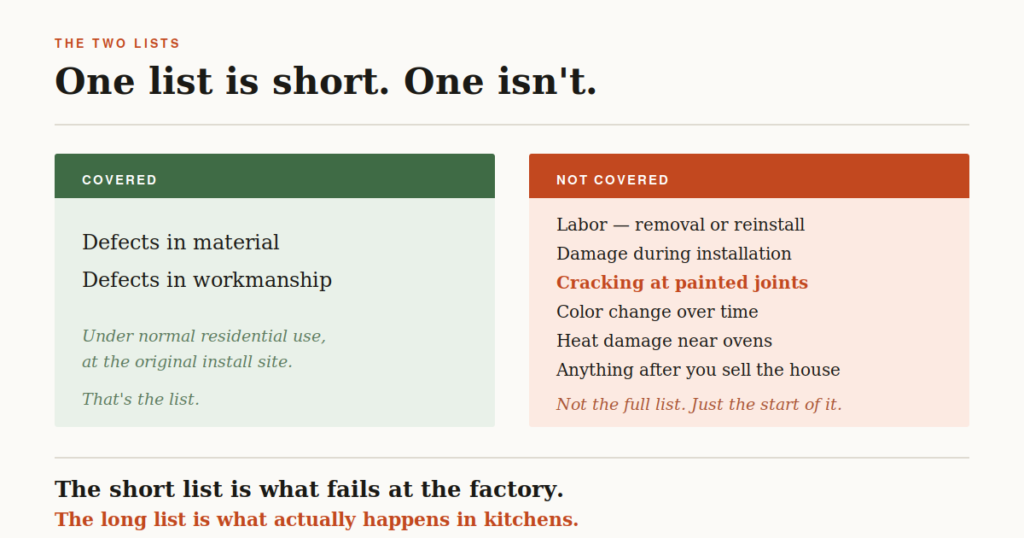
Covered: defects in material and workmanship, under normal residential use, at the original installation site.
That’s it. That’s the whole list.
Not covered is where the real information is. And one item on it is going to matter to almost everyone reading this:
Painted face frames and other painted products may eventually have visible cracking around the joint areas. These variations are considered the natural characteristics of the material.
Read that again if you’re buying painted cabinets — and most people are.
Painted joints crack. Not because anything went wrong. Wood moves with humidity, paint doesn’t move the same way, and over years a hairline appears where two pieces meet. It’s genuinely normal, it’s genuinely not a manufacturing defect, and it’s genuinely not covered.
So the thing most likely to bother you in year six is specifically excluded, and it’s excluded for a legitimate reason.
There’s a limit to what I saw firsthand. I was in this business for three years. That’s long enough to read the warranties, place the orders, and handle claims on new deliveries. It is not long enough for anyone’s paint to have cracked yet. I never fielded that call. The document is exact about what happens when you do.
The rest of the not-covered list is worth your attention too:
- Color change over time. Wood darkens or lightens with sunlight. Not a defect.
- Heat damage on thermofoil, acrylic or melamine near ovens, if heat shields weren’t installed properly. That’s an installation question, and it’s on you to ask whether they were.
- Anything that’s been altered. Which can include modifications your own installer made on site.
It’s parts only
Here’s the line that surprises people most, and it’s usually one clause long:
This Warranty is limited to defective parts replacement and does not include labor.
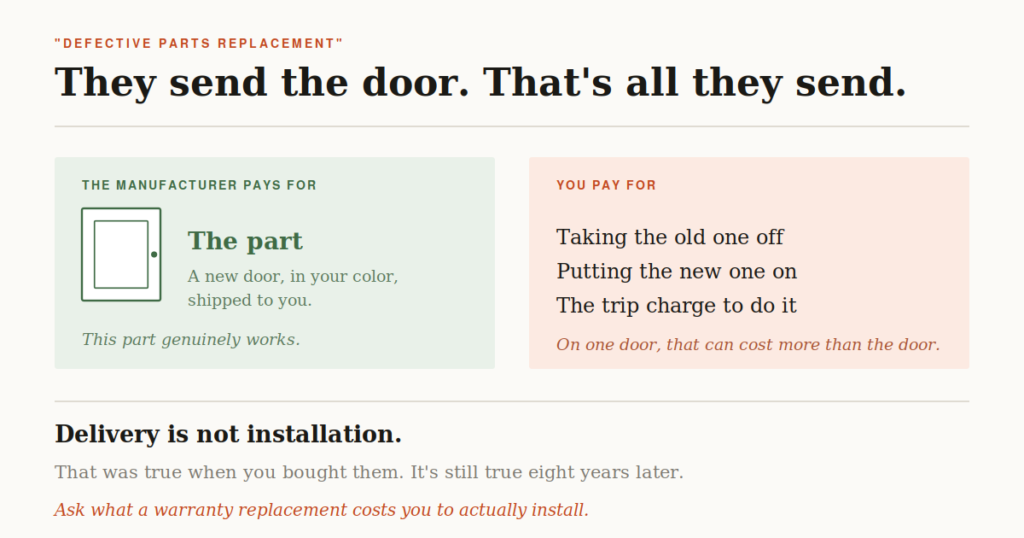
So the manufacturer will make you a new door, in your color, and ship it. That part works — in my experience, they don’t fight you on it.
What they won’t do is take the old door off and put the new one on. That’s a person, with a truck, billing you by the hour, eight years after they last thought about your kitchen.
On a single door, that labor can cost more than the door.
If this sounds familiar, it should. It’s the same gap that shows up at the very beginning of a cabinet project: delivery is not installation. It’s still true at the end.
It probably doesn’t transfer
One more clause, three words long, easy to skip: not transferable.
Sell the house, and the warranty doesn’t go with it. The new owners have beautiful cabinets and no coverage.
If part of why you’re redoing your kitchen is resale — and for a lot of people it is, at least partly — that’s worth knowing before you weigh a “lifetime warranty” as part of the value.
The five-dollar thing nobody mentions
Now the useful part. This is the single most practical thing in this entire article, and it costs almost nothing.

Order a touch-up kit in your color, at the same time you order the cabinets.
Here’s why this matters. Cabinets arrive with small scuffs sometimes. Installers nick paint — not through carelessness, just because they’re moving finished panels through a room with tools in it. It happens on nearly every job.
None of that is a defect. None of it is a warranty claim. It’s too small to file on and too visible to ignore.
A touch-up kit — a few crayons in your finish — fixes it in ten seconds.
You can order one in the same color as your doors, right on the original order. I did it on every single job. It costs almost nothing on top of a five-figure order, and it lives in your kitchen drawer afterward — for the scuff the mover makes, the nick from the toolbox, the mark that appears out of nowhere in year three.
Nobody will offer this to you. It’s not on the quote. It’s not in the brochure. You have to ask for it — and ask while you’re placing the order, not after, because that’s when getting your exact color is simple.
If you take one thing from this article, take that.
What to ask before you sign
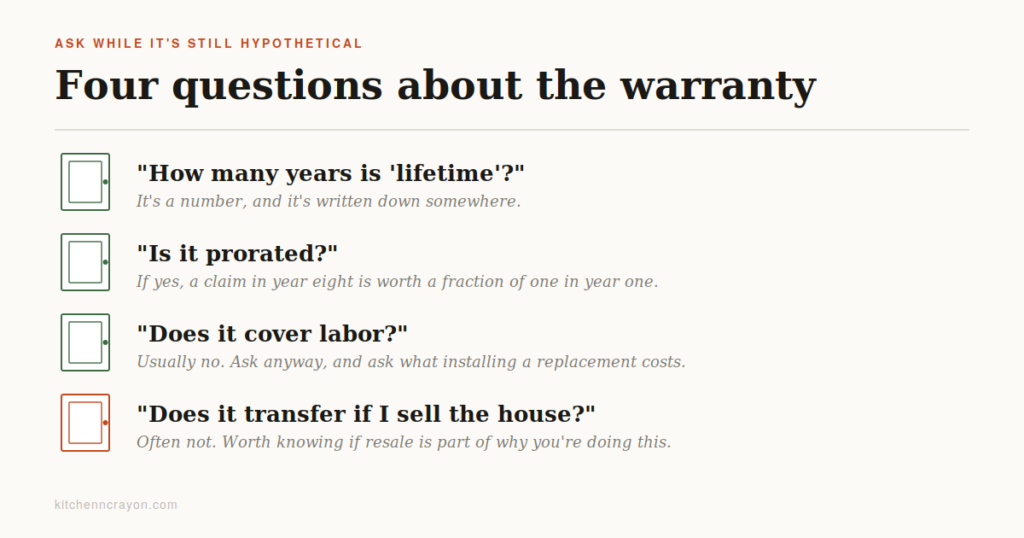
“How many years is ‘lifetime’?” There’s a number. Get it.
“Is it prorated?” If yes, understand that the warranty is worth the most on the day you least need it.
“Does it cover labor?” Almost certainly not. Ask what installing a warranty replacement would actually cost you.
“Does it transfer if I sell?” Often no. Factor that into how much the warranty is worth to you.
“Can I add a touch-up kit in this color to the order?” Yes. Always yes. Ask anyway.
The point
A warranty isn’t a promise that nothing will go wrong. It’s a specific, narrow list of things the manufacturer will make right, for a defined number of years, minus labor, minus wear, minus you selling the house.
That’s not a scandal. Every warranty in every industry works roughly like this, and honestly, it has to.
But “lifetime warranty” is doing an enormous amount of emotional work in that sentence, and it’s doing it before you’ve read a word of the document. The reassurance arrives first. The definition arrives later, in a drawer, in a paragraph.
Read yours. It takes five minutes, and it’s the only five minutes in this whole process where nobody is trying to sell you anything.