By the time your cabinets arrive, you’ve already paid for them.
That’s how this industry works — the balance is usually due before delivery, not after. So when the truck pulls up, you’re not a customer with leverage anymore. You’re a person standing in a driveway next to a stack of boxes you already own.
This is the part of the process nobody prepares you for, and it’s the part where an hour of your attention is worth more than anything else you’ll do that week.
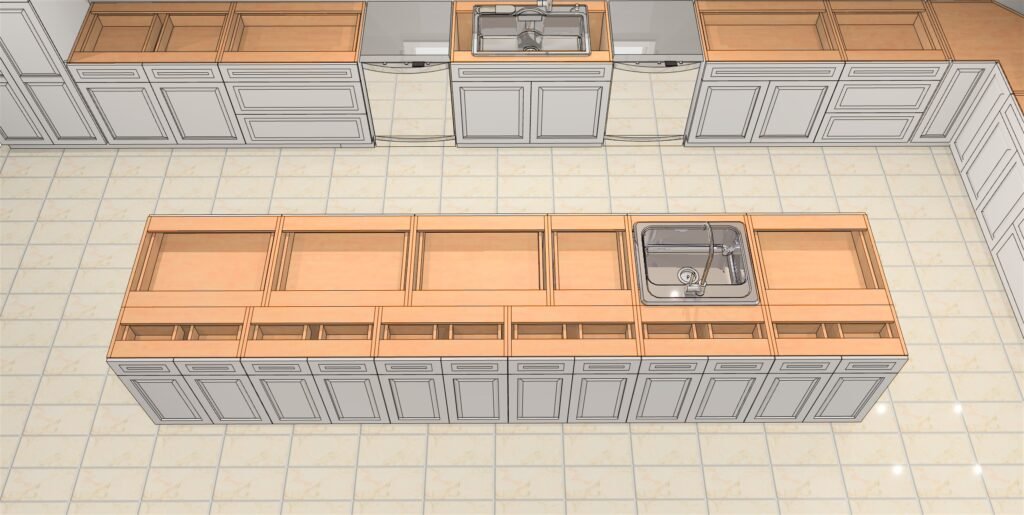
A kitchen I designed. Every box that builds this gets opened and checked on delivery day.Damage isn’t rare. It’s occasional — which is worse.
If damage never happened, nobody would think about it. If it happened every time, everyone would plan for it.
It happens sometimes. Often enough that I opened every single box, every single time. Not often enough that anyone expects it.
Cabinets travel a long way. They get loaded, unloaded, reloaded, stacked, and moved by people who are moving a lot of things that day. Most of it arrives fine. Some of it doesn’t.
Where the inspection actually happens
Here’s something most buyers don’t realize until the truck is already there: the boxes get opened at the job site. Not at a warehouse. Not by someone who checked them before they left.
That means the person doing the inspection is standing in your kitchen. Depending on how you bought your cabinets, that person is your designer, your installer, or you.
When I was doing this, it was me. Every box, opened and checked, at the site, on delivery day.
I’d encourage you to think about that arrangement before your delivery date, because if nobody has explicitly said whose job this is, the answer is going to be “yours,” and you’ll find that out on the day.
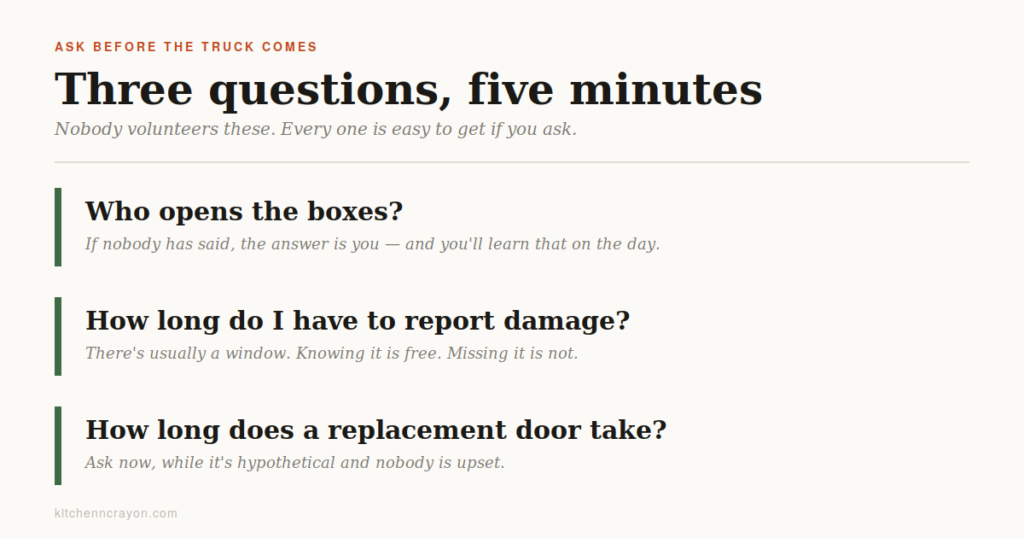
Ask, before delivery: who opens the boxes, when, and what happens if something’s wrong?
Open everything. Yes, everything.
Not the ones that look dented. All of them.
Cardboard tells you almost nothing. A box can look perfect and have a chipped door corner inside. A box can look crushed and the cabinet inside is fine. The only way to know is to open it.
This is tedious. On a full kitchen it’s a real chunk of your day. Do it anyway — because the alternative is discovering the damage in week three of installation, when you’ve lost the one thing that makes this easy: the ability to say it arrived that way.
Photograph it. Immediately.
If something’s damaged, take pictures before anything else. Before you call. Before you move the piece. Before you put it back in the box.
This isn’t defensive paranoia — it’s just how the claim works. Your vendor will ask for photos. Every time. That’s not them doubting you; it’s them needing something to send to the manufacturer, who is the one actually eating the cost.
Photos that help:
- The damage itself, close up
- The whole piece, so it’s identifiable
- The box it came in, especially if the box is damaged too
- The label or part number

The photo is the claim. A phone call without pictures is a conversation. A phone call with pictures is a replacement order.
The claim itself is the easy part
What surprises people is that vendors replace damaged parts without a fight.
In my experience they didn’t argue, didn’t stall, didn’t try to talk me out of it. Send the photos, get the replacement. It’s a normal part of the business and everyone treats it that way.
That’s damage on arrival. What they’ll replace in year six is a much shorter list, and it comes without labor.
So if you’re bracing for a battle, don’t. That’s not where the pain is.
The pain is somewhere you’re not looking.
The pain is the lead time
Here’s what nobody tells you.
Getting a replacement approved takes a phone call. Getting the replacement in your kitchen takes as long as it takes to make it — and that depends entirely on what broke.
Most people assume the answer is about size. Small part, small wait. Big part, big wait.
It isn’t. The dividing line is something else entirely:
Can anyone see it?
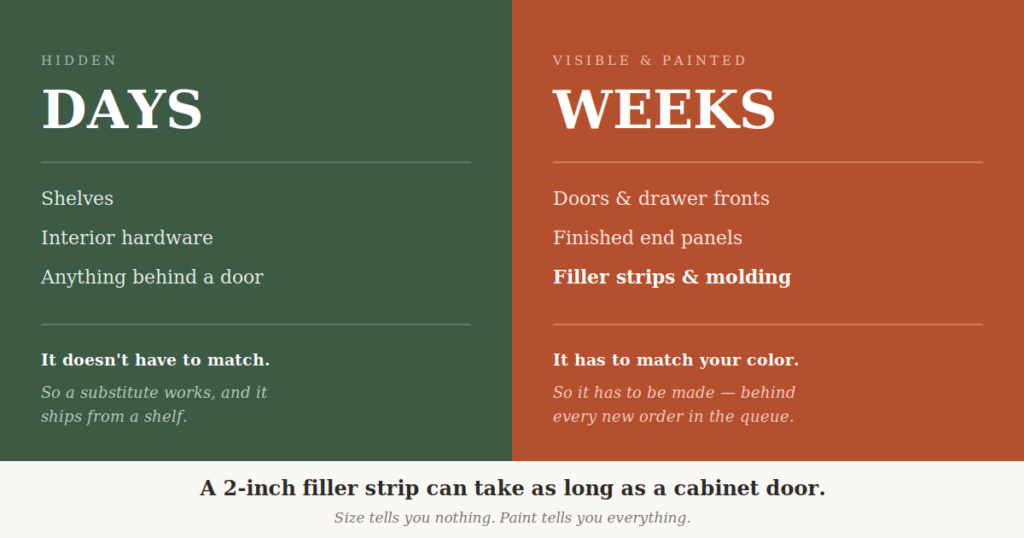
If it’s hidden, it’s fast. Shelves, interior hardware, anything that lives behind a closed door — none of it has to match anything. A substitute works. It ships from stock. Days, maybe a couple of weeks. Annoying, not painful.
If it’s visible and painted, it’s slow. This catches people out, because it isn’t only about doors.
A finished end panel is slow. Crown molding is slow. A filler strip is slow — that little sliver of wood between your cabinet and the wall, the one that costs almost nothing and takes ten seconds to install. If it’s painted to match your kitchen, it can’t come off a shelf. It has to be made and finished in your color, which means it goes into the same production queue as a new order, behind everyone else’s.
So the rule is not “doors take a long time.” The rule is:
Anything finished to match your kitchen takes about as long as your original lead time did.
Not eight weeks — your weeks. Door and finish lead times vary enormously depending on what you chose. Some run four weeks. Some run eight. Some run longer, and the more custom your finish, the longer that line gets.
Which means the answer to “how long will this take” is already sitting on your quote. Go look at your lead time. That’s roughly your answer — for a door, and for a two-inch filler strip.
That’s the whole reason this article exists. Two pieces of damage on the same delivery, both replaced free, both handled politely — and one costs you a phone call while the other costs you your entire lead time over again. And you cannot tell which is which by looking at how big it is.
The one I still think about
An island door arrived with a hole in it.
Not a scratch. Not a chipped corner. A hole.
I photographed it and sent it to the manufacturer the same day. They didn’t argue for a second — new door, on its way. They also told me not to bother shipping the damaged one back. Just get rid of it.
That’s a small detail, but it tells you everything about the economics here. It costs them less to build a new door than to freight a broken one back across the country and process it at the other end. Nobody is fighting you over a door. It isn’t worth their time to.
The new one took the full lead time.
So for those weeks, that client had a finished kitchen with a hole in the island. Not a filler tucked in a corner. Not something behind a cabinet door. The island — the thing you stand at, the thing every person who walks into the room looks at, the piece they’d been picturing since the first drawing.
It wasn’t my fault. I didn’t build the door. I didn’t drive the truck. I found it on day one, filed it on day one, and there was nothing else available to do.
I still sat on pins and needles every time I talked to them.
That’s not me asking for sympathy. It’s the reason I’m telling you to open every box on delivery day. The hole was going to be there either way. The only thing anyone controlled was whether the clock started on day one — or on week three.
Which is why the clock matters more than the deadline
People ask about claim deadlines — how many days do I have to report it?
There’s usually a window, and you should ask what yours is. But honestly, that’s the wrong thing to worry about.
The real reason to report immediately isn’t the policy. It’s the queue.
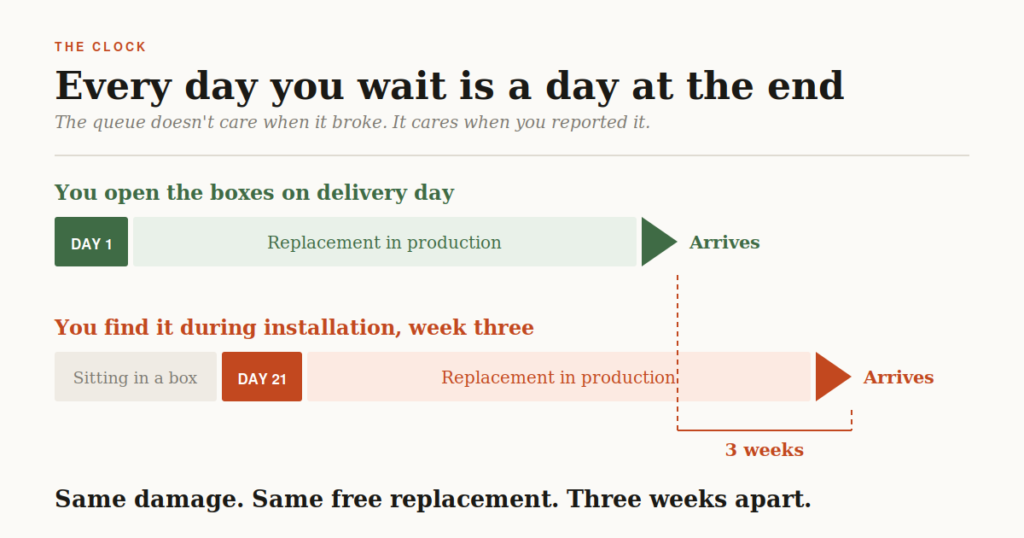
Every day you wait to open the boxes is a day added to the end of your project. Not to the paperwork — to your actual kitchen. Report it on Monday and your door is in production Monday. Notice it in week three and you’ve just added three weeks to a nine-week wait, and there’s no way to buy that time back.
When I was doing this, I pushed to confirm damage and file the claim the same day. Not because a rule said so. Because I knew exactly what the delay would cost the client, and I’d rather have an awkward conversation on delivery day than an angry one in month three.
Your kitchen doesn’t stop
One piece of good news, and it’s the thing people worry about most unnecessarily.
A damaged door doesn’t stop your installation. The rest goes in. The boxes get mounted, the counters get templated, the kitchen gets used. The replacement door gets installed on its own later — it’s a small, separate job.
So you’re not living without a kitchen while you wait. You’re living with a kitchen that has one door missing.
That’s a much smaller problem. It’s also a very visible one, and it’s the kind of thing that sits in your peripheral vision every time you make coffee. Worth avoiding if an hour of careful unboxing can avoid it.
What to do
Before delivery, ask three questions: Who opens the boxes? What’s the damage window? How long does a replacement door take?
On delivery day, block out real time. Open every box. Don’t sign off on anything until you’ve looked.
If something’s damaged, photograph it before you touch it, and report it that day.
Then keep going. Install the rest. The door will come.
None of this makes damage less likely. It just decides whether you spend the wait knowing it was coming, or spend it looking at a hole in your island and wondering why nobody said anything.