Somebody I knew asked me what a kitchen would cost. Roughly. Ballpark. Just so they’d know.
I couldn’t answer.
I explained why — I’d need the sizes, I’d need to know which model — and I could hear how it sounded while I was saying it. Like a dodge. Like the thing a salesperson says right before they take you into a room and start working on you.
That was the part that stayed with me. Not the question. The fact that I knew this person, and the honest answer was the one that sounded evasive.
So here’s the answer I should have given, laid out properly, because it turns out it takes more than one sentence.
What “roughly” assumes
When you ask what something costs roughly, you’re assuming there’s a thing, and the thing has a price, and I’m rounding it for your convenience.
That’s true for a refrigerator. There’s a model number. It costs what it costs. I can tell you within fifty dollars without asking you anything.
Cabinets aren’t that. Nothing is sitting on a shelf waiting for you. Your kitchen doesn’t exist yet, and until enough of it has been decided, there is no number to round off. Not a hidden one. Not an approximate one. There isn’t one.
The number is an output. You’re asking for it before the inputs exist.
The inputs
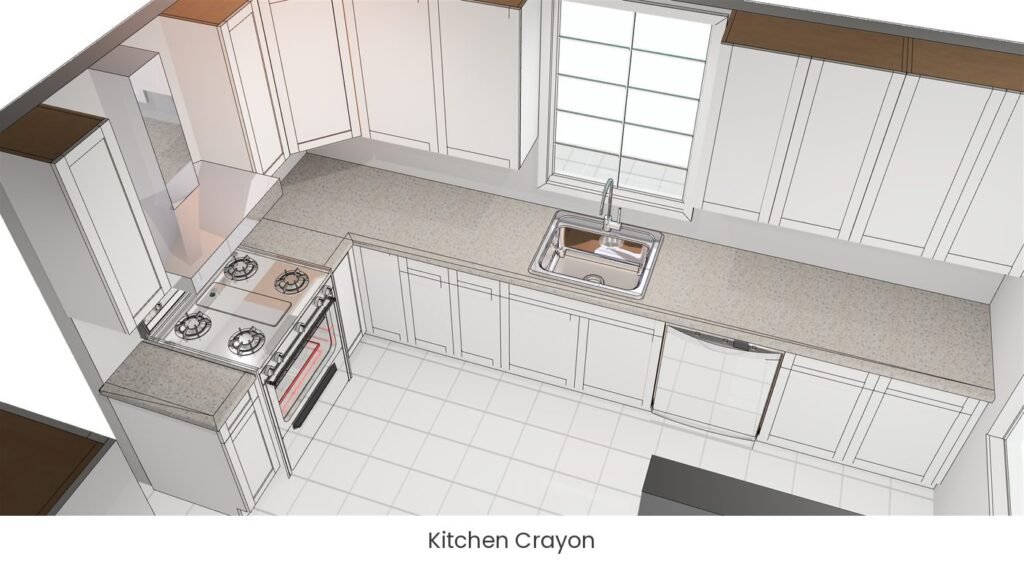
How many cabinets. This sounds obvious and it’s the one people skip. The price of a kitchen is mostly the count of boxes, and the count of boxes comes from the room — where the window is, where the door swings, where the sink has to go because that’s where the plumbing is. Two kitchens that both get called “medium” can be eleven boxes and nineteen boxes. That’s not a rounding difference.
The sizes. Here’s where it stops being intuitive.
Take a utility cabinet — the tall one, the pantry-style box. Three things about it vary, and every one of them is its own price.
Width: twelve, fifteen, eighteen, twenty-four, thirty. Five options.
Height: ninety-six, ninety, eighty-four. Three options.
Depth: twelve inches or twenty-four. Two options.
That last one catches people. Wall cabinets are twelve deep. Base cabinets are twenty-four. Those are fixed, and because they’re fixed, nobody expects depth to be a question at all — and then the tall cabinet asks it, and the answer is worth real money.
That’s thirty different cabinets, and a customer would describe every single one of them with the same three words: a tall pantry cabinet.
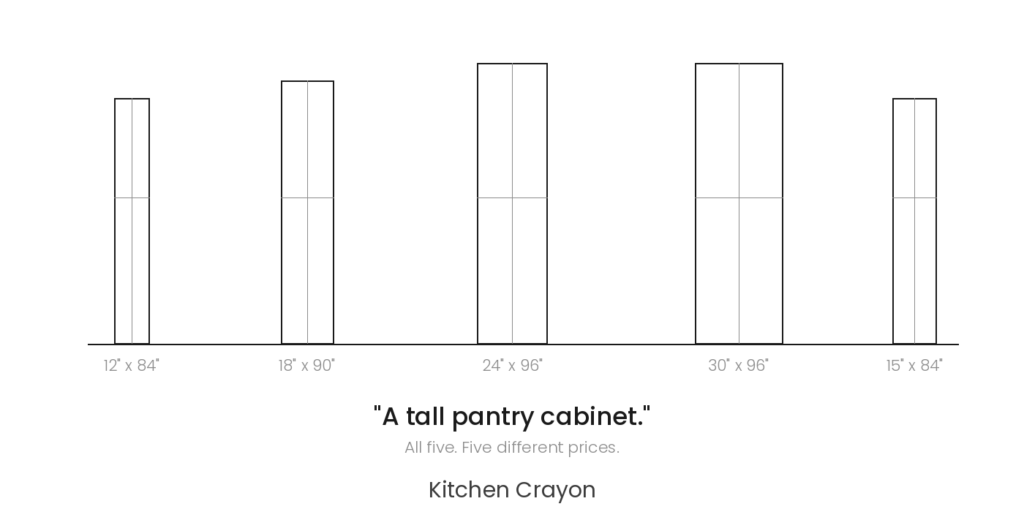
And that’s one cabinet type. Your kitchen has several.
The door. People think of the door as the look. It’s also a price tier.
One manufacturer I sold had six price levels for doors. Same box, same interior, same hardware — six columns across the page, and which column you land in depends entirely on which door you hang on the front. The door you like has no correlation with the tier it’s in. People fall in love with level five all the time. They also fall in love with level two.
Until you’ve picked, I don’t know which column I’m reading from.
What goes inside. A base cabinet with a door is one price. The same cabinet with roll-out shelves — rails installed so the shelf slides out to you instead of you reaching into the dark — is another. That’s a separate line, added on top. A real decision with a real number attached, and most people haven’t made it yet when they ask what things cost.
Which manufacturer. Same layout, same door style, same everything — different company, different price. Not slightly. And the same cabinets can cost different amounts at different dealers on top of that, which is its own conversation.
The multiplication
These don’t add. They multiply.
Five widths, times three heights, times two depths, times six door levels. That’s a hundred and eighty prices — for one cabinet type. One. Roll-outs are extra. And you haven’t counted your boxes yet, or picked a manufacturer.
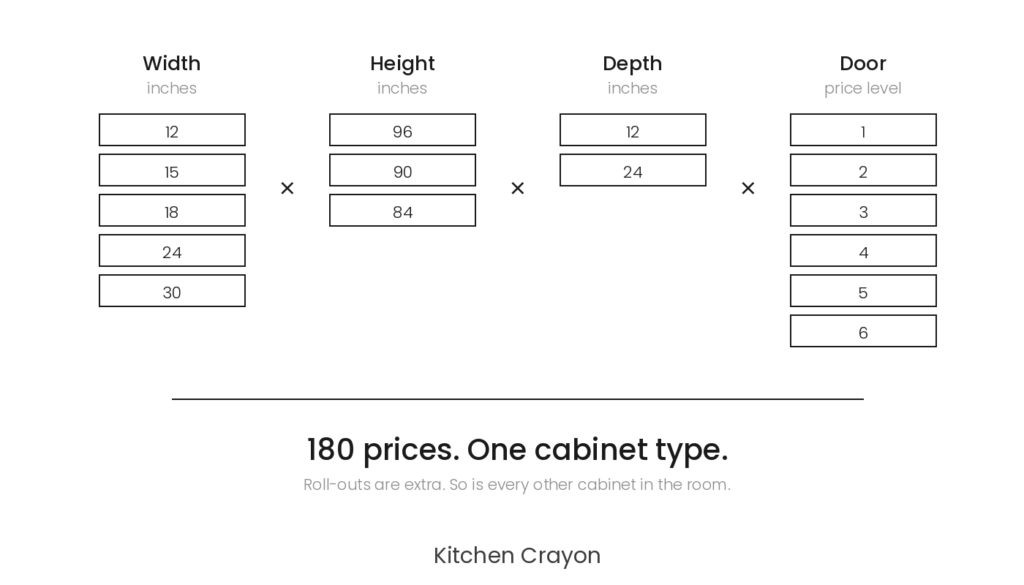
It isn’t a handful of choices with a handful of answers. It’s a grid, and the grid is enormous.
So when someone asks for a rough number, they’re picturing me consulting a list I’ve memorized. What’s actually in my head is the grid — a page of it, per cabinet type, per manufacturer — and the honest sentence is: tell me where you are on it and I’ll tell you the price in about ten minutes.
That sentence is not what people want to hear. I know.
Why the internet’s number is worse than no number
Search what a kitchen costs and you’ll get an average. Somebody will tell you $12,000, or $30,000, or a range so wide it covers both.
That number is not wrong, exactly. It’s the average of a set of kitchens that have nothing to do with yours. It’s the average of the eleven-box kitchen with a twelve-inch-deep pantry and a level-two door, and the nineteen-box kitchen with a twenty-four-inch pantry, a level-five door, and roll-outs in everything.
What it gives you is a feeling of knowing, and then you carry that feeling into a real quote and the real quote is off by half. And now you think somebody’s overcharging you, when what actually happened is that you anchored to a number that was never about your room.
I would rather tell you I don’t know than hand you that.
What I should have said
The thing I got wrong wasn’t the answer. It was that I gave the true answer without giving the reason, and a true answer with no reason sounds exactly like a lie.
What I should have said is: I’m not holding out on you. There’s no number yet. Give me your measurements and one hour, and I’ll give you a real one — and it’ll be more useful than any ballpark I could invent right now.
Because that’s the trade. A rough number takes me thirty seconds and tells you nothing. A real number takes an afternoon, arrives as a quote with lines on it, and tells you what you’re actually going to pay.
Anyone who gives you the first one that fast either has a very small catalog, or is telling you what you want to hear so you’ll keep talking to them.