Every kitchen has a corner. Most have two. Sooner or later somebody points at the drawing and asks what goes in there.
Short version: skip the upper corner, put a Susan in the base, and pay the little bit extra to get the one without the pole down the middle.
The rest of this is why.
The upper corner isn’t worth hardware
I almost never sold corner hardware for wall cabinets. Most of the time I talked people out of it.
Wall cabinets are twelve inches deep. Put a round rotating shelf inside a twelve-inch box and the circle you end up with is smaller than the square you started with. You just paid for a mechanism that gave you less shelf.
It’s also over your head. You can’t see what’s up there, so you’re spinning a shelf you’re not looking at, above your own face. A jar sitting near the edge comes off eventually. You find out when it does.
Plain shelf, plain door. Everyday things at the front. Waffle iron at the back. That corner is fine.
The base corner is worth it
Base cabinets are twenty-four inches deep and they sit below your waist. Both of those change the answer.
Twenty-four inches actually holds pots. And you’re looking down into it instead of up at it, so you can see what’s coming around, and nothing is landing on your head.
The blind corner is the real problem. That’s where one run of cabinets passes the other and the door only opens on one side, so there’s a chunk at the back you can’t see and can’t reach unless you get on the floor. Biggest dead space in the kitchen, usually.
Four things go on a quote for that spot.
What’s on the menu
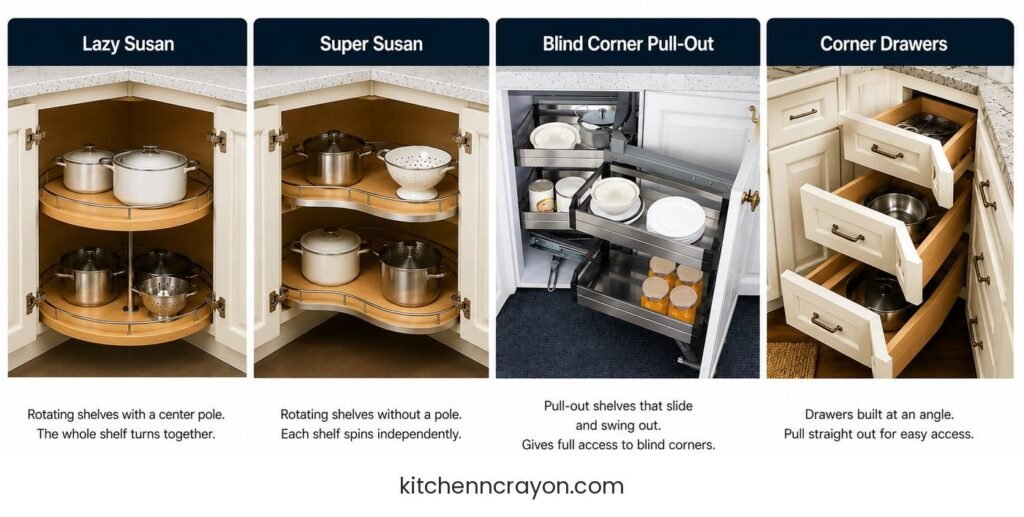
Lazy Susan. A metal post from the floor of the cabinet to the top, with round shelves bolted to it. Whole thing turns as one. Oldest option, cheapest by a lot. Rev-A-Shelf is the name you’ll see.
Super Susan. Same motion, no post. Shelves sit on bearings on top of a fixed shelf and each one spins on its own. Rev-A-Shelf makes them, Kesseböhmer makes them.
Blind corner pull-out. For blind corners. The shelves swing out of the cabinet instead of turning inside it, so the back of the corner comes to you. The famous one is the LeMans, made by Kesseböhmer. It’s usually sold through Häfele, which is why half the industry thinks it’s a Häfele product. Beautiful piece of engineering. Priced like one.
Corner drawers. Not hardware. The box itself has to be built with angled fronts meeting at the corner, so this is a decision you make when you pick the cabinet line, not something you bolt in later.
Everybody buys a Susan
Once the four are on the table, it doesn’t take long. Most corners in most kitchens get a Susan.
It’s the one that matches how people use a corner. Open the door, spin it, take the pot out. Nobody has to be taught. Kids figure it out, guests figure it out, and nobody calls you in six months asking how it works.
It also shows well. You open the door and a big round shelf swings past, and people like that. They show it to visitors.That’s not a good reason to spend money. It happened constantly anyway, and I stopped arguing with it.
So the question was never really which of the four. It was which Susan. And even that answer has five shapes behind it.
The pole is the whole argument
Anybody who’s lived with a Lazy Susan tells you the same two things.
First, stuff falls off the back. A Lazy Susan is a circle sitting in a square box, so the corners of that box are behind the shelf where you can’t see them. Anything that slides off the back edge is now back there. It’s always spice jars. I heard about spice jars for three years.
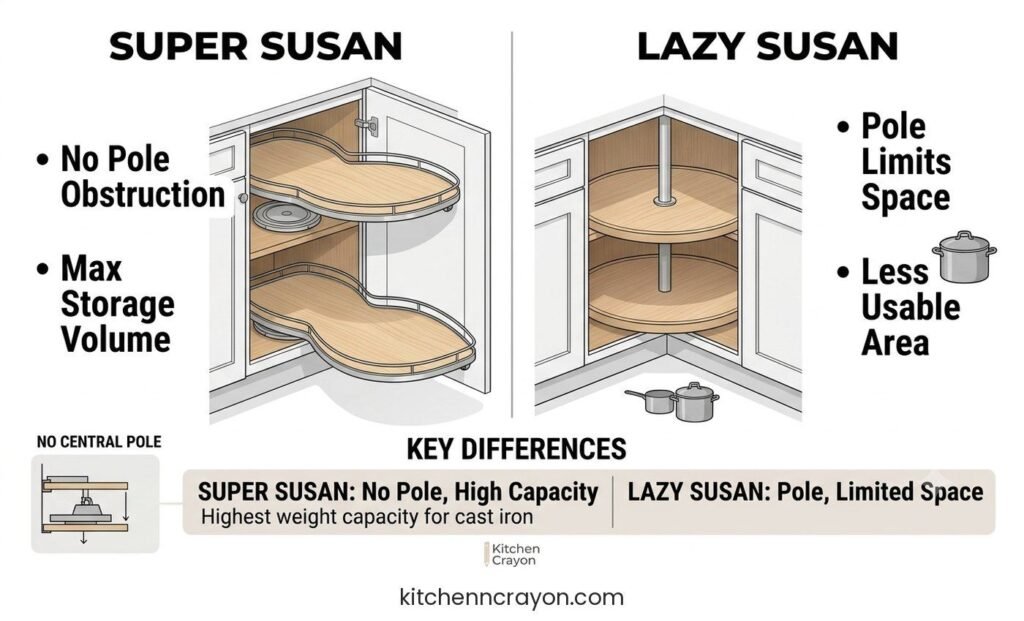
Second, you learn the angle. The post runs floor to ceiling right through the middle of the cabinet, so anything bigger than a can goes in tilted, past the pole, and comes back out the same way. You don’t load that cabinet. You arrange around it. Nobody called it a dealbreaker — they just knew they were never going to use the whole thing.
Which is the part that gets me. You paid for twenty-four inches of depth and a mechanism on top of it, and you’re still working around a piece of steel.
Take the post out and you’ve got a Super Susan. Shelves ride on bearings on a fixed shelf, the middle is open, each level turns by itself.
Then there’s weight. On a Lazy Susan the load hangs off the post. A shelf of cast iron is being held up by one piece of hardware standing in the middle of the box. On a Super Susan the weight sits on a fixed shelf and goes straight down through the cabinet, same as any shelf. The turntable on top only has to spin. It isn’t holding anything.
Which matters, because the corner is where the heavy stuff goes. Dutch oven, stockpots, the stand mixer nobody wants living on the counter. It’s the deepest cabinet in the room and it collects whatever you don’t feel like carrying. Then it turns four times a week for fifteen years.
The Super Susan costs more. Not a lot more, but enough to show up as its own line on the quote, and it’s an easy thing to cross off.
Most people didn’t cross it off. Once someone pictured that pole sitting in the middle of their pots — and worked out that the heavy end of the whole thing was hanging off it — the extra money stopped looking like an upgrade.
Lazy Susans still go in. Builder-grade kitchens, rentals, anywhere the unit price matters more than what it’s like to use on a weeknight. If money is genuinely tight, buy one and don’t feel bad about it. But when it was somebody’s own kitchen and their own money and they planned to stand there for fifteen years, they found the difference.
Nobody asked for corner drawers
Three years. Not once.
They’re the best answer on paper — no spinning, no reaching, drawers pull straight out at you — and they photograph beautifully, which is why you’ve seen them. But nobody brought it up, and I never sold a set.
Cost is part of it. You’re not buying a mechanism, you’re buying a different box, and that’s a different bracket. The other part is timing. It has to be settled before the layout locks, and most people don’t start thinking hard about the corner until the drawing is already finished.
If you want corner drawers, bring it up in the first meeting.
What to actually do
Upper corner: nothing. Plain shelf. Ice cream maker in the back.
Base corner with an angled door: Susan. If you can stretch, the one without the pole. More room in the middle, holds weight better.
Blind corner with heavy things going in it: this is what the pull-out was built for, and it’s the only spot where the expensive option is doing something the cheap ones can’t.
Corner drawers: say so on day one, not day thirty. After that it’s a redraw.