Search this and you’ll get a dozen articles, and they all land in the same place. Blind corner holds more. Lazy Susan is easier to reach. Weigh your priorities, decide what’s right for you, good luck.
I sold kitchen cabinets. I laid these two options out for people, one after another, for years. And I can tell you exactly how that decision went, because it went the same way nearly every time.
They took the Susan.
Not because I pushed it — I explained both and stepped back. But over the whole run of it, I can count the customers who went without one, and they had something in common. Small kitchen. Tight number at the bottom of the quote. Every single one.
Not one of them said “I’d rather have the volume.”
First, what these actually are
They’re not two organizers you drop into the same box. They’re two different cabinets, and which one you’re getting is decided when the kitchen is being drawn — long before anybody starts talking about what goes inside.
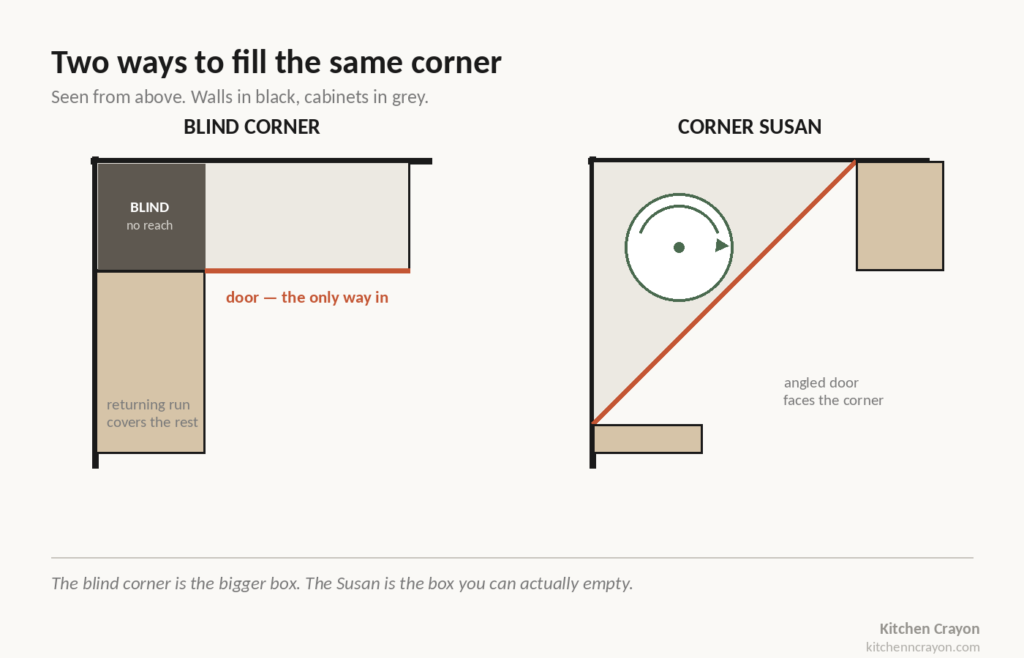
A blind corner runs one cabinet past the corner and tucks it in behind the run next to it. There’s a door on one side. The other half of the box vanishes behind the neighboring cabinet, which is where the name comes from. You open the door and reach into a deep space you can’t see the end of.
A corner Susan cabinet faces the corner head-on, usually with a door set at an angle, and it has shelves that turn. You open it and spin the shelf instead of reaching.
That’s the whole difference. Everything else people argue about comes out of that.
Why the comparison falls apart in person
On paper, the blind corner wins. It’s a bigger box. More cubic inches. If you’re comparing spec sheets, that’s the end of it.
Then you stand in front of one.
The back of a blind corner is where the roasting pan goes to be forgotten. You know something’s back there. You can’t quite remember what. Getting to it means crouching down and pulling out everything in front of it first, and by then you’ve decided you didn’t need it that badly.
The Susan takes the same corner and brings it to you.
I watched a lot of people open both, in that order, and the comparison stopped being close somewhere around the second cabinet. Storage volume is a number on a page. Reaching blindly into a dark hole is a Tuesday evening.
That’s why the fifty-fifty framing bothers me. It’s not that the capacity claim is wrong — it’s true, the blind corner does hold more. It’s that “holds more” turned out not to be what anyone was actually deciding on once they could see the thing.
So why did anyone skip it?
Money. That’s it. That’s the whole answer.
The Susan cabinet costs more. It’s a different cabinet with hardware in it, and that shows up as a bigger number on the quote.
Everyone I saw go without one was in the same spot: a small kitchen, a total that was already uncomfortable, and a corner that looked like somewhere they could take a little back out. That’s a rational thing to do and I’m not going to sit here second-guessing it. When the budget is the constraint, the budget is the constraint. I’ve watched people make that call and I understood it every time.
But I want to name it properly, because the articles don’t.
Skipping the Susan is a cost decision. It is not a storage strategy.
That distinction matters more than it sounds. If a page tells you the blind corner is the smarter pick for maximizing space, and you take that as a blessing, you can end up spending the money elsewhere anyway and living with a corner you quietly resent for twenty years. Cutting it because the budget says so is fine. Cutting it because someone told you it was the better cabinet is a different thing, and you should know which one you’re doing.
The middle option
There’s a third path, and it sits between the two.
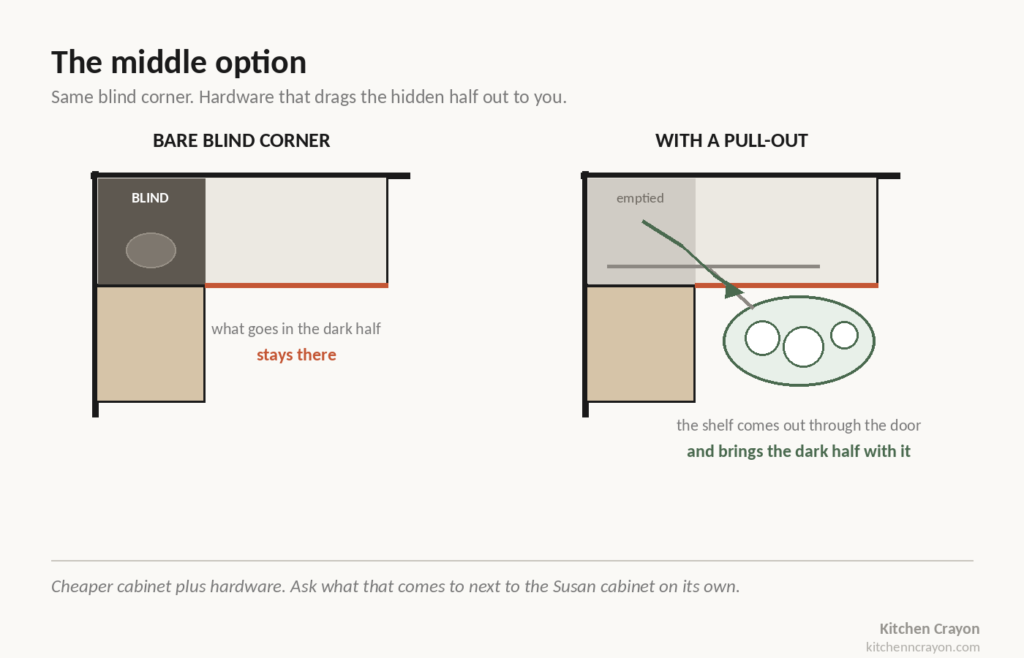
Keep the blind corner cabinet, and put a pull-out organizer in it — swing-out trays, sliding shelves, hardware that hauls the hidden half out into the light.
Here’s where I have to be straight about the edge of what I know. I sold cabinets. I didn’t sell aftermarket organizer systems, and I don’t have years of watching them wear the way I do with the boxes themselves. So I’m not going to tell you how they hold up, because I don’t know.
What I can tell you is the shape of the trade. You’re adding cost to the cheaper cabinet. The closer that added cost creeps toward the price of the Susan cabinet, the less there is to be clever about.
So if you’re weighing it, ask your dealer the only question that settles it: what does the blind corner plus the organizer come to, next to the Susan cabinet on its own? Sometimes that gap is a lot smaller than people assume. It’s the same question worth asking about any upgrade on the quote — not “is it good,” but “what does it actually cost me over the alternative.”
The questions I’d rather you were asking
If you got here trying to choose between a blind corner and a Susan, I’d nudge you off that question entirely. Two better ones.
Am I one of the exceptions?
Small kitchen, tight total, and the corner is one of the last places left to trim. If that’s genuinely you, the blind corner is a real answer and you’re not making a mistake. If it isn’t you — if the money is there — the corner is not where I’d go looking for savings. It’s a bad place to save, because you pay it back in daily annoyance rather than in dollars, and that bill never stops arriving.
Which Susan?
This is the one that actually splits people, and almost nobody walks in knowing it’s a question. There’s more than one kind. They behave differently. And unlike the blind-corner debate, this difference shows up every single day rather than once on a quote.
Some of my customers chose a lazy Susan when a Super Susan was on the table. That’s the fork that deserved all the deliberation everybody spends on this one instead. I wrote about it separately, because it’s the decision I’d actually want you to slow down for.
Where to look on your own quote
Everything here is about base cabinets — the ones under your countertop. That’s where the corner problem bites hardest, because they’re deep and you’re reaching down as well as in.
Your quote won’t spell any of this out in plain English. Corner units arrive as codes and line items like everything else.
The drawing will tell you, though. The elevation shows you what the quote leaves out, and the corner is easy to read once you know what you’re looking at: a door set at an angle, facing into the corner, is a Susan cabinet. A door sitting flat on one side, with the box disappearing behind its neighbor, is a blind corner.
And if you’d rather not squint at a drawing, just ask. It’s a one-second answer.
Better to have it now than the first time you go looking for the stockpot.
Related reading
- Lazy Susan vs Super Susan? Lose the Pole — the choice that actually matters
- The Upgrades Worth Paying For, and the Ones Nobody Uses
- How to Read a Cabinet Quote, Line by Line