Your quote says Lazy Susan. Or it says Super Susan, if you went that way.
Either way it’s one line, you glance at it, and you move on to arguing about the door color.
Here’s the thing about that line. It’s telling you the truth. It’s just answering a different question than the one you’d ask if you knew there was a question.
Because there are five types of lazy Susans. They mount differently, they fit different cabinets, one of them takes your cabinet doors along for the ride when you spin it, and the two that look most alike behave differently every day for the next twenty years.
Your quote doesn’t say which one.
Mine didn’t either. It said Lazy Susan or Super Susan — the part the customer picked — and it stopped there. In all the quotes I wrote, nobody ever asked me to go further, because nobody knew there was anything further to ask about.
A note on where this comes from
I sold cabinets. I didn’t sell organizer hardware, so the technical detail below comes from the manufacturers’ own catalogs rather than from years of my own with them.
What I can tell you from my side is the part nobody else can: which of this lands on the piece of paper you’re handed, and which of it quietly doesn’t.
The quote answers the wrong half
Once you see this, it’s hard to unsee.
Your quote names the Lazy vs Super decision — whether there’s a pole running up the middle of the cabinet or not. That’s a real choice, it’s yours, and you made it.
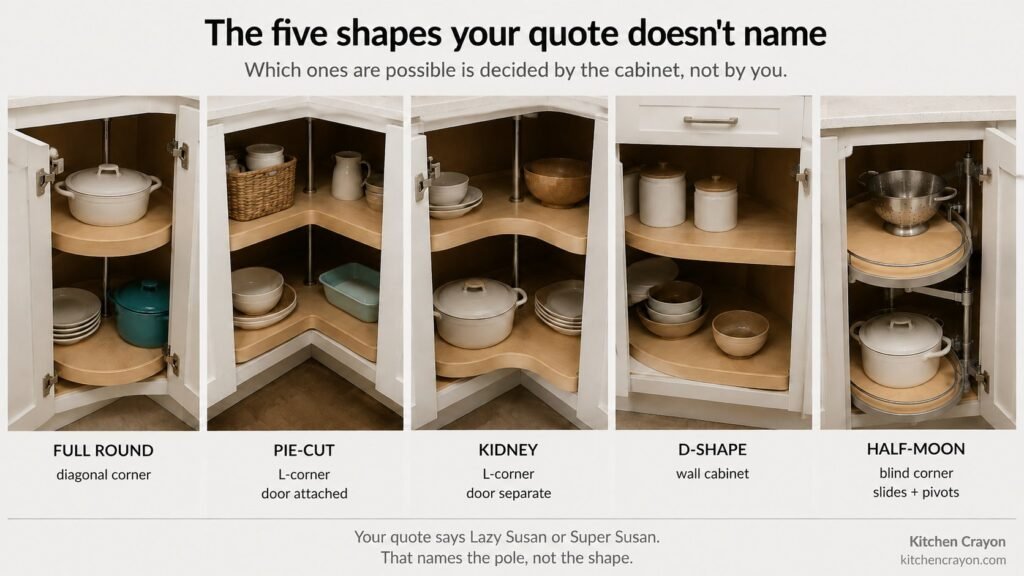
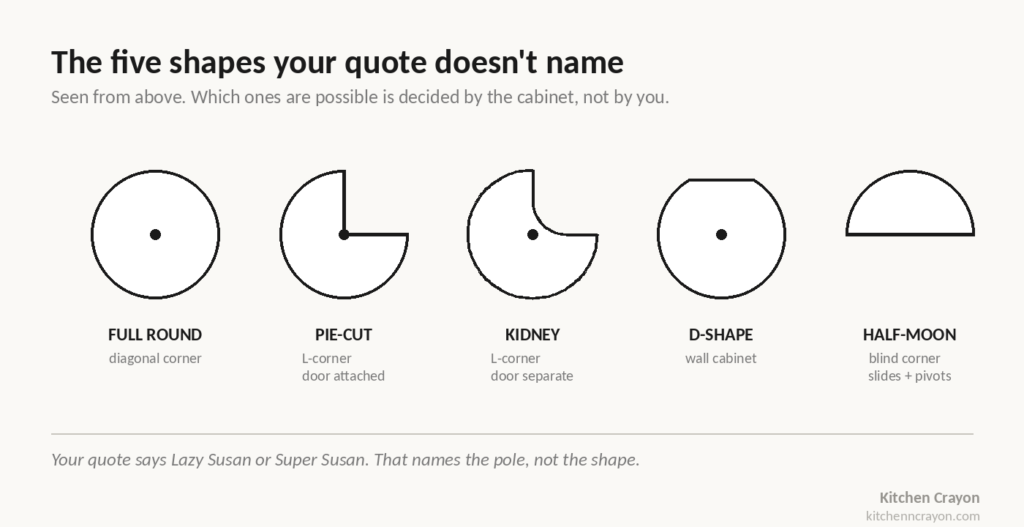
Your quote does not name the shape. Full-round, pie-cut, kidney, D-shape, half-moon. Nothing.
And the reason is almost defensible: you were never going to choose the shape anyway.
By the time anyone says “Susan” out loud, the corner cabinet is drawn. That cabinet has already ruled out three of the five. A full-round won’t go in an L-shaped corner. A half-moon won’t go in a diagonal one. The layout picked the cabinet, the cabinet picked the shape, and nobody consulted you at any point in that chain because there was nothing to consult you about.
So the quote lists what you decided and omits what was decided for you.
Which is fine, right up until the morning you discover that spinning the shelf pulls your cabinet doors around with it, and nobody mentioned that was going to happen.
The five
Full-round. A complete circle stacked on a center post, like a cake stand. Goes in a diagonal corner cabinet — the kind with a door set at an angle across the corner. The shelf doesn’t touch the door. The door opens, the shelf spins, they mind their own business.
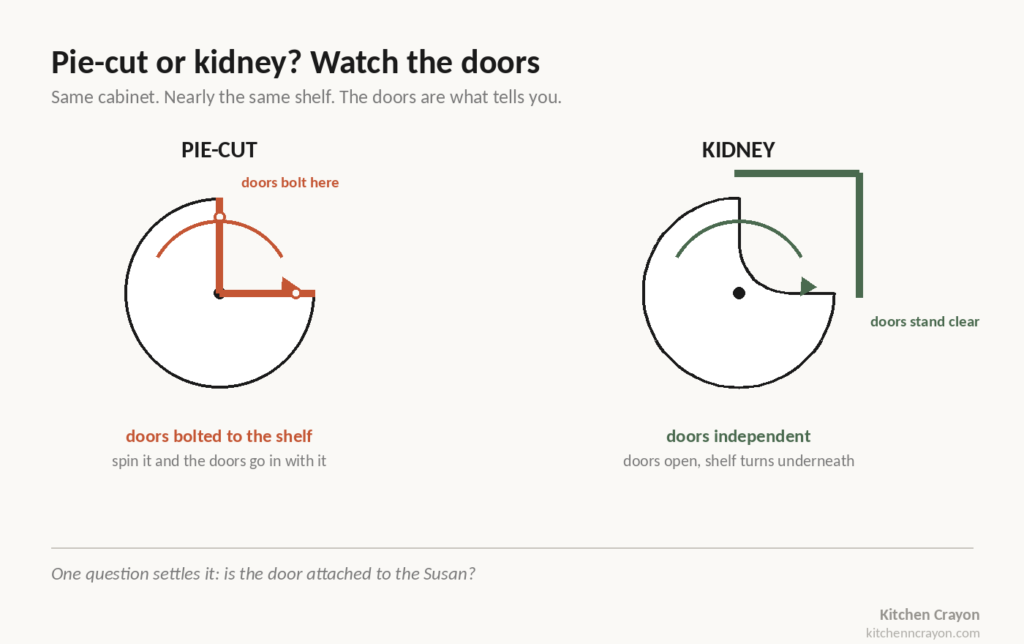
Pie-cut. A circle with a 90-degree wedge taken out, for an L-shaped corner where two doors meet at a right angle. And here’s the surprise: the doors are attached to the shelves. Spin the shelf and your cabinet doors rotate into the cabinet along with it. It’s a genuinely satisfying bit of machinery when it’s right. It’s also fussier to install, and the largest ones typically stop around 28 inches across, which won’t fill every corner.
Kidney-shaped. Looks almost exactly like a pie-cut. Same corner, same rough outline, a curved cutout instead of a sharp one. The difference is that the doors are not attached. They swing open on their own and the shelf turns independently underneath.
Same cabinet. Nearly identical shelf. Completely different behavior.
D-shape. One flat side, the rest a curve. The flat edge sits against the door so it closes flush. This one usually turns up in wall cabinets — over the fridge, in a pantry — rather than down in a base corner.
Half-moon. The odd one out. It’s for blind corners, and it doesn’t spin around a post at all. It slides and pivots out of the opening. Base cabinets only. If you have a blind corner and you’ve been told a Susan isn’t an option, this is the thing you weren’t told about.
The pair that causes the trouble
I want to stay on pie-cut and kidney, because this is where the gap in the quote actually bites.
They look the same. They go in the same cabinet. They cost roughly the same. And your quote calls them the same thing.
With a pie-cut, the doors and the shelf are one system. Elegant — the doors get out of the way as the shelf comes round. It also means the tolerances have to be right, and a corner unit that got racked slightly during installation is a corner unit where the doors and the shelves argue with each other.
With a kidney, the doors and the shelf are strangers. Less elegant, fewer things to go out of alignment, and it can be fitted after the fact rather than planned into the cabinet from the start.
Neither one is the correct answer. But one of them is going into your kitchen, and if you want to know which, the quote is not going to tell you.
What to ask
Two questions. Each takes about a second, and between them they close the whole gap.
“Which corner cabinet is on my drawing — diagonal, L-shaped, or blind?”
That tells you which shapes are even possible. The elevation drawing shows this plainly even when the quote doesn’t: a door set at an angle across the corner is diagonal, two doors meeting at a right angle is L-shaped, and a box vanishing behind its neighbor is blind.
“Is the door attached to the Susan?”
That’s the pie-cut versus kidney question in the only form that gets you a straight answer. Nobody has to know the vocabulary. Either the door comes round with the shelf or it doesn’t.
Somebody at the dealership knows both answers. They’re in the manufacturer’s catalog and they’re on the order that gets placed. They just don’t make the trip onto the page you’re handed.
Which is the same story as the grade of the board and the hinge brand and half of the spec block.
Your quote tells you which Susan you chose.
It doesn’t tell you which one you’re getting.
Related reading
- Lazy Susan vs Super Susan? Lose the Pole — the half your quote does name
- Blind Corner vs Lazy Susan — the decision before this one
- What Your Cabinets Are Actually Made Of — the rest of the words on your quote