People used to come in and ask about wood. Now they come in with a phone.
They’ve seen the flat white kitchen with no handles anywhere. They’ve seen the drawer that opens to reveal a perfect grid of dividers. They’ve seen the trash can that glides out from under the counter like it was always there.
Most of that is real. Some of it is worth the money. Some of it I’d talk you out of, and one of it I’d tell you to go buy somewhere else entirely.
Here’s how I’d sort them — the cabinet upgrades worth paying for, and the ones I watched people regret.
Handleless doors
This is the one people want most right now, and it’s the one they understand least.
There are no handles. You push the door and it opens. You push it again and it closes. It’s clean, it photographs well, and every young couple who walks in has it saved somewhere.
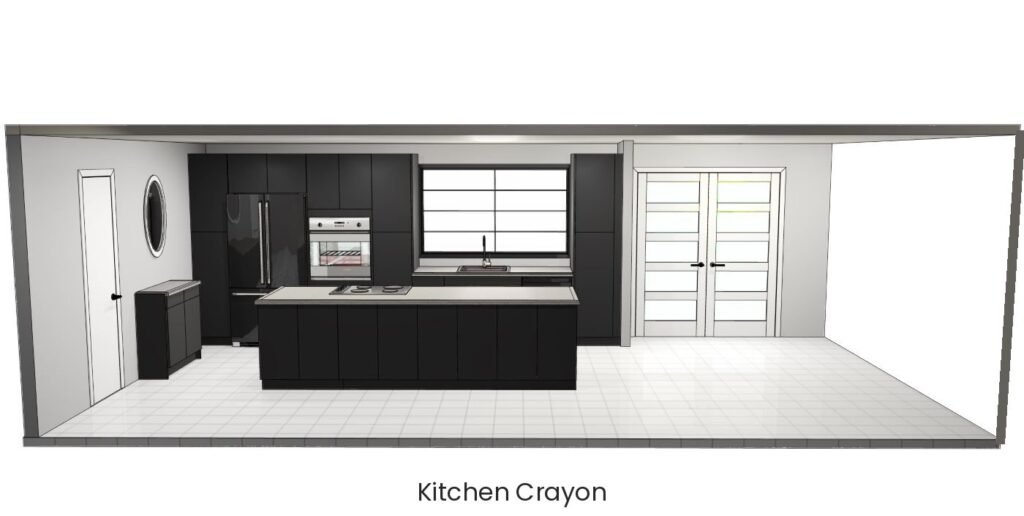
Two things nobody tells you.
First: it has to be soft close. Not as an upgrade — as a requirement. A push-open door without a soft-close mechanism is a door that slams every time you use it, and you use kitchen doors forty times a day. This isn’t a luxury add-on. It’s the difference between the thing working and the thing being a mistake.
Second: the hardware is the whole product. A push-open door is a spring-loaded mechanism doing a job that a handle does with your hand. When the mechanism is cheap, it fails, and it fails in a specific way: your doors start popping open on their own. Not dramatically. Just slightly, a quarter inch, all the time. Because the door has shifted by a hair and the latch can’t tell the difference between “closed” and “pressed.”
The cheap versions start doing this in one to three years. That’s the number that gets passed around in this business, and I can’t tell you it’s been tested — it’s shop-floor knowledge, not a study.
I never found out for myself, because I only ever ordered Blum. I never got a call about it. Not once. I’m not telling you Blum is the only hardware that works, and I’m not telling you every cheaper mechanism fails — I’m telling you what I chose to put my name on, and what happened after. Other people will have had different experiences with different brands.
One thing worth knowing before you decide this on price: if the mechanism does fail in year two, what your warranty actually covers is a narrower list than you think, and it almost certainly doesn’t include the labor to fix it.
It also has to be installed precisely. A handle forgives a door that’s a little off. A push latch doesn’t.
What it actually costs
Here’s where the conversation usually surprises people.
Everyone assumes handleless is the expensive choice. It depends entirely on what you were going to put on the doors instead.
If you were going to buy cheap handles — the basic ones, the ones that come in a box of ten — then going handleless will add something in the range of five to ten percent, based on the quotes I used to write.
If you were going to buy nice handles, the ones people actually pick when they see the display, the price lands in about the same place. You’re not paying extra for handleless. You’re paying for one thing instead of another thing.
Your numbers will be different. Every manufacturer prices this differently, and it’s been a few years since I was the one writing the quote. The point isn’t the percentage. The point is that “handleless costs more” is a comparison, and nobody ever tells you what it’s being compared to.
Drawers instead of doors
People want drawers now, and they’re right.
A base cabinet with a door is a cave. You put a pot at the back and you never see it again. A base cabinet with drawers gives you the whole depth every time you pull.
This is one of the few upgrades where the fashionable choice and the correct choice are the same choice. Order the drawers.
The trash pull-out
Recommend this to somebody and watch their face.
It’s a cabinet with a bin that slides out. That’s the whole thing. And it’s the single item on the quote that gets the most delighted reaction, because everybody has spent their entire adult life with a trash can standing in the corner of the kitchen and nobody ever thought to ask if it had to be there.
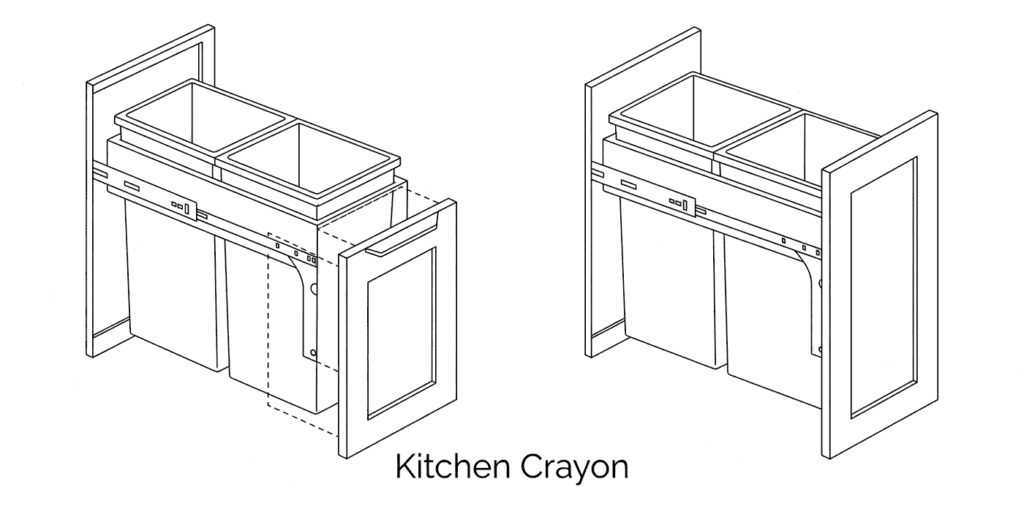
Make it soft close. This is the one drawer in your kitchen you will push with your foot, with your hip, with the back of your hand while holding something wet. It needs to close itself gently, because you’re never going to close it gently.
Base organizers, yes. Wall organizers, no.
Base organizers — the dividers, the pull-outs, the tiered inserts down low — those earn their money. That’s where the heavy, awkward, stackable stuff lives.
Wall organizers are the ones I’d leave off, for two reasons.
The first is that almost nobody actually needs one. In all my years I can count the people who asked.
The second is design, and this is where I’ll say plainly that I’m giving you my opinion as a designer, not a rule. Some people won’t be bothered by this at all.
A wall organizer means a narrow cabinet. Three inches. Six inches. And your wall run is a rhythm — thirty, twenty-seven, thirty — and then suddenly there’s a three-inch sliver wedged into it.
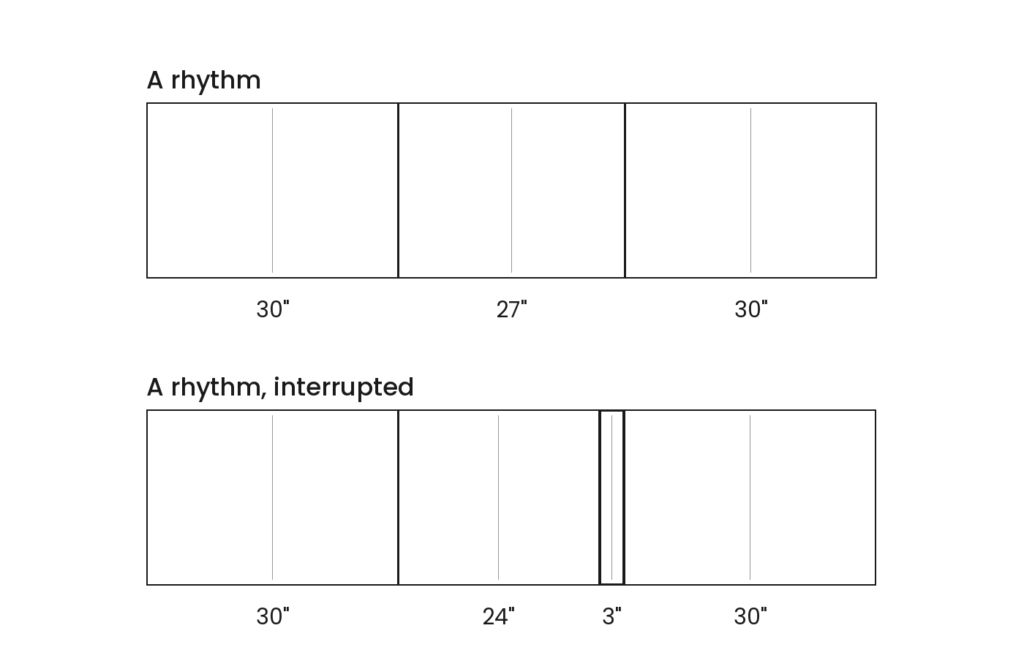
It looks chopped to me. Not broken, not wrong, just chopped.
And wall cabinets are the first thing you see. You walk into a kitchen and your eyes land at that height before they land anywhere else. The base cabinets are furniture. The wall cabinets are the face of the room. A sliver in the middle of the face is a thing you’ll notice every day for twenty years, in exchange for a spot to keep spices you could have kept anywhere.
Glass doors
I was in a house once with glass doors on the wall cabinets, and the kitchen looked cluttered. I didn’t have to say anything about it. The homeowner brought it up herself.
She was right, and here’s the thing — nothing in there was wrong. It was a normal kitchen with normal things in it. That was the problem.
Glass doesn’t make a cabinet look nice. Glass makes a cabinet look like whatever is inside it. In the showroom that’s six matching bowls, spaced out, lit from below. In your house it’s the cereal box, the mismatched mugs, and the plastic container with the lid that doesn’t fit anything.
Unless what you own is genuinely beautiful — and I mean actually beautiful, not just clean — glass is going to show you something you didn’t mean to display.
There’s one place I’d say yes.
Sometimes you stack wall cabinets two high, all the way to the ceiling. The top box is above eye level and you can’t see into it. Which means every time you’re looking for something, you’re dragging a chair over to find out what’s up there.
That’s where glass earns it. Not because it’s pretty. Because it means you can see.
And the stuff people put in the top box tends to be the stuff that deserves glass anyway — the serving pieces, the things you use twice a year, the wedding present nobody’s touched. It’s already curated. It got curated by being inaccessible.
So: glass at eye level, where your daily life lives, is a decision you’ll be managing for twenty years. Glass up top, where you can’t reach anyway, is just a window into a closet.
The stuff you should buy yourself
Two things on this list I’d tell you to leave off the quote entirely.
Cutlery trays, knife blocks, spice inserts. The manufacturer will sell you these. They’ll be fine. They’ll also be more expensive than the ones at IKEA, and there will be four options instead of forty. Buy the cabinet from me. Buy the plastic tray that goes inside it from somebody who sells plastic trays for a living.
Handles. Same logic, more so.
Every cabinet company offers handles, and every cabinet company’s handle selection is small. It has to be — they’re a cabinet company. Handles are an afterthought in their catalog and the entire product line for somebody else.
Handles are also the one part of your kitchen you physically touch every single day. That’s not the place to accept a limited menu because it was convenient to check a box.
Go look at handles. Hold them. Buy the ones you like. It’s the cheapest way there is to make a kitchen feel like yours, and it’s the one decision in this whole process where your taste is genuinely the only thing that matters.
The point
Almost every upgrade on a cabinet quote is real. The trash pull-out really does change your kitchen. Drawers really are better than doors. Blum hardware really does last.
But an upgrade list isn’t a wish list. It’s a set of trades, and the same item trades well in one spot and badly in another — glass is a window when it’s over your head and a confession when it’s at eye level. A narrow cabinet is storage on the quote and a chop in the face of your kitchen on the wall. A plastic tray is convenient in the same truck and marked up in the same truck.
And whatever you add, the quote still won’t show you everything that has to happen in that room before any of it works.
The good ones are the ones you’d still want on year eight — when the kitchen isn’t new anymore, when nobody’s taking pictures of it, when it’s just the room where you make dinner.