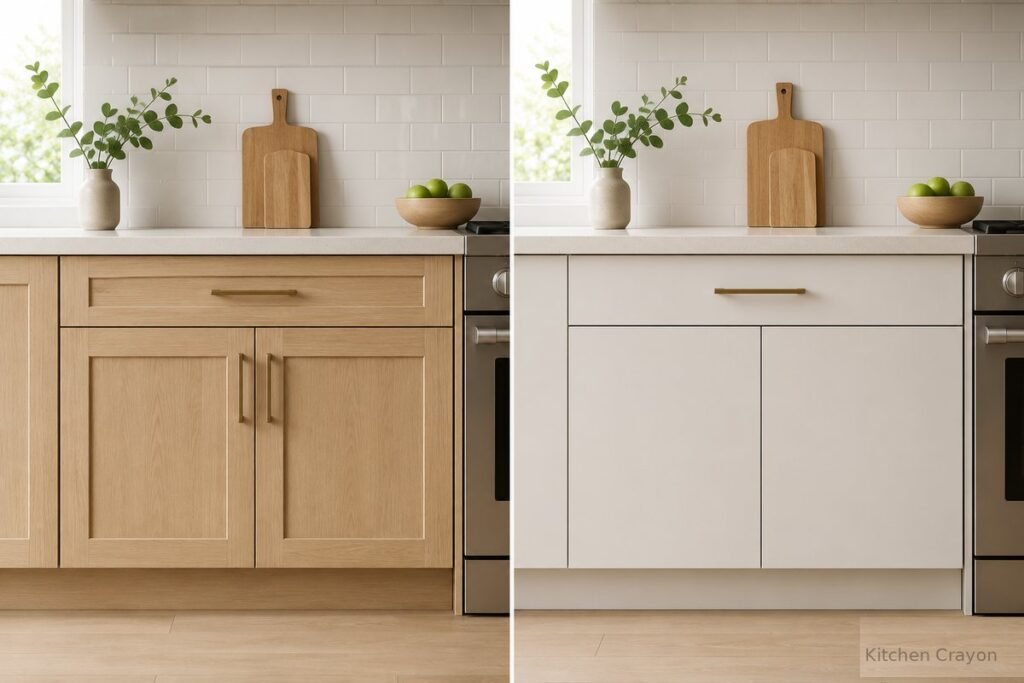
Nobody with kids has ever asked me this.
I’ve thought about why. I think it’s because you don’t walk into a showroom in durability mode. You walk in and there’s a wall of doors and one of them gets you, and that’s more or less the end of it. Durability shows up later, in your own kitchen, usually right after something happens. By then it’s not a question. It’s a door.
So — one family asked. Four boys. And I’ve thought about what I told them more than I thought about it at the time.
The house with four boys
They liked slab. The flat one. The clean one, the one that looks like the kitchen in the ad.
I said shaker. It’s more solid, it’ll take more of a beating.
I meant it. But there’s a gap in what I said, and I only see it now that I’m writing it down.
The shaker I sold was solid maple and oak.
That’s the shaker I knew. All of it. Every door I’d handled, delivered, gotten a phone call about. So when somebody asked me about shaker, that’s where the answer came from, and the answer was true.
Just not the whole thing.
I said shaker is sturdier. What I actually knew was solid wood is sturdier than the cheap stuff, and every shaker I’ve ever touched was solid wood. Sounds the same. Isn’t. And you can’t see the difference from inside your own experience — I couldn’t, anyway.
Where it bites is the next showroom. The shaker on that wall might not be solid anything. My sentence walks in there with you and quietly stops being true, and there’s nobody standing next to you to mention it.
They went with slab. It was fine. I’ll come back to that.
The shape isn’t the thing
Shaker has a reputation in this country. It looks made instead of manufactured — you can see the frame, you can see the joinery, and it reads as solid.
The reputation is fair when the door is solid wood. The problem is the reputation sticks to the shape, and the shape isn’t doing the work.
A cheap shaker isn’t tougher than a good slab. It’s a cheap door with a frame drawn on it.
And slab isn’t the budget option. That’s the assumption and it’s wrong. A good slab will beat a cheap shaker without much of a fight — different core, different finish, different everything — and it looks exactly like the cheap slab from six feet away. Which is why nobody spots it on the display wall.
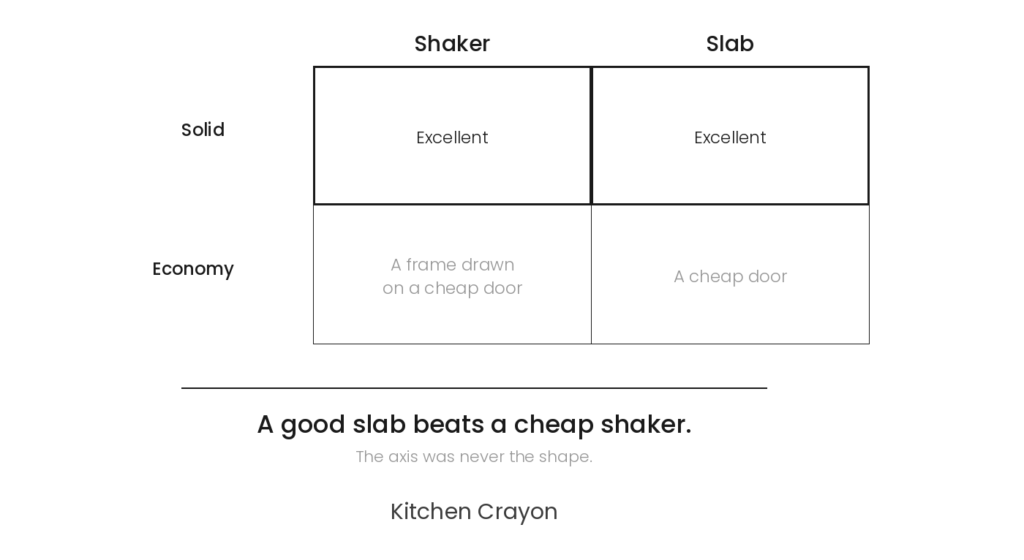
Solid or economy. That’s the split, and it runs through both shapes.
If you only ask one question about durability, ask whether the finish peels.
That’s the failure I saw. Not the profile. The surface letting go of what’s underneath — an edge, a corner, somewhere a thumb has caught it a few thousand times. Once that starts, the door’s done, and it doesn’t matter what shape it was.
Slab is easier to clean, and with kids that’s not nothing
Here’s the thing I underweighted with the four boys.
A shaker is a panel sitting inside a frame. Where those meet, you get an inside corner. All the way around. Every door.
Stuff lives in there. Not grease — dust. The fine gray stuff that packs into a ninety-degree angle where a cloth can’t lie flat. You can’t wipe it. You have to dig it out with a rag pushed into the corner by a fingernail, and then do that on the next door, and the next one.
Nobody does that every week. I don’t do that every week.
A slab is flat. You wipe it and walk away.
I sold a lot of frameless, which meant a lot of slab, and people were happy. Not “no complaints” happy — happy. Nobody came back.
The grease everybody worries about isn’t really the issue. The cabinet over the range does collect it, and it’s worse over gas. But it’s fixable and the fix is boring: run the hood, actually run it, and wipe the door right after you cook while the film’s still warm. Ten seconds and it’s gone.
It’s the corners that get you. Slab doesn’t have any.
Color and finish matter more than the shape does
Light hides fingerprints. That’s it, that’s the rule, and it’s more useful than anything I could tell you about door construction. A dark door in a house with kids is a fingerprint gallery and it never stops being one. “We’ll wipe it down” doesn’t survive contact with actual children.
Then there’s sheen, and this is where you actually feel it.
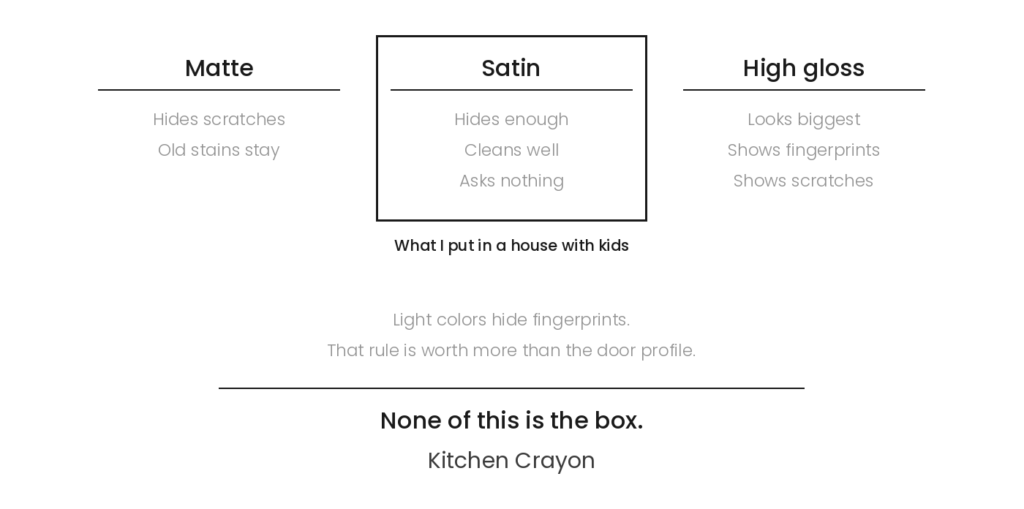
Matte is great for scratches — hides them. But it grabs old stains. Once something’s been sitting in a matte finish a while, you’re not getting it out.
High gloss is gorgeous. It’s the most modern thing on the wall and it genuinely opens up a room. It also shows every fingerprint, and a scratch announces itself the second it happens. Beautiful. Also a job. Put high gloss in a house with small kids and you didn’t pick a finish, you picked a chore.
Satin is the one I’d put in. Hides enough, cleans easy, doesn’t ask anything of you.
The handles
Your kids run into the handles more than anything else in the kitchen. And almost everybody treats it like jewelry.
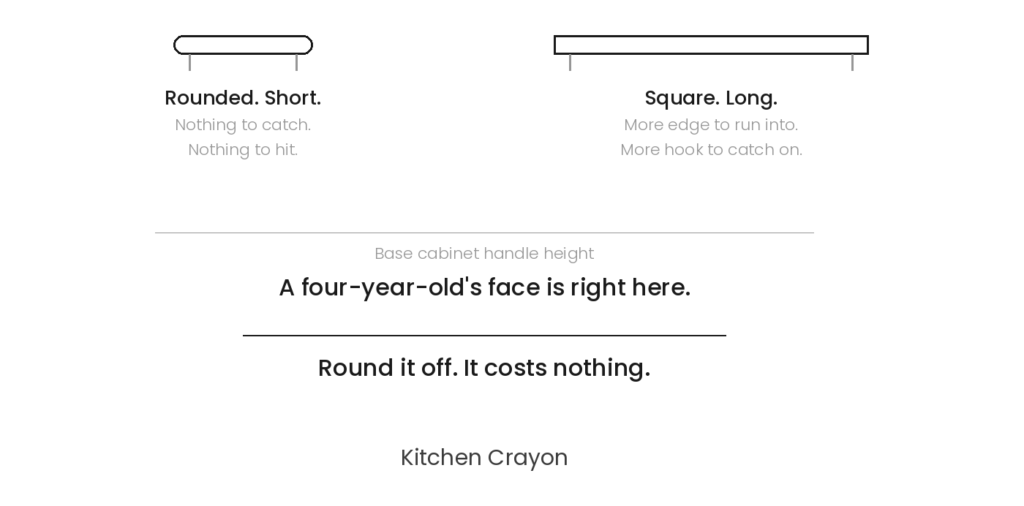
Round the corners. Look at where a base cabinet handle sits, then look at where a four-year-old’s face is. Same height. A square-cornered handle is a small hard thing at head level in a room kids run through. Rounding it costs you nothing.
Don’t go too long. More bar is more edge to hit and more hook to catch. Sleeves, pockets, a kid going past in a hurry. A short handle has less of everything.
Soft close. Not an upgrade in a house with small hands. A requirement.
A door that closes itself gently can’t slam on fingers. Everything else people like about soft close — the quiet, the feel — is extra. If you’re cutting somewhere, don’t cut here.
But none of that is quality
Now the part nobody asks about, which is where I’d put the money.
The finish is what you’re looking at. The quality is what you’re paying for. Not the same, and only one of them is visible when you’re standing at the display wall.
A satin door on a bad box is a bad cabinet with a nice surface. It’ll still swell. The edges will still let go. The hinge will still work its way loose out of a screw hole in something that was never going to hold a screw.
What’s inside the box is the durability question. The profile isn’t. The sheen isn’t.
Customers don’t ask. In all those years the box only came up because I brought it up, and even then people were mostly being polite until we could get back to the part they could see. I told them anyway. Not because I expected it to land. Because if I didn’t say it, nobody was going to.
Short version
For a house with kids:
Door — either shape. Solid over cheap. Ask if the finish peels.
Color — light.
Sheen — satin.
Handles — rounded, short.
Soft close — all of it. Don’t negotiate.
The box — put the money here. You’ll never look at it once.
Almost none of that is shaker versus slab, which is the only part you were planning to look up.
Which is the funny thing about this whole business. The question everybody researches gets answered in four seconds by your own eyes the moment you see the door you like. And the ones that decide how the kitchen ages — nobody asks those. I’d tell you anyway.