Many homeowners save money by buying cabinets from one company and hiring a separate installer. Sometimes it works perfectly. Sometimes it creates a problem no one expects: nobody agrees who’s responsible when something goes wrong.
There’s a moment I saw over and over when I sold cabinets. The customer has picked everything. The boxes, the doors, the layout, the little upgrades they went back and forth on for a week. Then they get the number for installation, and they go quiet. A day or two later they come back with some version of the same sentence: my guy will do it for less.
I never argued hard. Most of the time I just said okay.
And most of the time it was fine. That’s the part people leave out when they warn you about this. Splitting the job usually works. The installer shows up, the cabinets go on the wall, nobody calls me. Buying the cabinets from one place and the labor from another is not a dumb idea. Cabinets are a product. Installation is labor. If each one is cheaper on its own, the math looks right.
The math looks right until something on site doesn’t line up. That’s when you find out what you actually bought when you hired two companies instead of one.
Let me tell you about a corner cabinet.

The corner cabinet
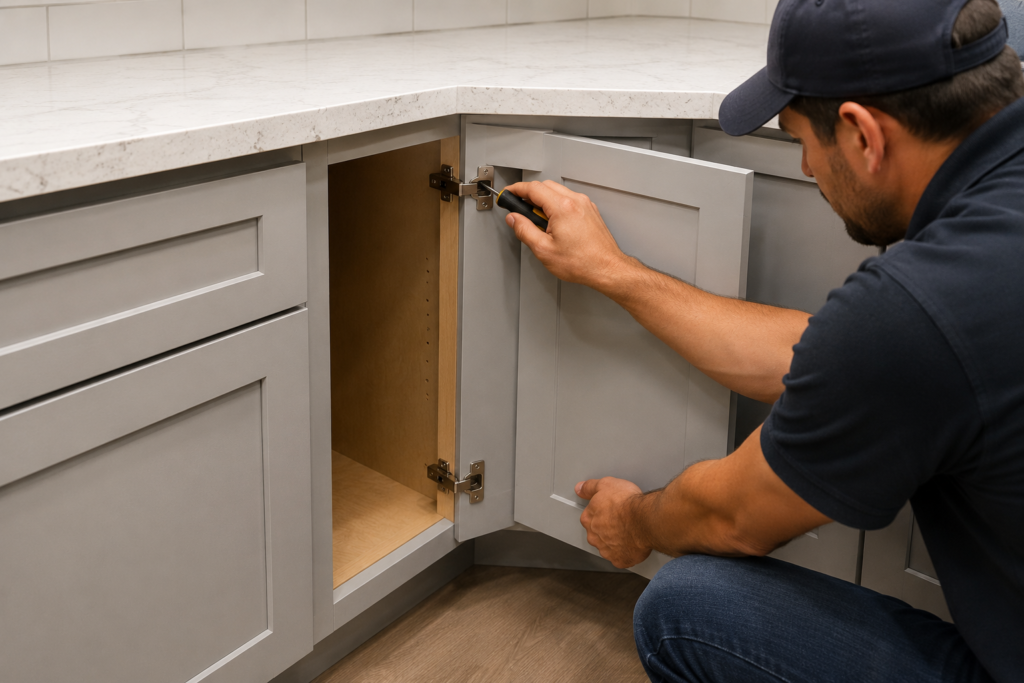
The kitchen shown in these photos is one of my own designs. The corner wall cabinet pictured here is the same style of cabinet that inspired the story below.
It was a job where the customer brought in their own installer. Not my guy. Somebody they found who came in under my install number. Fine by me. The cabinets went out.
Then I got the call. The corner cabinet door wouldn’t stay shut. It kept swinging back open. And by the time I heard about it, the installer had already told the homeowner what the problem was: the cabinet came in wrong. Out of square. Not his install — the box.
Here’s the honest part. I couldn’t tell you, sitting here now, whose fault that actually was. A corner cabinet is the fussiest box in the kitchen. It can rack a little if the wall’s out, if the floor’s out, if it got set even slightly off level. It can also leave the shop not perfectly true. Both happen. On a door that won’t stay shut, you usually can’t cleanly separate the two. Anyone who tells you they can, from a photo, is guessing.
So what did I do. I drove out. I looked at it. And then I apologized. I stood in that kitchen and told the homeowner I was sorry, and I more or less asked them to bear with me while we got it sorted.
The installer adjusted it right there. Tweaked the hinge, got the door to sit, and that was it. It held. Problem closed. Took him a few minutes once everyone had said their piece.
That’s the part that stayed with me. The fix was small. The standing around it was not.
But look at who did what. He fixed it. I apologized for it. And I still don’t know it was mine to apologize for.
I did it anyway. I’d do it again, too, because the incentives aren’t complicated. That installer is in the homeowner’s kitchen every day. He’s the one they trust. He’s the one who’s there when they ask “is this normal?” I’m a name on an invoice and a number they call. When he tells the homeowner the cabinet came wrong, I can’t win that from a phone. It’s cheaper for me to drive across town, eat it, and keep the peace than to be right and be the far-away vendor who’s arguing.
Why one team never has this problem
Now run the exact same corner cabinet with a crew that sells and installs together.
That door never becomes a conversation. The installer sees it on the wall, reaches into his own stock for a shim or a different hinge, and it’s handled before anyone’s standing around deciding who’s to blame. The homeowner might not even know it happened. When one company owns both halves of the job, a problem on site is just a thing to fix. There’s nobody to point at, because pointing at yourself doesn’t get you anywhere.
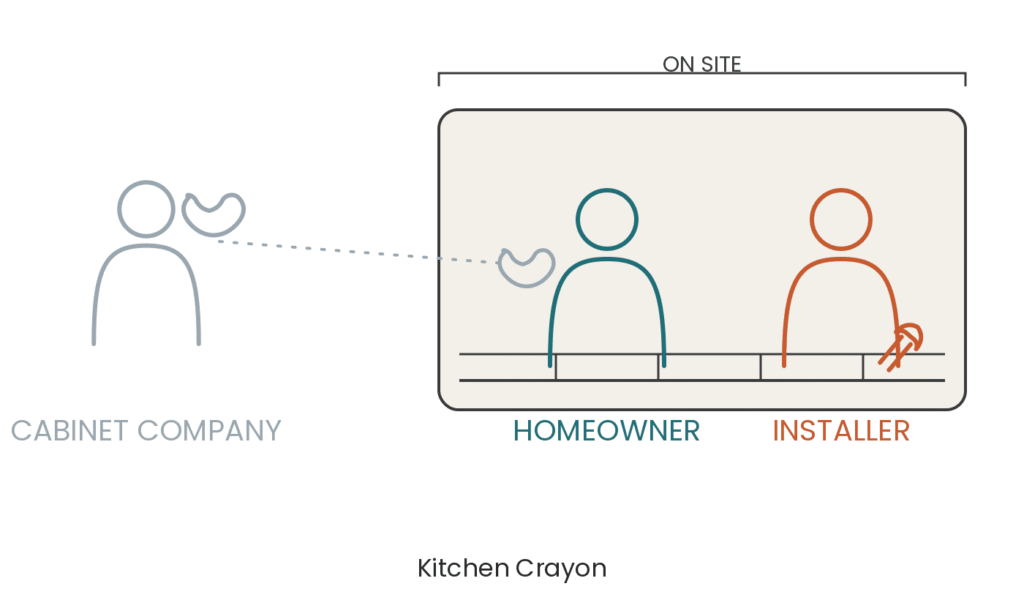
That’s the piece that doesn’t show up in the price. A matched team isn’t only labor with a warranty stapled to it. It’s a single point of responsibility. Something goes sideways, you call one number, and the person who answers can’t hand it off — because there’s no one to hand it to.
Split the job and you break that. Now you’ve got two companies who don’t work together, standing in your kitchen, and each one can point at the other. Whoever’s standing closest to you tends to win. Sometimes that’s fair. Plenty of times it isn’t. Either way, you’re the one who ends up in the middle of it.
And think about the spot that puts you in. You didn’t cause the problem. You don’t have the tools to fix it. You can’t even tell who’s right, because both of them sound reasonable and you’re not the one who knows how square a corner cabinet is supposed to sit. So you’re standing in your own kitchen refereeing two professionals, and the only real leverage you have is deciding which one you’re going to be annoyed at. That’s not a job you signed up for when you were trying to save a few hundred dollars. But it’s the job you get.
And it’s quiet. Nobody sends you a bill for it. The corner got adjusted, the door sits, everybody moves on. You just never see the version where it got fixed in ten minutes with no apology and no drive across town, because that version happens on jobs where one crew owns the whole thing.
If you’re going to split it anyway
I’m not telling you to always buy install from your cabinet company. Sometimes their number really is padded. Sometimes your own guy is genuinely better than whoever they’d send. Splitting can be the right call.
But if you’re going to do it, do it with your eyes open.
Tell your cabinet company you’re using your own installer, and tell them up front. Don’t let them find out when there’s a problem. It changes how a warranty conversation goes, and it changes how willing everyone is to lean in when something’s off.
Then ask your installer a few real questions before you hire him. Has he set these before — this style especially? Frameless is less forgiving than framed, and a lot of guys who are fine with framed get humbled by it. What does he do when something doesn’t line up on site: does he fix it himself, or does he stop, call the cabinet company, and wait? Who does he expect to handle a door or a drawer that isn’t sitting right after he’s packed up and gone?
The answers tell you whether you’ve hired someone who solves problems or someone who finds them and hands them back to you.
Why I apologized
The corner cabinet got fixed. The homeowner was happy. They saved money on the install and the door sits fine to this day. On paper, they came out ahead. They didn’t get burned. I did. I drove across town to apologize for something that may not have been mine, because the man I was up against had the one thing I didn’t. He was in the room, and I wasn’t.
So why should any of this matter to you, if the homeowner walked away fine?
Because it doesn’t always break that way. That time the fix was a hinge tweak and a short drive. The next time it’s a door that has to be remade, or a run that has to come off the wall, and now two companies are arguing about who eats it while your kitchen sits half-finished. Splitting the job didn’t hurt this homeowner. It just quietly handed them the referee’s whistle and hoped they’d never have to blow it.
You might never have to either. But before you save that few hundred dollars, it’s worth knowing that’s the trade — and knowing who you’d be calling if it went the other way.
Would you split the job to save money, or would you rather have one company handle everything?