I sold countertops for years, and I could set my watch by the first question. Somebody would walk in, put both hands on the sample display, and ask, “So which one’s the best?”
I never had a good answer, because there isn’t one. Every slab on that display has a flaw, and the whole trick is figuring out which flaw you can live with in your own kitchen, with your own cooking and your own patience for wiping a spill before it sits. The customers who called me later, unhappy, almost never picked the “wrong” material. They just never found out what theirs couldn’t do until it was in the house and paid for.
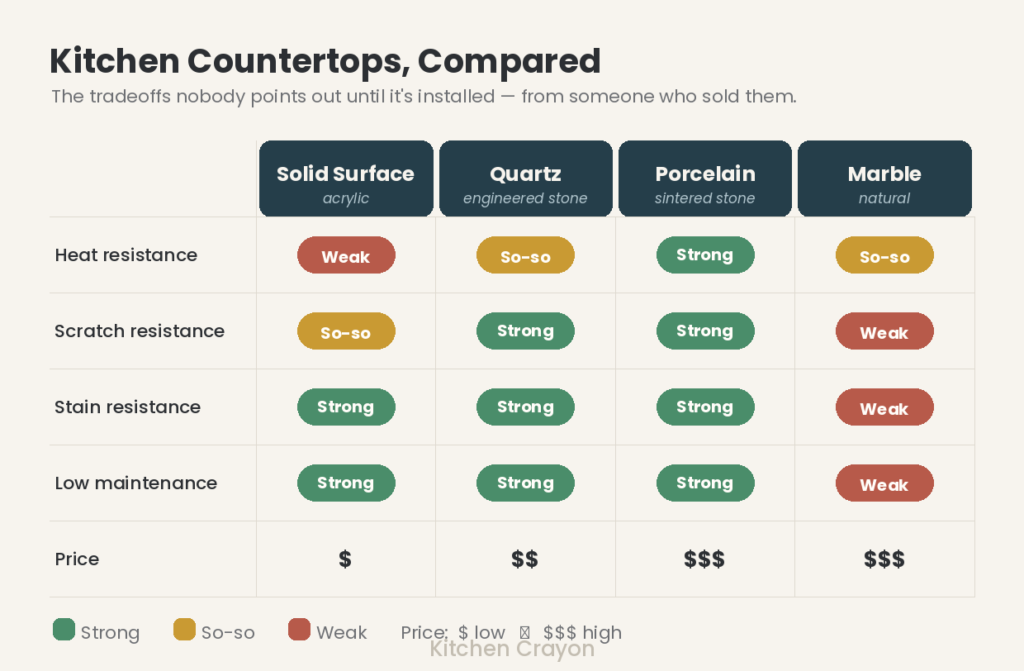
So here’s what I’d tell a friend standing at that display with me. Four materials, what they’re really made of, what you’re actually paying for, and the thing nobody mentions until the check clears.
Solid surface
Corian, Hi-Macs, Staron. It’s acrylic, not stone, and never was, whatever the brochure implies. Its one real trick is that it hides its own seams. A decent fabricator welds two pieces into a single surface you can’t find the joint on, molds the sink right into the counter so there’s no rim collecting gunk, and runs the backsplash up the wall without a break. Nothing else in the shop does that.
It’s nonporous, so you never seal it, and it heals Scratch it or dull it and a fabricator sands the mark right out. Try that with granite. For a bathroom vanity or a laundry room it’s honestly the smart money, and most of the folks who write it off have never seen a good one installed.
Then somebody sets a hot pan on it. That’s the flaw. It’s soft and it can’t take heat. A pot straight off the burner leaves a mark a sponge won’t touch, and in a few colors it reads a little plasticky under bad lighting. Quartz ate its lunch fifteen years ago and it never really came back. Bit of a shame, honestly.
Quartz
Caesarstone, Silestone, Cambria, MSI. This is where you land when you’d rather not think about your counter ever again. It’s about 90% crushed quartz held together with resin, and that resin is the whole story, good and bad. The good: it’s hard, it doesn’t stain, you never seal it, and what you saw in the showroom is what shows up on the truck. No surprise vein running the wrong way. For most kitchens it’s simply the right answer, and I sold a mountain of it without losing any sleep.
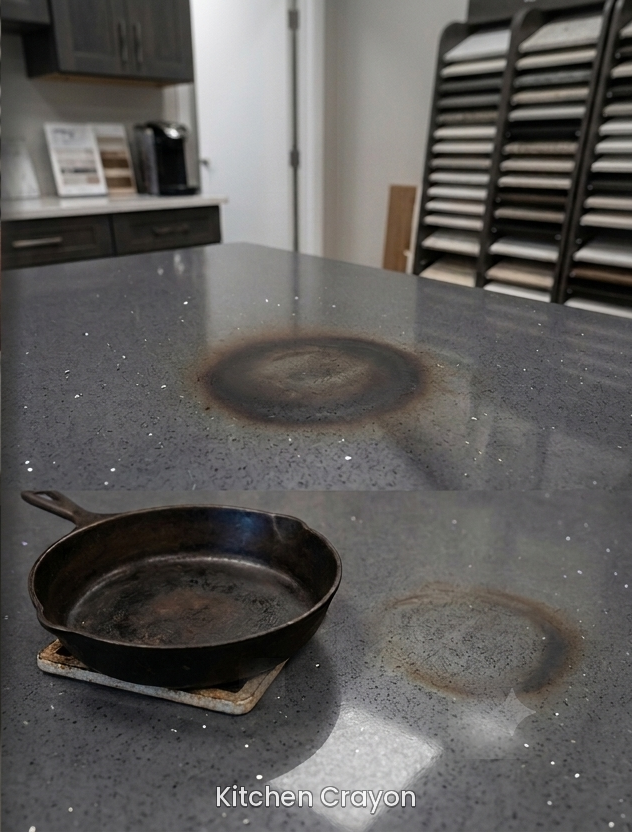
The bad is the resin, and it shows up as heat. This is the one I talked people down from constantly. “It’s stone, it’ll be fine.” No. It is not all stone. Take a cast iron skillet out of a 450-degree oven, set it down bare, and you can scorch the resin right where the quartz can’t help you. Use a trivet and the thing will outlive your mortgage. Forget it on the wrong day and now you own a scorch mark. Same reason it doesn’t belong outdoors or under a big south-facing window, where UV slowly yellows the resin.
One more thing while I’m on it. Quartz is not quartzite. I have watched salespeople mix the two up to a customer’s face. Quartzite is a natural stone: harder, actually handles heat, but porous and needs sealing. They rhyme, and that’s about all they have in common. Ask which one is on your quote before you compare a single price.
Porcelain
Dekton, Neolith, Lapitec. Newest thing on the floor and, on paper, the toughest. It’s mineral powder fired under enormous heat and pressure into a slab so dense it just doesn’t care. Set a hot pan on it, genuinely. It shrugs off stains and scratches, it doesn’t fade in the sun, and it’s the one surface I’d put in an outdoor kitchen without a second thought. Thin, light, capable of looks the others can’t manage.
Two catches, and the second one matters more than people expect. First, it’s brittle at the edges. Hit a corner hard enough and it chips in a way that’s a pain to repair. Second, it’s genuinely difficult to fabricate. It needs a shop that knows the material, and the gap between a great porcelain job and a butchered one is night and day. A so-so fabricator still hands you a fine quartz counter. That same fabricator hands you chipped edges and seams that don’t meet in porcelain. If you go this route, vet the installer harder than the brand. I mean that.
Marble
Carrara, Calacatta, the real thing. Nothing fakes it, and everyone selling a “marble-look” quartz knows it. They’re selling a photograph of this. The depth, the veining, the way light settles into it. That’s what the money buys, and it never goes out of style.
It’s also the highest-maintenance surface you can put in a kitchen, and I say that as someone who loves the stuff. Marble is soft and porous. It etches: a squeeze of lemon, a splash of wine, a drop of vinegar, and the acid eats a dull spot straight into the polish. It stains if you leave a spill sitting. It needs sealing. It scratches. On heat it’s a funny middle. Real stone won’t scorch the way resin does, but a screaming-hot pan can thermal-shock a hairline crack or cook the sealer, so you keep a trivet within reach anyway. Two years in, it will not look the way it looked the day they set it.
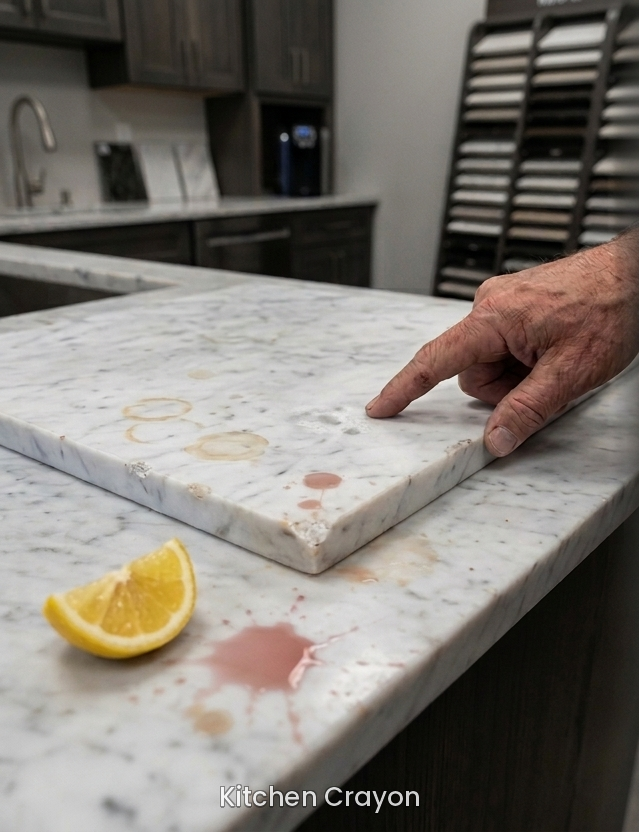
And here’s the thing I wish every marble customer heard on day one. The ones who love their marble wanted it to age. They look at the etches and the soft spots and see patina, proof the kitchen gets cooked in. The ones who end up miserable expected it to stay showroom-perfect forever. Marble isn’t a durability decision, it’s a temperament. Figure out which one you are before you sign, because that one question would have spared half my marble customers a world of grief.
Plainly: if you need it to still look flawless in five years, buy quartz or porcelain. If you want a counter that gets better as it collects your life, buy marble. Both are right answers. They just answer different questions.
The heat thing, one more time
Because it’s the myth that cost my customers the most. “It’s stone, so it’s heatproof.” Only porcelain actually is. Quartz and solid surface both carry resin that scorches. Marble cracks, or the sealer bakes. If “I never want to think about a trivet again” is a real, non-negotiable line for you, porcelain is the only one of the four that keeps the promise. And even then, you mind the edges.
How I’d actually pick
Strip the brochures away and it’s short. Seamless, low fuss, not a heavy-cooking counter: solid surface. The safe, right-most-of-the-time answer you can ignore for a decade: quartz. The toughest surface made, if you’ll pay a good fabricator to do it right: porcelain. The real thing, if you’ve made peace with it aging: marble.
One honest note to end on. What you approve on a three-inch chip almost never reads the same across a full slab in your own kitchen light, which is the same gap that trips people up all over a remodel. And price ladders about how you’d guess, solid surface on the bottom, quartz through the middle, porcelain and marble up top. But the real number moves on edge profile, thickness, and how many seams your layout forces, the same line-by-line reading you’d give anything else. The material is only half of it.
Pick the flaw you can live with. That’s really the whole game.