One door. One hundred and seven days. And there was nothing behind it.
Not nothing as in the cabinet was empty. Nothing as in there was no cabinet. That door was mounted over a dead corner to make a wall look finished.
It went to the plant on March 11. The date they gave me was June 9. My customer got it on June 26. I drove out to that factory twice for it, and the first time I drove home empty.
Cabinet lead times get quoted in weeks. This one ran in months.
The whole thing started with me typing a number wrong.
The part that was my fault
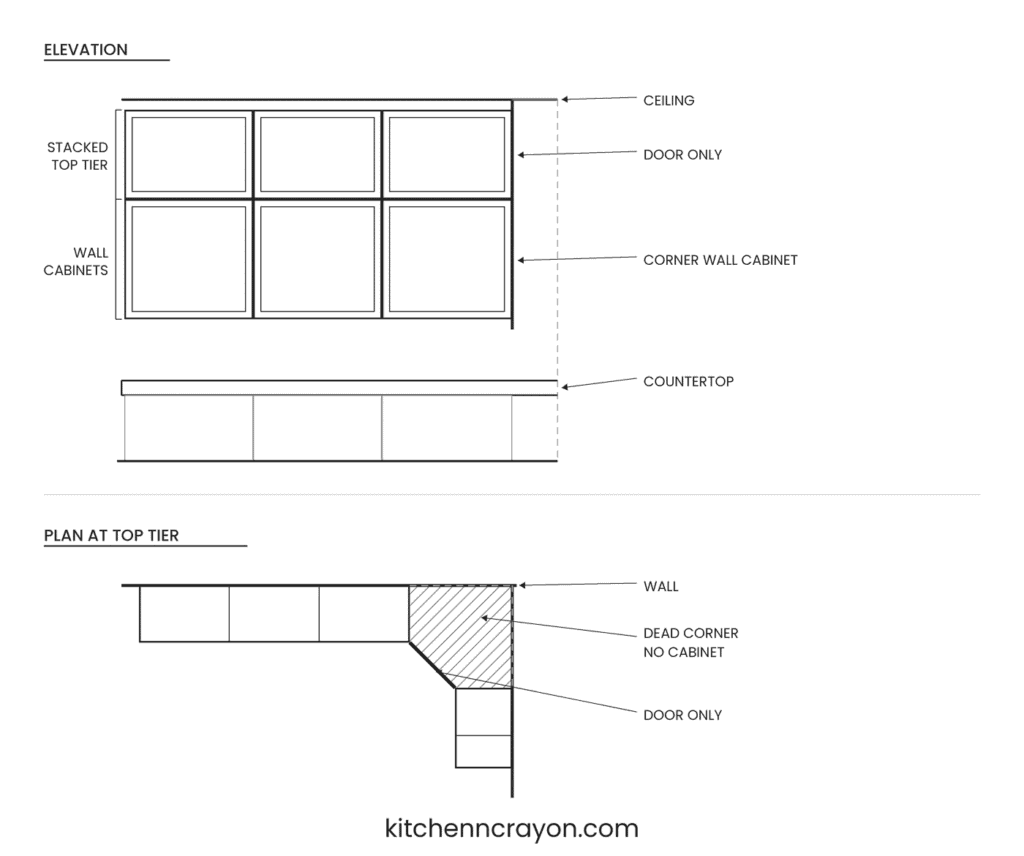
We stacked the wall cabinets in that kitchen. A normal run of wall cabinets, and then a second tier above it going up to the ceiling. It looks good, it kills the dust shelf on top, and it buys you real storage. It also creates a problem in corners, which is where I got myself into this.
The bottom tier corner was fine. The top tier wasn’t, because that line didn’t make a corner wall cabinet in the height I needed up there. Corner cabinets come in fewer heights than regular ones do. Most people never run into this because most people never stack.
So I did what you do. I ordered a door and no cabinet — just the door, cut to a custom size, matching finish, mounted across the dead corner so the top run reads as continuous cabinetry instead of stopping short and leaving a gap. From the floor nobody can tell. It’s a good trick and I’d used it before.
I put the wrong dimension on it.
No factory error. No shipping problem. No rep dropping the ball. I entered a number, the number was wrong, and a door showed up that didn’t fit a hole that didn’t exist.
A reorder doesn’t jump the line
Here’s what I believed, after years of doing this for a living: a replacement moves faster. It’s one door. The kitchen’s already built and sitting in the customer’s house. Somebody made a mistake, so somebody flags it and pushes it through.
No.
And a custom size makes it worse, because there’s nothing to pull off a shelf. Somebody has to build the thing, from scratch, inside a plant that already has a full schedule taped to the wall. March 11 in, June 9 out. Thirteen weeks for one door, on a line that had quoted twelve for the entire kitchen.
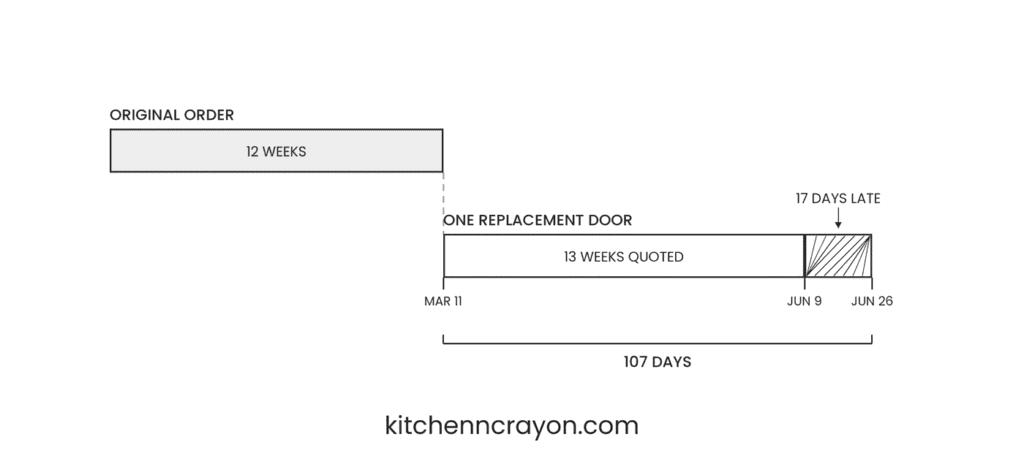
I don’t blame the plant. Their calendar was set before my problem existed, and one door for one dealer doesn’t move a production schedule. But run it from the customer’s side: they waited the full lead time for a kitchen, then waited nearly the full lead time a second time, for a piece of wood the size of a cutting board with nothing behind it.
I’ve had a while to sit with that one.
If your salesperson ever tells you “no problem, we’ll just reorder it,” there is a number hiding inside that sentence. Make them say it out loud.
Then it wasn’t there
June 9 came and I didn’t wait for the truck. A scheduled delivery adds days on the back end and I wanted this one closed, so I got in the car.
It wasn’t there. Seventeen days out, and I found that out standing in a warehouse.
In fairness to the factory, they were moving. Not had moved. Moving. At that moment, somewhere in that building, people were putting an operation onto pallets while still trying to run it. Production doesn’t stop for that. It also doesn’t run the same.
None of which shows up on your paperwork. There is no field on an order acknowledgment for “plant is mid-relocation.” You get a date. Everything behind the date stays inside the building.
My rep knew they were moving. I don’t think he knew what it would do to my one door, and I’ve never held it against him. I found out the way my customer would have — by showing up and looking at an empty spot on a rack.
The phone call
I called that day. Not the next morning.
I told them the door wasn’t ready. I told them I’d driven out to get it myself, so they’d know it wasn’t sitting somewhere waiting on paperwork. I told them I didn’t have a new date I trusted yet. Then I apologized without sliding the factory in underneath the apology, because they bought from me and the original mistake was mine anyway.
They said it was fine.
Which was worse. If somebody yells at you, you’re square by the end of the call. If they’re nice about it you carry it around. I still think about that kitchen and they’ve almost certainly forgotten it.
What actually got the door here
Nothing clever.
I called instead of emailing. Email gets answered when somebody has a minute. A phone call gets answered now, and you can hear whether the person on the other end is actually walking over to look.
I asked a different question. Not “is it on schedule.” Is it built and sitting on your dock. Those sound like the same question. Only one of them gets you an answer you can drive on.
Then I made a nuisance of myself, politely and more often than was comfortable. The orders that move are the ones somebody keeps asking about. I’d rather be the annoying guy to my rep than to my customer.
Second trip was June 26, after somebody at the plant told me the door was in his hands. That time I drove home with a door.
What a lead time actually covers
While we’re here, because this is the part people get wrong before they ever have a problem.
There is no single number for how long cabinets take. Stock cabinets run two to four weeks — fixed sizes, fixed finishes, half of them already sitting in a warehouse, so you’re waiting on a truck more than a factory. The far end is twenty weeks. Specialty finish, odd size, a species the plant doesn’t run often, a door style they set up for twice a year. Those don’t add up so much as multiply.
This kitchen was a twelve-week brand. The customer picked a door they loved, and that door only came off a line that ran twelve weeks. Nobody at the showroom table says out loud that picking a door style is also picking how long you eat takeout.
And that twelve weeks is when the cabinets leave the factory. That’s the whole scope of the number. Delivery, installation, countertop templating, fabrication — all of it happens after the lead time runs out, and none of it is in there.
If you’re the one waiting
Four things, from the side of the desk I used to sit on.
Ask when the order actually went to the plant. Approving a drawing is not placing an order. The clock starts on the second one, and there can be days or weeks between them.
Ask what a reorder costs you in time. Ask before you sign, while it’s hypothetical and nobody’s defensive about it. Ask specifically about custom or modified pieces, because those are the slow ones.
Don’t book your installer off the quoted date. Book it when the boxes are in your garage and you’ve counted them. An installer who held a week for you and pulls up to an empty garage is going to bill somebody, and it won’t be the factory.
Judge your salesperson on when they tell you, not on whether it’s late. Everything is late eventually, at every price point and every brand. What varies is whether you hear about it the day they find out or the day the truck doesn’t show. If you have to be the one who calls to find out your kitchen isn’t coming, you’ve learned something about how the rest of the job is going to go.
It worked out
June 26 the door showed up, the corner got closed, the kitchen looked the way it was supposed to look. The customer was gracious about the whole thing — more gracious than I’d earned.
I drove to that plant twice for one door and made one phone call I didn’t want to make. The phone call was the harder of the two.