In three years, not one customer ever asked me about the small type.
I know exactly what they asked about instead, because it was always the same two things and it always came late. Where’s the utility cabinet going. What’s going inside the drawers.
Last week of the job. Sometimes the last day. Sometimes after I thought we were done and the phone rang anyway — sorry, one more thing, does the pantry work better on the other wall?
Fair enough. That’s the part you live with. Nobody lies awake over eight-point type at the bottom of page one.
But I wrote some of that eight-point type. And I can tell you it isn’t filler. Every one of those lines exists because something went sideways once, for somebody, and afterward a sentence got added.
So here’s the small print, line by line, from the guy who used to type it.
The thing to know before any of it
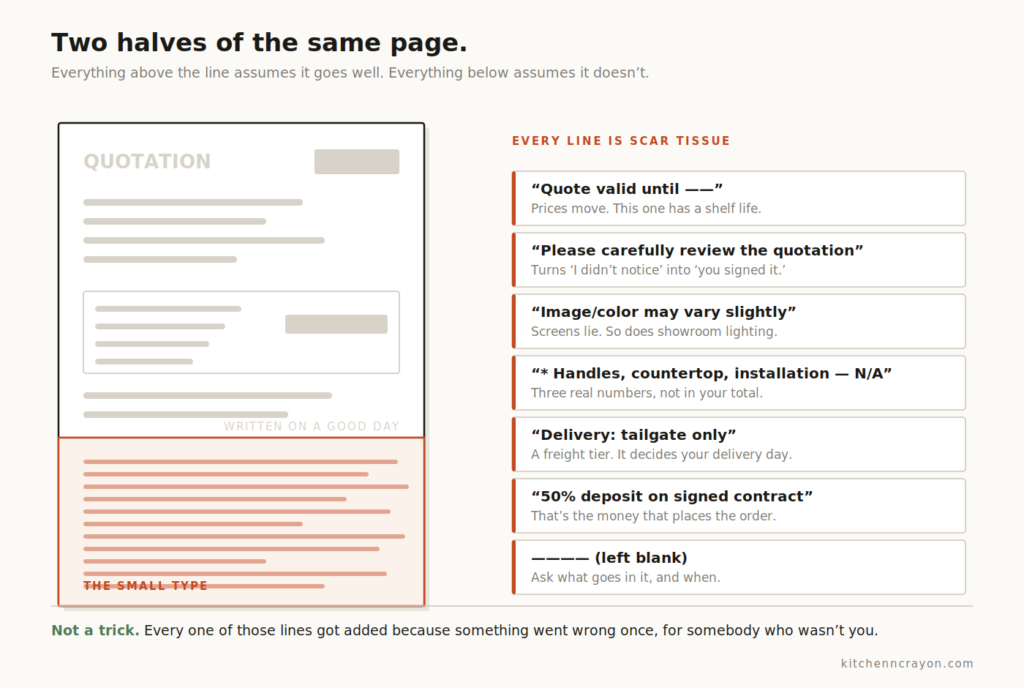
The rest of your quote was written on a good day.
The price, the door style, the lead time, the render of your beautiful kitchen — all of that assumes everything goes the way it’s supposed to.
The fine print assumes it doesn’t.
It’s the seller thinking about the delivery that shows up short. The color that looked different in the box. The customer who changes their mind in week six. Every line down there is a small argument somebody wants to have already won.
Which makes it the most honest part of the document. It’s a list of what actually goes wrong in this business, written by the people it went wrong to.
Read it like that and it stops being boring.
“Quote valid until [date]”
Usually three or four weeks out.
This one’s real. Cabinet prices move — manufacturers raise them, sometimes with a few weeks’ notice, sometimes across a whole line at once. Honor a four-month-old quote and the difference comes out of the dealer’s pocket.
So the date isn’t a tactic. It’s a shelf life.
Ask: “If I’m still deciding in six weeks, does this price hold?”
And if somebody’s using that date to hurry you along — that’s a person problem, not a paperwork problem. Different issue entirely.
“Please carefully review the quotation”
One line. Right above where you sign. Looks like a pleasantry.
It isn’t. It’s the sentence that turns I didn’t notice into you signed it.
I’m not being dark about that. It’s a fair thing to write, because the alternative — the seller reading nine hundred words of terms out loud to every customer — happens exactly nowhere. But it does move something. After your signature, having read it is your job.
So do the thing it asks. Not the whole page. Just anything with a number, a date, or a word you’d have to google.
Ten minutes. Cheapest ten minutes in the project.
“Image/color may vary slightly”
This sits under the little picture of your door, and it’s the line I have the most complicated feelings about.
The reasons are real. Screens lie. That photo was shot under lights that don’t exist in your house, and your door genuinely looks like a different color at ten in the morning than it does under your undercabinet lights at nine at night.
Then there’s the bigger version, the one everybody in the trade repeats: order the same door twice on different days and you might get two different colors.
I heard that for three years. Here’s what I actually saw.
Not one color complaint. Not one.
And I accidentally ran the experiment. I ordered a door in the wrong size — my fault, completely — and had to reorder a single replacement weeks after the original went in. When it landed I set it next to the rest of the kitchen fully expecting to wince.
Couldn’t see it. Neither could anyone else. No call, no complaint, nothing.
That’s one door, one order, one manufacturer. It doesn’t prove the disclaimer is nonsense and I’m not going to pretend it does. But I’d rather tell you what happened to me than repeat a warning I never once watched come true.
Ask: “Can I take a door sample home?”
Put it in the actual room. Daylight and night. Not because the factory’s going to get it wrong — because you might, and a screen is a terrible place to find that out.
While you’re deciding, remember that the finish also decides how the first chip gets repaired. You’ll notice that more than a shade nobody can see.
The asterisk: “Handles, countertop and installation not included”
This is my favorite line on a cabinet quote, because it’s genuinely trying to help you and people still walk past it.
It’s not buried. It’s usually sitting right under the specs with a little star next to it, quietly announcing that three real numbers are missing from your total.
Handles, which you need the morning of install. Countertop, which is a different trade on a different calendar and doesn’t get templated until your cabinets are standing. Installation, which can be a serious fraction of what you’re looking at.
Hinges are included, incidentally. Nobody itemizes those.
Ask: “What else is going to show up on a different invoice?”
Your total is one line in a budget, not the budget. I’ve written before about everything else that has to happen in that room before any of it works.
“Delivery: tailgate only”
Tailgate is a freight word, not a cabinet word. It’s on your quote because your dealer buys shipping from a carrier, and carriers sell delivery in tiers.
There are four. The word on your quote picks one.
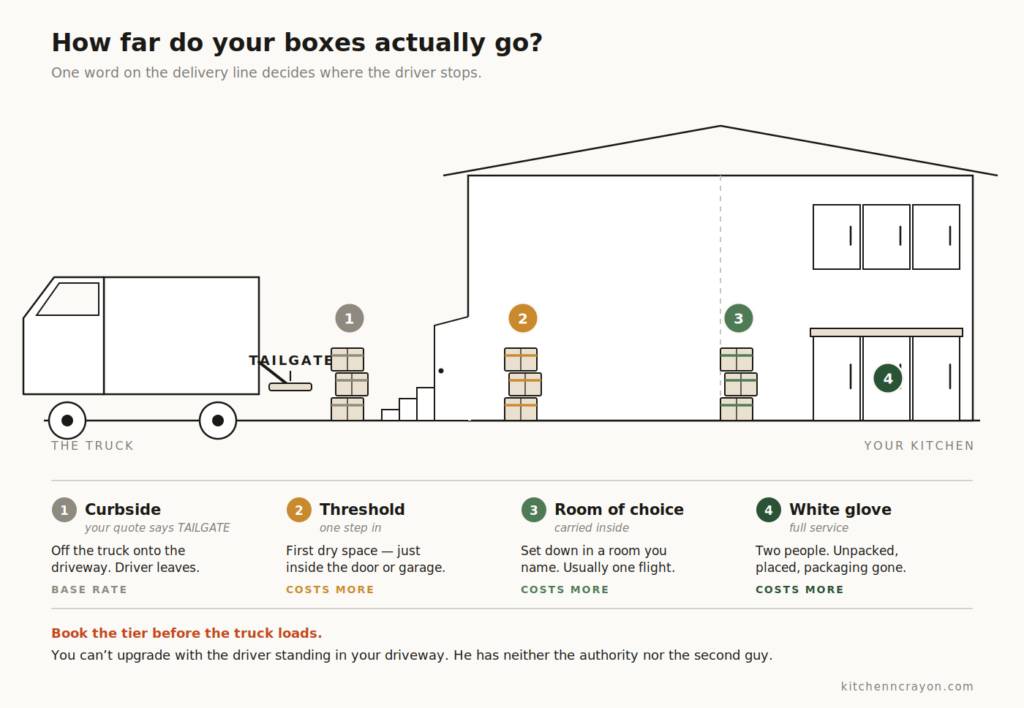
Curbside — also called tailgate. Boxes come off the truck onto your curb or driveway. Driver leaves. That’s the floor.
Threshold. One step in. First dry space — just past the front door, or the garage. If your entrance has stairs, this is where they stop and set everything at the bottom of them.
Room of choice. Carried to a room you name. Usually covers one flight.
White glove. Two people, room placement, packaging hauled away, sometimes light assembly.
Each tier costs more, none of them come free with the base rate, and they all have to be booked up front. You cannot negotiate a tier upgrade with a driver standing in your driveway. He doesn’t have the authority and he doesn’t have the second guy.
Companies tend to work at one tier and stay there. It’s how they’re set up. Nobody sat down and picked a tier for your job.
Which also means comparing delivery charges between two quotes isn’t comparing the same thing. It’s comparing two different services that happen to share a word.
Ask: “Which tier does your delivery actually include?”
And tell them about your stairs when you order, not on delivery day. You often won’t be charged — the dealer usually eats it — but a driver who was warned shows up ready, and one who wasn’t shows up irritated.
While you’re at it, ask how many boxes. A kitchen arrives as a wall of cardboard, days before anybody picks up a screwdriver, and it needs a dry room that isn’t the room being demolished.
“50% deposit on signed contract”
Half up front is standard. Here’s what that money actually does: it’s what I used to place your order.
That’s the part people get wrong. It isn’t a hold. It isn’t a gesture of good faith. You paid it, I turned around and sent the order to the manufacturer, and from that moment your cabinets existed as a job on somebody’s floor — cut to your sizes, sprayed in your color, useless to every other human being on earth.
So cancelling wasn’t a policy I was being firm about. It just wasn’t a thing. I couldn’t unspend money I’d already spent on your kitchen.
Which means the question everyone asks is the wrong one. “How much of my deposit do I get back?” has a short answer and you won’t enjoy it.
The useful question is about timing.
Ask: “When exactly does my order go in?”
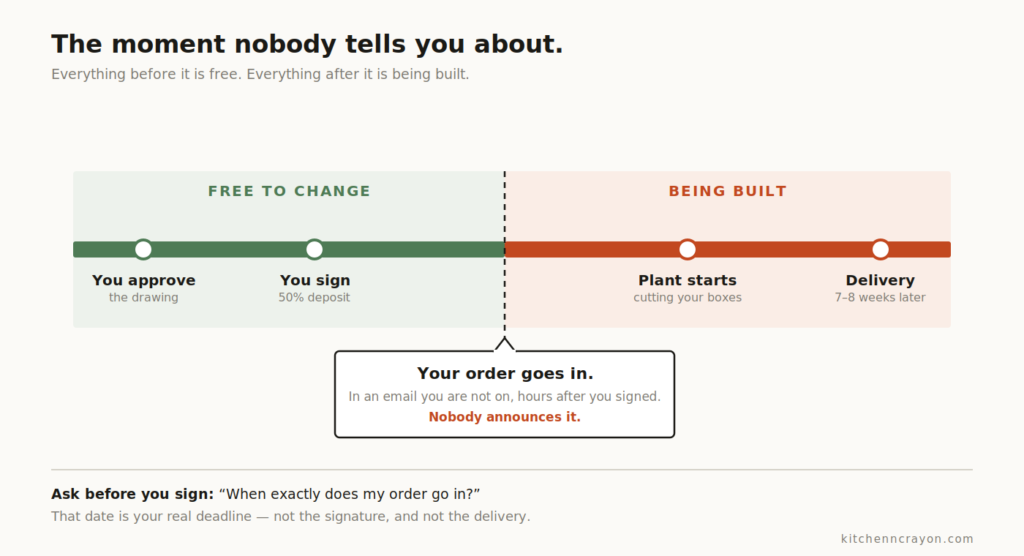
That’s your real deadline. Everything before it is free. Everything after it is being built.
And that moment is invisible to you. It happens in an email you’re not on, some number of hours after you signed, and nobody announces it. Approving a drawing isn’t the same as placing an order, and the gap between those two things is where nearly every mess I ever cleaned up actually started.
If you want one more look at the corner cabinet, one measurement double-checked, one small change — that’s the window. Find out when it shuts.
The blank one
Every quote form has an empty field on it somewhere.
Sometimes it’s a deduction line. Sometimes a note box. Sometimes a measurement that gets filled in later.
And sometimes, honestly, I couldn’t have told you either. The form came down from above me with lines on it that predated me, and I filled in the ones that were mine.
So I’m not going to stand here and explain every blank box on every quote in America. But the move is obvious.
Ask: “This line’s empty — what goes in it, and when?”
If the answer is nothing, ignore it, great. If the answer is that gets filled in after we measure, congratulations, you just learned a number can still move and you know which one.
What I’d actually do with all of it
Don’t read the fine print looking for the trick. Usually there isn’t one.
Most cabinet dealers are small businesses working off a form they inherited, and the small type is scar tissue from things that happened to somebody who isn’t you.
Read it as a list of what goes wrong around here. Then ask about the four or five lines that touch a number, a date, or a word you don’t know.
Do it while you’re still holding the pen. It’s the last moment in this entire project when asking is free.
Three years selling and designing kitchen cabinets. Now I write about what I learned on the other side of the counter.