Most articles about cabinet quotes describe them. This one shows you one.
Below is a real quote I wrote when I was designing and selling kitchen cabinets. I’ve blacked out the client’s address and my old contact details. Everything else is exactly as it went out: the specs, the price, the lead time, the payment terms, the fine print.
I’m showing it because reading about a quote and reading a quote are different skills, and the second one is what you actually need in the showroom.
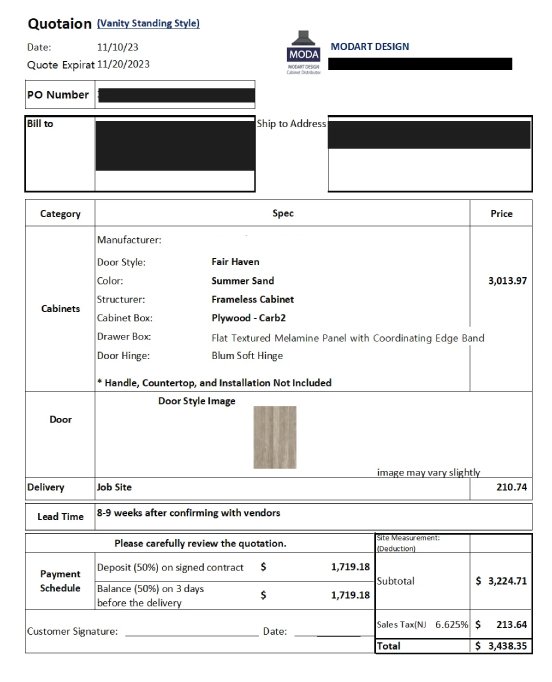
everything else is as it went out.
A note on scale before we start: this one is for a vanity, not a full kitchen, so the total is small. Ignore the number. The structure is identical whether you’re buying one vanity or thirty cabinets, and the structure is what we’re reading for.
Start at the top: the date is a term, not decoration
Look at the two dates. Written November 10. Expires November 20.
Ten days.
That’s not a sales tactic. Cabinet pricing moves — manufacturers raise prices, and a quote written today at today’s cost can’t be honored in March. So the expiration is the vendor telling you, honestly, how long they can stand behind this number.
What it means for you: an expired quote is not a price. If you’re still comparing three quotes six weeks later, at least one of them has quietly stopped being real. Ask for a refresh before you decide, not after.
The spec block is where quotes actually differ
This is the section that separates a real quote from a number on a napkin.
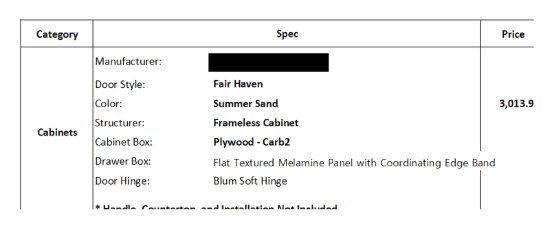
Go through it line by line and notice what each one is doing.
Manufacturer. Named. Not “premium cabinets” — an actual company you can look up. If a quote doesn’t name the manufacturer, you cannot compare it to anything, because you don’t know what you’re comparing.
Door style and color. Named. These are the manufacturer’s own product names, which means they’re verifiable.
Structure: Frameless. This is a real construction difference, not a finish preference. It changes your interior access and how the doors sit. A quote that doesn’t say framed or frameless has left out a fundamental fact about the product.
Cabinet Box: Plywood — CARB2. Two pieces of information. Plywood tells you the box isn’t particleboard. CARB2 is a formaldehyde emissions standard — it’s about what your cabinets off-gas into your kitchen. Most buyers have never heard of it. It’s on the quote because it should be.
Drawer Box. Specified separately from the cabinet box, because they’re often different materials. Plenty of quotes let you assume they’re the same.
Door Hinge: Blum. A brand name. Hinges are where cheap cabinets hide. Naming the brand is a commitment.
Every line in this section is the product. I broke down what each spec line actually means in a separate post.
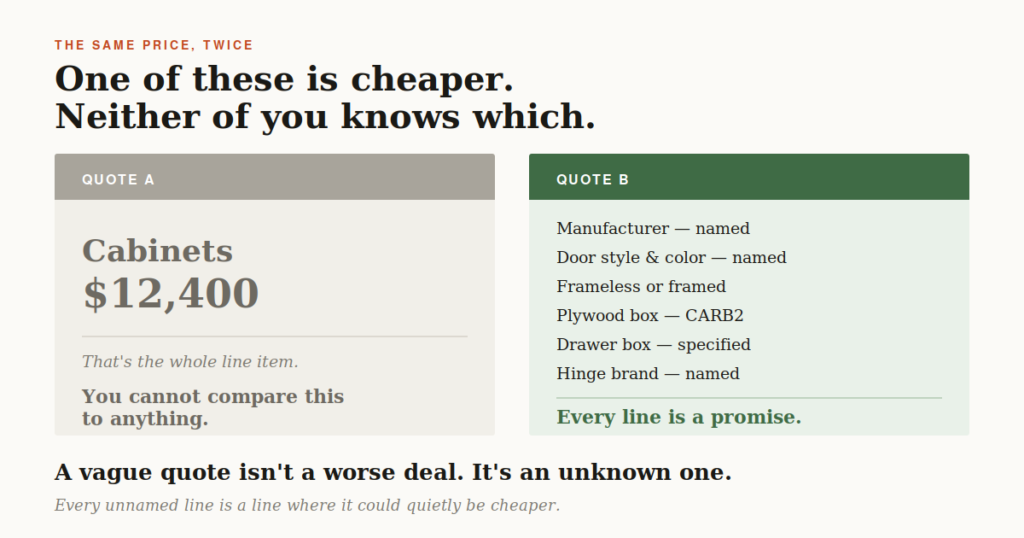
What to take from this section: every line here here is a line where a cheaper quote could be cheaper. Not by lying — just by not saying. If your quote lists “Cabinets — $12,400” and nothing else, it isn’t a worse deal. It’s an unknown one.
And when two dealers quote the same spec at different numbers, the gap usually isn’t greed either. It’s where each of them started.
And when two dealers quote the same spec at different numbers, the gap usually isn’t greed either. It’s where each of them started.
The asterisk
Under the specs, in bold:
Handle, Countertop, and Installation Not Included
That’s the most important line on the page, and it’s the one most people’s eyes skip.
Not because it’s hidden — it’s in bold — but because it’s a negative. People read quotes looking for what they’re getting. This tells you what you’re not.
Ask for this line on every quote you receive. If it isn’t there, say: “Please add a line listing what’s not included.” A vendor who won’t is telling you something.
Everything the quote leaves out still shows up on your final bill.
“Image may vary slightly”
Next to the door style photo. Four words that do a lot of work.
Wood and finish vary between production runs. Your cabinets will not look exactly like the picture, and the difference is often visible in person under your lighting. This line is the vendor being straight with you up front rather than arguing with you later.
If you care about the exact color — and if you’re spending five figures, you do — ask for a physical door sample. Not a photo. A sample you can carry home and put against your floor at 6pm.
The lead time says more than a number
Lead Time: 8–9 weeks after confirming with vendors
Read the second half of that sentence again.
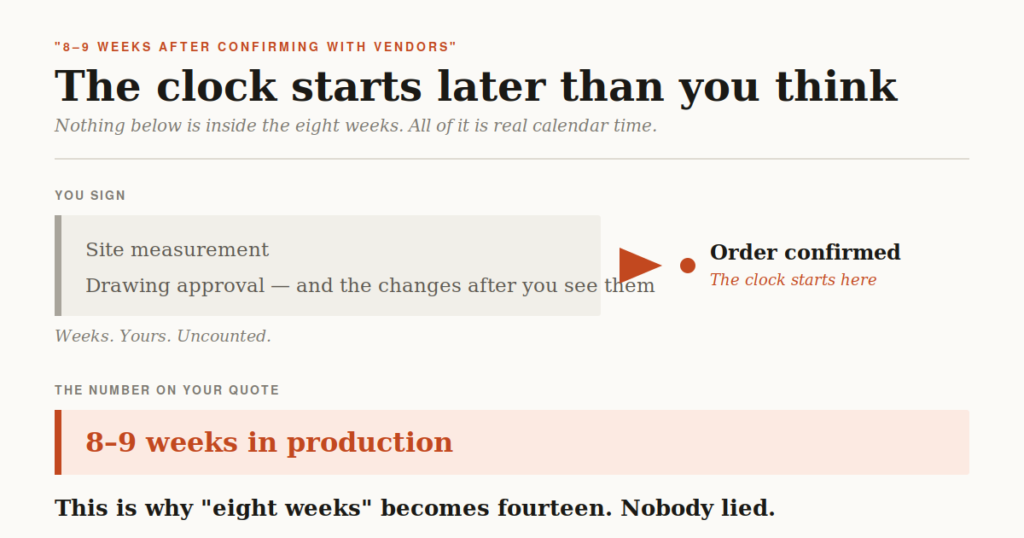
Not eight weeks from today. Not eight weeks from your deposit. Eight weeks after confirming with vendors — after the final specs are locked and the order is actually placed with the factory.
Between your signature and that confirmation, there is measurement, there is drawing approval, there are the three changes you’ll make once you see the drawings. That’s real calendar time, and none of it is inside the eight weeks.
This is why “eight weeks” so reliably becomes fourteen. Nobody lied. The clock started later than you thought it did.
Ask directly: “When does the eight weeks start counting, and what has to happen before it does?”
The payment schedule tells you who carries the risk
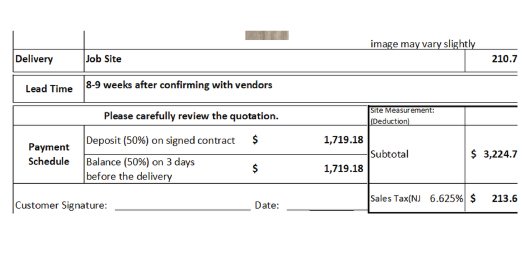
50% on signing. 50% three days before delivery.
Read that again too: the balance is due before the boxes arrive. Not on delivery. Not after you’ve opened them.
That’s industry standard and there’s a reason — cabinets are made to order and can’t be resold to anyone else — but you should understand what it means. You will pay in full before you see the product. Whatever protection you have is in the contract, not in your leverage.
So: know the damage policy before you send the second payment, not after. Who inspects? How long do you have to report? Who pays for a replacement door, and how long does that take? These are questions with answers, and the time to ask is now.
Also on this block:
Site Measurement (Deduction). A line item acknowledging that the count changes after someone measures your actual walls. The quote is telling you it isn’t final.
Sales tax. On the subtotal, itemized. Worth checking whether the other quotes you’re comparing showed theirs — because a quote that quietly excludes tax looks 6% cheaper than one that includes it.
Delivery — Job Site. Its own line, its own price. Delivery is not installation. It never was.
What a complete quote looks like
Put together, this document tells you: who made it, what it’s made of, what’s in it, what isn’t in it, what it costs, when it comes, when you pay, and what could still change.
That’s the bar. Not “is it cheap” — is it knowable.
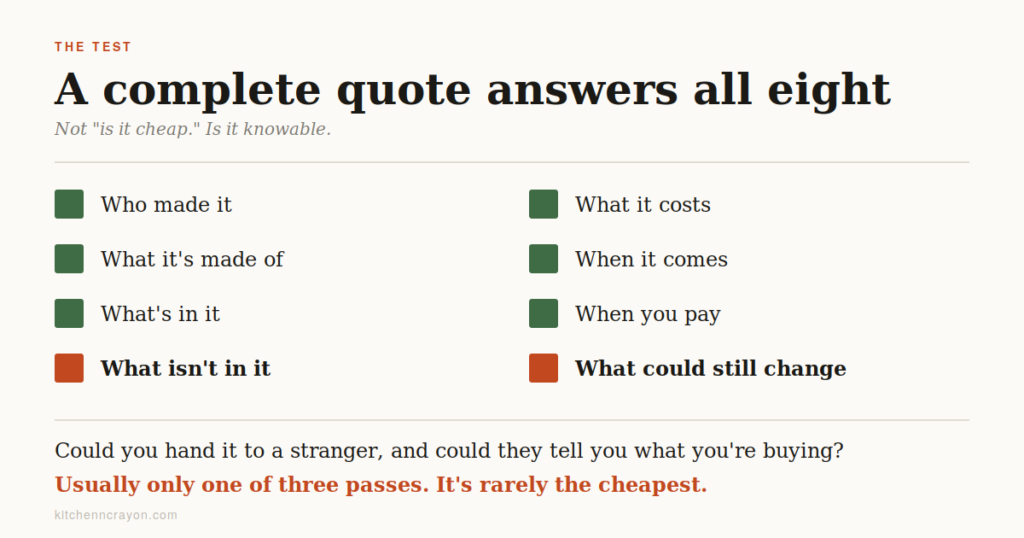
When you put three quotes side by side, don’t start with the totals. Start by asking which of them you could hand to a stranger who could then tell you exactly what you’re buying.
Usually it’s one of them. That’s usually the one worth taking seriously — and it’s very often not the cheapest, for exactly the reason that it isn’t hiding anything.
Why I wrote it this way
I wrote this quote the way I did for a selfish reason.
Every time I’ve moved, the movers have quoted me one number and then asked for more on moving day — after the truck was loaded, after my whole apartment was in boxes, when saying no wasn’t really an option anymore. I hated that. Not the money. The position it put me in.
I never wanted to be the person making that phone call. So I put everything on the page up front — what’s in it, what isn’t, when it ships, what could still move — because the alternative is calling someone in week seven to explain a number they never agreed to. That conversation is worse for them, and honestly, it’s worse for me too.
A quote that tells you everything on day one is not the vendor being generous. It’s the vendor not wanting that phone call either.